 Agent Studio
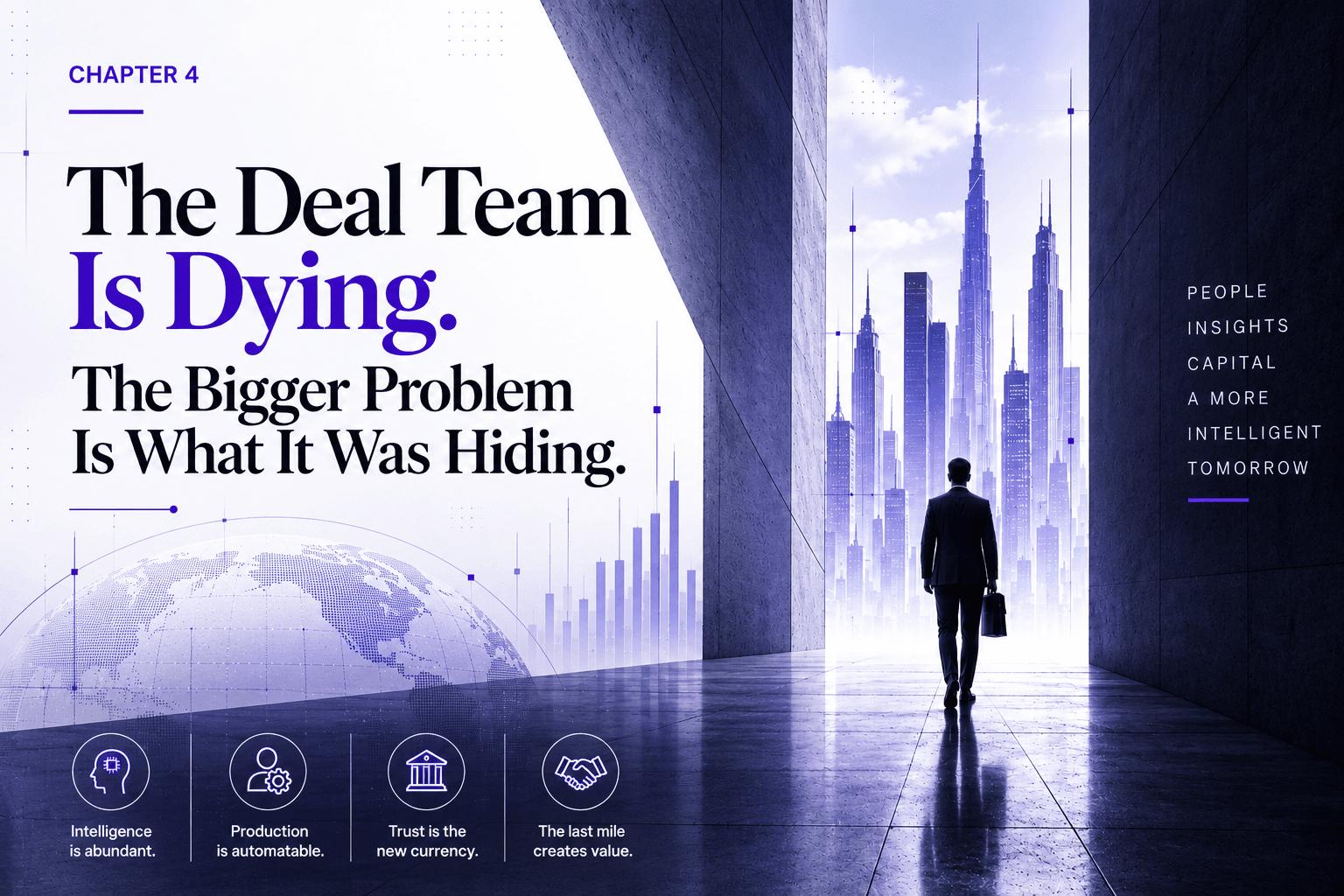
The Deal Team Is Dying. The Bigger Problem Is What It Was Hiding
Wall Street may soon discover that the work it hated was quietly manufacturing the bankers it needed.
The Ghost in the Committee Room
In the winter of 2025, a multi-billion-dollar private credit fund in London held an emergency investment committee meeting.
A $180 million senior secured loan to a European enterprise software company had abruptly breached its debt-service coverage covenant. Six months earlier, during underwriting, the deal team had used an enterprise AI system to ingest the target’s 400-page data room, extract customer churn metrics, and model forward revenue retention under varying macroeconomic stress scenarios.
The model produced by the system had been immaculate. The net revenue retention looked rock-solid at 108%. The base-case debt yield was 14.2%. Every credit officer on the committee had seen the green verification ticks across the dashboard.
When the default occurred, the Managing Partner demanded to know who approved the churn assumptions. The Vice President pointed to the model output. The risk officer pointed to the automated vendor due-diligence report. The junior partner pointed to the compliance audit score.
No single human had falsified a number. No analyst had fat-fingered an Excel cell. What had happened was far more insidious: the deal team had quietly stopped interrogating the machine and started rubber-stamping its conclusions.
The software had treated multi-year enterprise contracts with disputed renewal clauses as guaranteed cash flow. It was a subtle legal distinction buried in Schedule 4.12 that an exhausted, time-pressured deal team assumed the algorithm had already caught.
I call this the Delegation Trap. It is the threshold where machine intelligence stops advising a banker and quietly begins deciding for them, and where human teams maintain the illusion of oversight while surrendering the reality of judgment.
1. The Equation that Built the Pyramid is Breaking
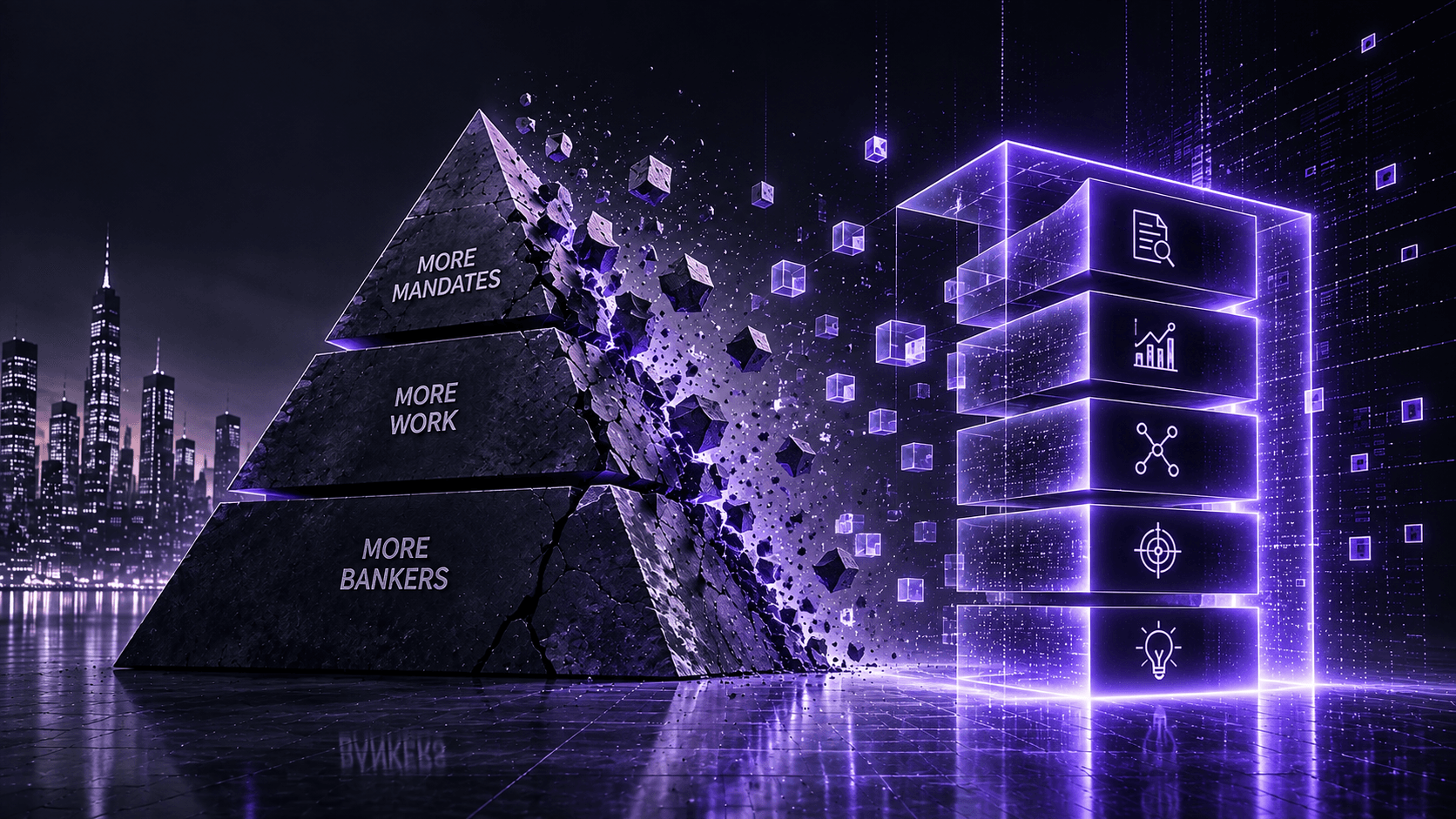
And so Wall Street built the pyramid. For decades the equation was simple. More mandates equals more work equals more bankers.
That equation is beginning to break. JPMorgan is already rolling AI tools across its investment banking operation to improve information access, content preparation and client engagement. UBS has gone further. From 2027, candidates for parts of its investment bank will be expected to demonstrate AI proficiency alongside traditional banking skills.
These sound like ordinary technology announcements. They are not. Underneath them sits a much bigger organisational question. What happens to a business designed around scarce human production when production stops being scarce?
The price of running frontier-quality models has fallen dramatically. Recent work on the AI stack describes inference costs falling roughly 1,500-fold over six years, and argues that machine intelligence is moving rapidly toward commoditisation. Agent systems, meanwhile, are moving beyond merely answering questions toward executing multi-step tasks.
We should be careful here. Today’s agents are not magic employees. They still fail. This is not an argument that Goldman Sachs will consist of seventeen humans and a server room by Christmas.
The more useful observation is directional. The marginal cost of many cognitive tasks is collapsing, and organisations eventually reorganise around changes in marginal cost. Factories reorganised around mechanical power. Corporations reorganised around telecommunication. Markets reorganised around electronic execution. Software companies reorganised around cloud computing.
Professional services will reorganise around cheap cognition. Investment banking will not be exempt because it owns nicer suits.
2. Death of the Deal Team
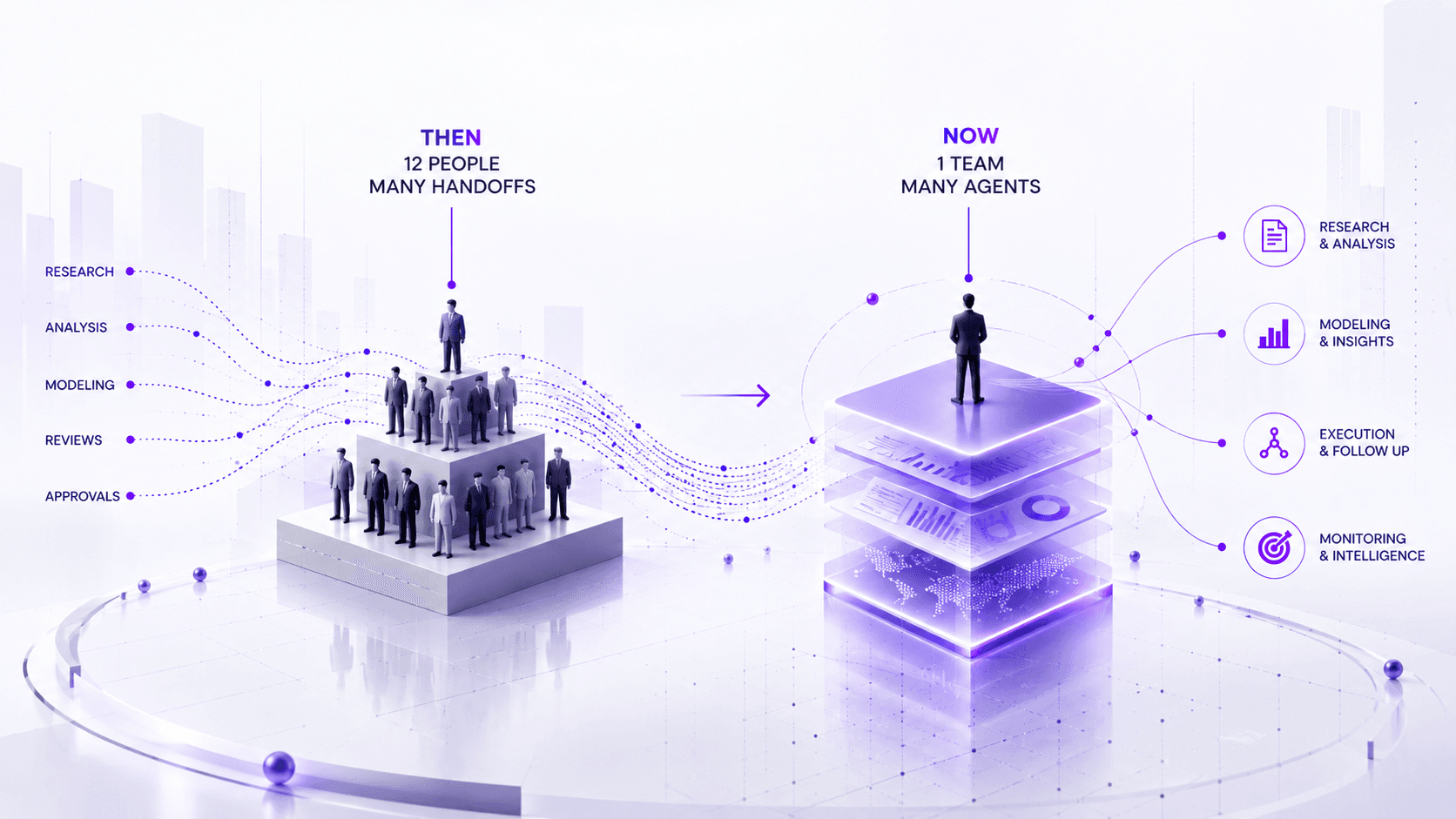
For nearly half a century, the prestige of an investment bank or private equity sponsor was measured by the physical mass of its deal teams.
When a tier-one M&A mandate was announced, the apparatus mobilised like an expeditionary force. A twelve-person junior bullpen for extraction, modelling and formatting. A diligence team interviewing customers. Lawyers billing $1,500 an hour to redline indentures. Accountants normalising EBITDA across twelve jurisdictions. Risk committees convening weekly.
This apparatus existed for one reason: coordination latency. Every hand-off between siloed teams introduced friction, miscommunication and billing drag. The Managing Director at the top spent most of their bandwidth managing internal communication logistics rather than advising the client.
Now imagine increasingly capable financial agents underneath a much smaller team. One maintains the operating model continuously. One tracks comparable companies and precedent transactions. One reads every new filing. One monitors the data room. One reconciles inconsistencies. One records and structures every diligence call. One runs scenario analysis overnight. One prepares the first version of tomorrow morning’s presentation before anybody has remembered they need one.
Suddenly the question changes. It is no longer how many analysts do we need. It becomes how much machine capacity can one accountable human effectively command. That is a radically different organisational problem.
3. From Pyramid to Pod to Point
I think the transition can be understood in three shapes.
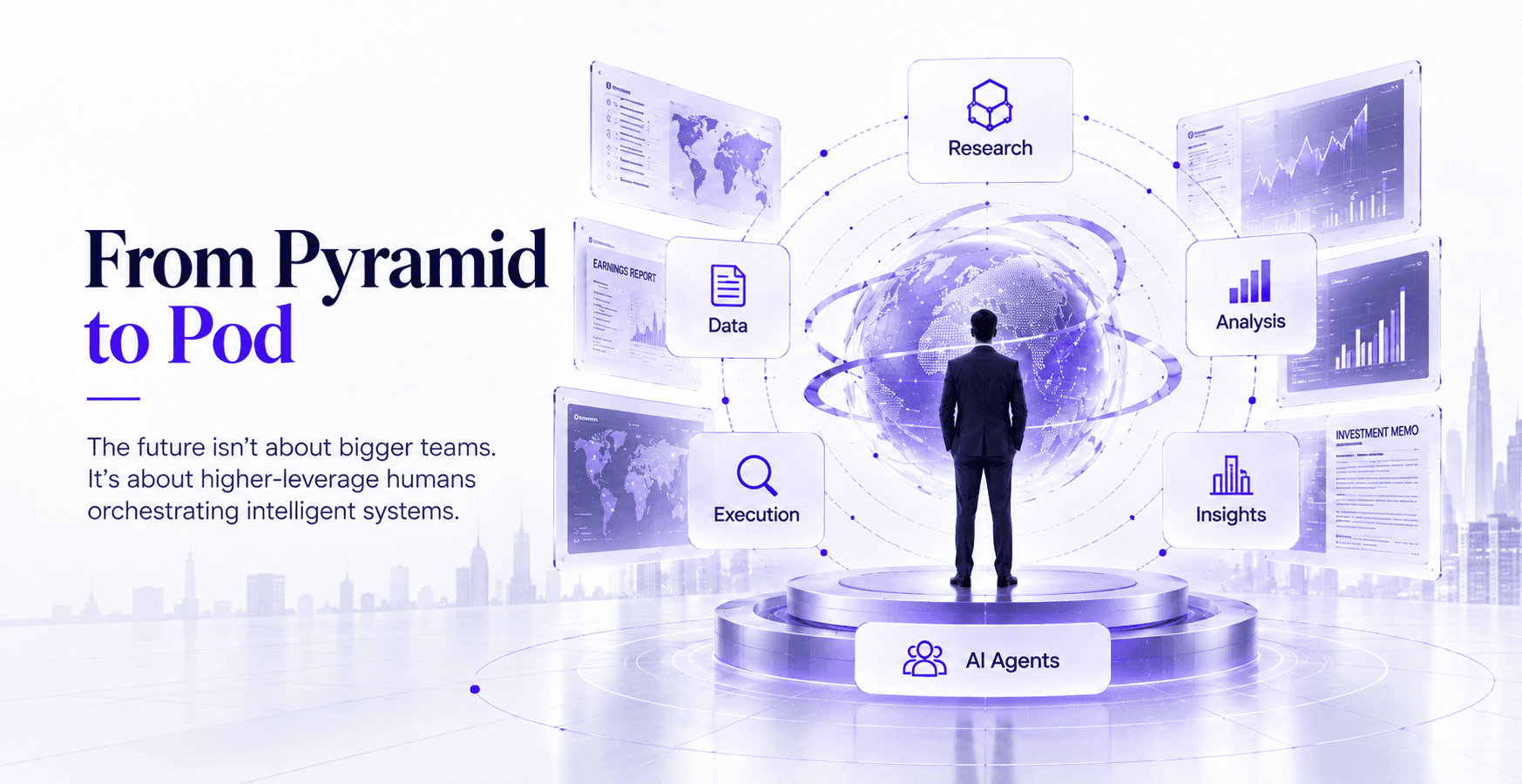
The Pyramid
The traditional institution. Human production sits beneath human judgment. More output requires more people. Headcount is capacity.
The Pod
The likely intermediate institution. A small number of highly capable humans sit inside a much larger machine perimeter. Three or four humans may execute work previously requiring ten or fifteen.
The humans increasingly own judgment, client trust, negotiation, exception handling and responsibility. The machines increasingly own production, monitoring, drafting, retrieval, reconciliation and scenario generation. The new production function becomes something like institutional output equals human judgment multiplied by machine capacity, not human headcount alone.
At its centre sit two people. A Relationship Principal who owns the client trust, navigates boardroom politics and originates the mandate. And the Forward Deployed Banker from the last chapter, who translates corporate reality into computational parameters, challenges what the agents conclude, and carries personal liability for the structure.
The Point
Eventually, certain forms of advisory may compress further. One extraordinary banker. One client. One enormous cognitive infrastructure underneath them. Not for every transaction. Not for every regulatory situation. But enough to matter.
At that point something profound has happened. The banker is no longer merely an employee inside the production system. The banker becomes the control surface for the production system.
4. The Delegation Trap: Three Stages of Machine Surrender
As deal teams collapse and software takes over the analytical engine, institutions face the most dangerous trap of the AI era. The transition from human judgment to algorithmic complacency does not happen overnight. It occurs in three seductive, predictable stages.
Stage one: Assistance
The system is treated strictly as an accelerator. The banker commands the machine to extract data, format tables and surface references. Every single output is actively verified, cross-checked and challenged. Human scepticism remains fully engaged. Safe and productive.
Stage two: Reliance
Because the system is correct 98% of the time, cognitive fatigue sets in. Deal teams stop opening the primary source documents. Instead of verifying the mathematical link between Footnote 12 and the working capital adjustment, the banker glances at the green verification badge and assumes the model is sound. Scepticism becomes a formality.
This is the dangerous stage, and it is dangerous precisely because nothing looks wrong. The work is faster. The packs are cleaner. Nobody schedules a meeting to approve the shift from verifying to trusting. It happens on a Thursday when everyone is tired and the deadline is Friday.
Stage three: Abdication
The machine stops advising and begins deciding. When an investment committee asks why a transaction is structured at 6.2 times leverage rather than 5.5, the answer is no longer derived from first-principles institutional reasoning. The answer becomes that the algorithm optimised the capital structure based on historical sector comparables and volatility indices.
The moment an institution reaches stage three, it has ceased to be a financial institution. It has become a distribution channel for un-underwritten algorithmic risk.
5. Perhaps We Misunderstood Boring Work
There is an obvious shareholder version of this story. Smaller teams. Greater revenue per employee. Faster execution. Higher margins. Wonderful.
But there is a hidden defect in this beautiful machine. The pyramid did something else. Something Wall Street rarely put in the investor presentation. It manufactured bankers.
Professional services have spent decades complaining about grunt work, and rightly so. Some of it is genuinely absurd. Moving logos around PowerPoint is not character formation. Manually copying numbers between spreadsheets does not make you Warren Buffett. Changing twelve slides because a senior banker decided that strategic alternatives sounds more sophisticated than options is unlikely to be studied by future historians as a golden age of human development.
We should automate these things enthusiastically. But there is a danger in assuming that every repetitive task is educationally worthless merely because it is unpleasant. Some boring work contains compressed experience.
Building the model teaches the business. Constructing the buyer universe teaches the industry. Reading the footnotes teaches scepticism. Drafting the presentation teaches narrative. Watching the VP destroy your first draft teaches standards. Doing it again teaches memory. Doing it fifty times teaches intuition.
The task is not always valuable because the output is valuable. Sometimes the task is valuable because of what it does to the person performing it.
The traditional apprenticeship was remarkably inefficient. But it had one enormous advantage. You could hardly avoid learning. Experience happened because you were physically inside the production process. The organisation did not need a sophisticated judgment development framework. It simply needed to keep you in the building long enough.
AI changes that. Once the machine performs much of the production, learning becomes decoupled from doing. Institutions will have to manufacture deliberately what they previously manufactured accidentally. This is a much harder problem.
6. The Apprenticeship Paradox
Anthropic’s recent labour research offers an interesting clue. Its data suggest AI adoption is affecting jobs at the task level rather than simply removing entire occupations, and that highly exposed roles may experience either deskilling or upskilling depending on which tasks disappear. It has also found tentative evidence that hiring of younger workers has slowed in occupations with high observed AI exposure.
This matters enormously for finance. Because a profession is not merely a bundle of tasks. It is also a sequence. Analyst, associate, VP, director, managing director. Each level assumes experience accumulated below it.
If you remove a large percentage of junior production work, you have not simply changed today’s cost base. You may have changed tomorrow’s supply of senior professionals. Which creates what I would call the Apprenticeship Paradox:
The better machines become at doing junior work, the harder institutions must work to create senior humans.
That may apply far beyond banking. Law. Medicine. Accounting. Consulting. Engineering. Architecture. In each of them, the machine handles the routine and the human inherits the emergency.
AI handles the ordinary model. The standard analysis. The first draft. The familiar diligence request. The obvious buyer list. And the human increasingly receives the weird situation. The hostile board. The accounting problem. The collapsing process. The founder refusing reality. The regulator with a different interpretation. The buyer who disappears at 11:58 p.m.
In other words, the less routine work humans perform, the more disproportionately their remaining work consists of exceptions. Unfortunately, exceptions are precisely where experience matters most.
Imagine telling a trainee pilot: we have automated take-off, cruise and landing. Great news. We will call you when both engines fail. This would certainly improve utilisation. The training department might raise an objection.
7. Wall Street Has Seen Structural Change Before
This will not be the first time technology has compressed a financial workforce.
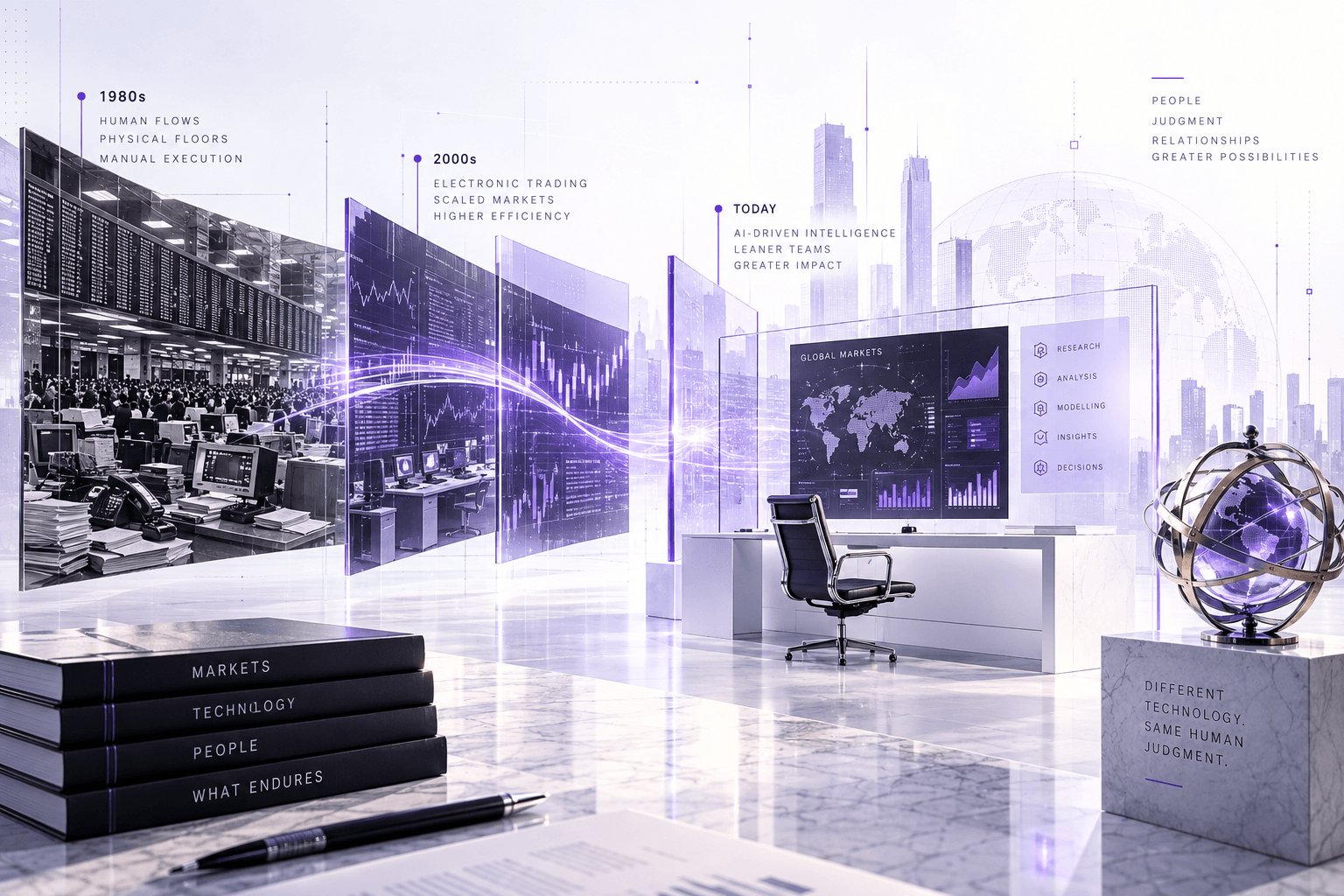
Walk onto a trading floor in the 1980s and the physical scale told you something about the infrastructure required to move capital. Rows of humans. Phones everywhere. Paper everywhere. Noise everywhere. Bodies were part of the market’s plumbing.
Electronic trading eventually demolished that physical architecture. The market did not disappear. Quite the opposite. Volumes exploded. Spreads compressed. Human roles migrated. The value moved away from physically transmitting orders toward designing systems, providing liquidity and interpreting markets.
Investment banking may now be approaching its own version of that moment. The old trading floor compressed because execution became electronic. The old deal team may compress because cognition becomes computational. That is a much bigger transition than adding a copilot to Excel.
But banking has one problem trading did not. The trading floor could lose thousands of manual tasks without worrying very much about whether those tasks were training tomorrow’s relationship banker.
Investment banking is different. It is a craft business disguised as an information business. Its highest-value product is not the spreadsheet, or the deck, or even the analysis. At the decisive moment, the client is buying confidence in somebody else’s judgment.
And judgment has a strange property. It is difficult to download. You can transfer knowledge, data, models. You can codify processes. But tacit experience remains stubbornly human.
Which leaves the institution with a transition problem: how do you remove the work without removing the experience?
8. The Manchester United Problem
There are two races happening simultaneously, and everybody sees only the first.
Race one is to automate the work. Build faster, research faster, model faster, execute faster, reduce costs, increase margins. Banks are already running that race.
Race two is less visible: reinvent the apprenticeship. Develop judgment faster. Expose young professionals to more decisions. Capture institutional memory. Teach humans how to challenge machines.
The institution that wins only race one may become highly efficient. For a while. The institution that wins both becomes something else entirely. It becomes self-renewing.
There is a useful sports analogy here. The greatest clubs do not merely field great teams. They build systems that continuously produce talent. Manchester United’s Class of ‘92 became legendary not because the club accidentally found six extraordinary players in the car park. It had an institutional pipeline. Barcelona’s La Masia became similarly powerful because the academy produced players already trained in a particular footballing philosophy.
Talent development was not separate from competitive advantage. It was competitive advantage.
Investment banks have traditionally had their own academies. We called them analyst classes. The difference is that Wall Street’s academy also happened to produce pitch books until two in the morning.
AI may remove the pitch books. Fine. But it would be unwise to demolish the academy at the same time. A bank without a talent engine eventually becomes a collection of senior rainmakers living off intellectual capital accumulated somewhere else. A little like a club that stops running an academy because buying experienced players appears more efficient. That works wonderfully until everyone has the same idea and discovers there are no young players left to buy.
9. Expensive Education with Production Attached
The obvious reaction to AI is that we need fewer juniors. Perhaps. But another possibility is more interesting. We may need to spend far more per junior.
Each young banker becomes more valuable while receiving fewer natural repetitions. So instead of eight analysts doing low-value production, the institution hires three and develops them deliberately. Earlier client exposure. Structured simulations. Real-time review of machine outputs. Decision journals. Post-mortems.
The purpose of the analyst programme changes. It stops being cheap production with education attached, and becomes expensive education with production attached. That is a profound reversal.
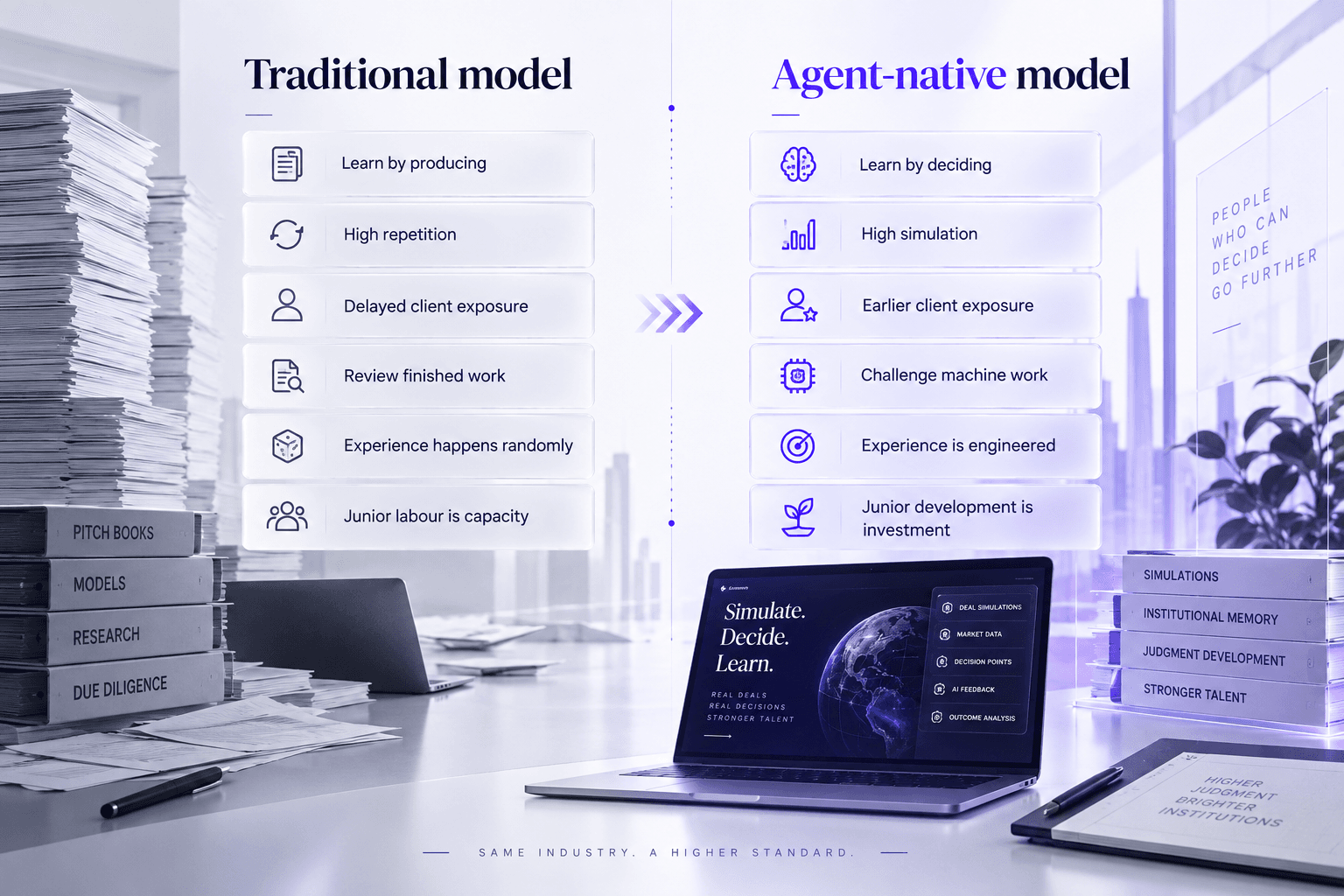
That final row matters most. It changes the economics of talent.
10. The Flight Simulator for Bankers
Suppose every major transaction created a permanent institutional record. Not merely the final PowerPoint, but the decision history. What information was available at each moment. What the model concluded. What management believed. What the banker recommended. What risks were underestimated. What happened next.
Now imagine giving that institutional memory to a twenty-five-year-old banker.
Freeze the transaction in March 2022. Here is the company. Here is the market. Here is the debt load. Here are the buyers. Here is management’s view. What would you recommend?
The trainee decides. Then the system reveals April. New information arrives. Decide again. Then June. Then the financing market closes. Decide again. Eventually, reveal the actual outcome.
You could compress years of pattern exposure into deliberately constructed training. Airlines use simulators because waiting for an engine failure in real life is a fairly inefficient training curriculum. Finance may eventually need the same philosophy. Not because judgment can be fully simulated, it cannot, but because experience can be structured.
That may become one of the most important pieces of infrastructure inside the future financial institution. Not the model. Not the chatbot. The judgment simulator.
There is a related shift that gets surprisingly little attention. Today a VP manages people doing work. Tomorrow a VP may increasingly manage work itself. Some performed by humans, some by agents, some generated automatically, some escalated because confidence is low. Managing five analysts is fundamentally different from orchestrating two humans and fifty machine processes operating continuously.
This resembles the evolution of military command. A general’s power historically depended partly on how many soldiers could be directly coordinated. Modern command became increasingly about orchestrating intelligence, communications, logistics and sensors. The effective unit of power changed. The future senior banker may not supervise the biggest human team. They may command the largest reliable sphere of intelligence.
11. And that is Where the New Deal Team Begins

For most of Wall Street history, senior judgment was scarce and junior labour was abundant. AI may reverse the operating logic. Machine labour becomes abundant. Research becomes abundant. Drafts become abundant. Eventually, competent analysis becomes abundant.
And suddenly the bottleneck is no longer producing another answer. It is producing people capable of knowing whether the answer is any good.
The great irony of the AI revolution may therefore be this: the technology that makes human labour less necessary may make human development more important. Because once machines can do almost everything ordinary, the human is left with everything extraordinary.
The old deal team was organised around production. The new one will be organised around judgment. Fewer humans may surround each transaction, but each carries a larger responsibility. The analyst becomes less of a production unit and more of a developing decision-maker. The VP becomes less of a workflow supervisor and more of an orchestrator of intelligence. The MD becomes capable of operating at extraordinary scale.
The firm becomes smaller above ground and vastly larger below it.
Pyramid. Pod. Point.
And underneath all three sits the question we should probably be asking before we celebrate the disappearance of grunt work. Who manufactures the judgment?
Because Wall Street may soon discover that it has solved one of its oldest problems. The machine can finally do the work everybody hated. Unfortunately, buried inside that work was the factory that produced the people everybody trusted.
If we automate the ladder, we had better build another way upstairs.
What do you think?
If the apprenticeship disappears, who trains the people we will need to sign the difficult decisions in 2035?
I would be glad to hear how bankers, investors, founders and builders see this, particularly anyone who has already started redesigning their analyst programme.
If you enjoyed this piece, Subscribe to Capital Markets Reimagined for the next chapter.