 Agent Studio
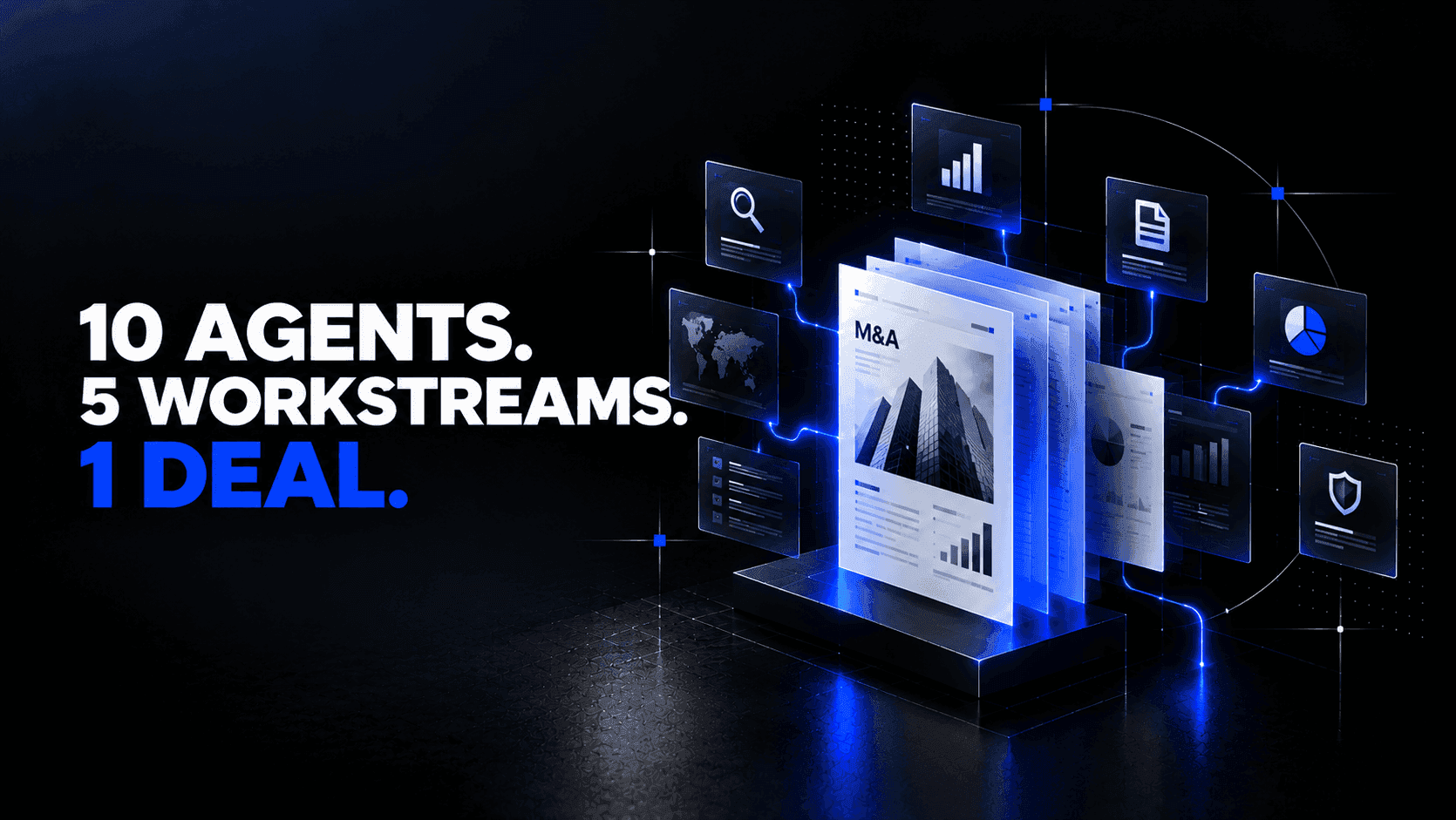
10 Agents, 5 Workstreams, 1 Deal: Inside the New Architecture of M&A
Discover how agentic AI can connect M&A workstreams, coordinate due diligence, financial analysis and deal execution, while keeping human judgement at the centre.
Imagine a deal that can survive a difficult valuation and a difficult negotiation. But it cannot afford to be discovered three days before an investment committee meeting, and the final nail in the coffin is that the financial model and the diligence findings have been telling two different stories.
Consider a target company whose revenue growth looks compelling on paper. The commercial team sees an attractive market opportunity. Financial analysis suggests healthy margins. But buried in the customer contracts is a concentration risk that could materially change the investment thesis.
The information exists. The problem is getting the right information to the right people in time for it to change a decision.
This is the less visible challenge of mergers and acquisitions. Deals are not short of information or expertise. They are often constrained by how those resources are coordinated.
As AI becomes capable of handling increasingly complex analytical tasks, the next question for capital markets is no longer simply how quickly a machine can review a document. It is how multiple specialised systems can contribute to a single transaction without losing context, consistency or accountability.
This is where agentic AI in M&A begins to offer a different way of thinking about deal execution.
Why traditional M&A workflows are ready for a reassessment.
An M&A transaction is a collection of interdependent investigations, each answering a different question about the same business.
Financial due diligence examines the quality of earnings, working capital and cash flow. Commercial diligence tests the market opportunity and competitive position. Legal diligence examines obligations, contracts and potential liabilities. Tax and operational reviews uncover their own sets of exposures.
These workstreams operate in parallel, but their conclusions cannot remain separate.
A change in revenue assumptions may affect valuation. A contractual obligation may alter the integration plan. A customer concentration issue may require further financial analysis and change the risk profile presented to the investment committee.
The traditional model relies heavily on people to connect these findings. Analysts consolidate spreadsheets, circulate updated reports, chase responses and reconcile information across deliverables.
AI tools can already help with parts of this work, including document extraction, research, financial analysis and drafting. Yet automating one task does not automatically coordinate the wider process.
The emerging opportunity is to move from isolated AI assistance towards connected, multi-step workflows. Research from firms including Accenture and BCG similarly points to the potential for agentic systems to connect work across the M&A lifecycle rather than focus exclusively on individual efficiency gains.
The five workstreams behind a modern AI-enabled deal
Take a hypothetical acquisition of a mid-market software company. The deal team has a compressed diligence window, a large virtual data room and an investment committee that expects a defensible view of the opportunity.
A coordinated agent architecture could organise the work across five workstreams.
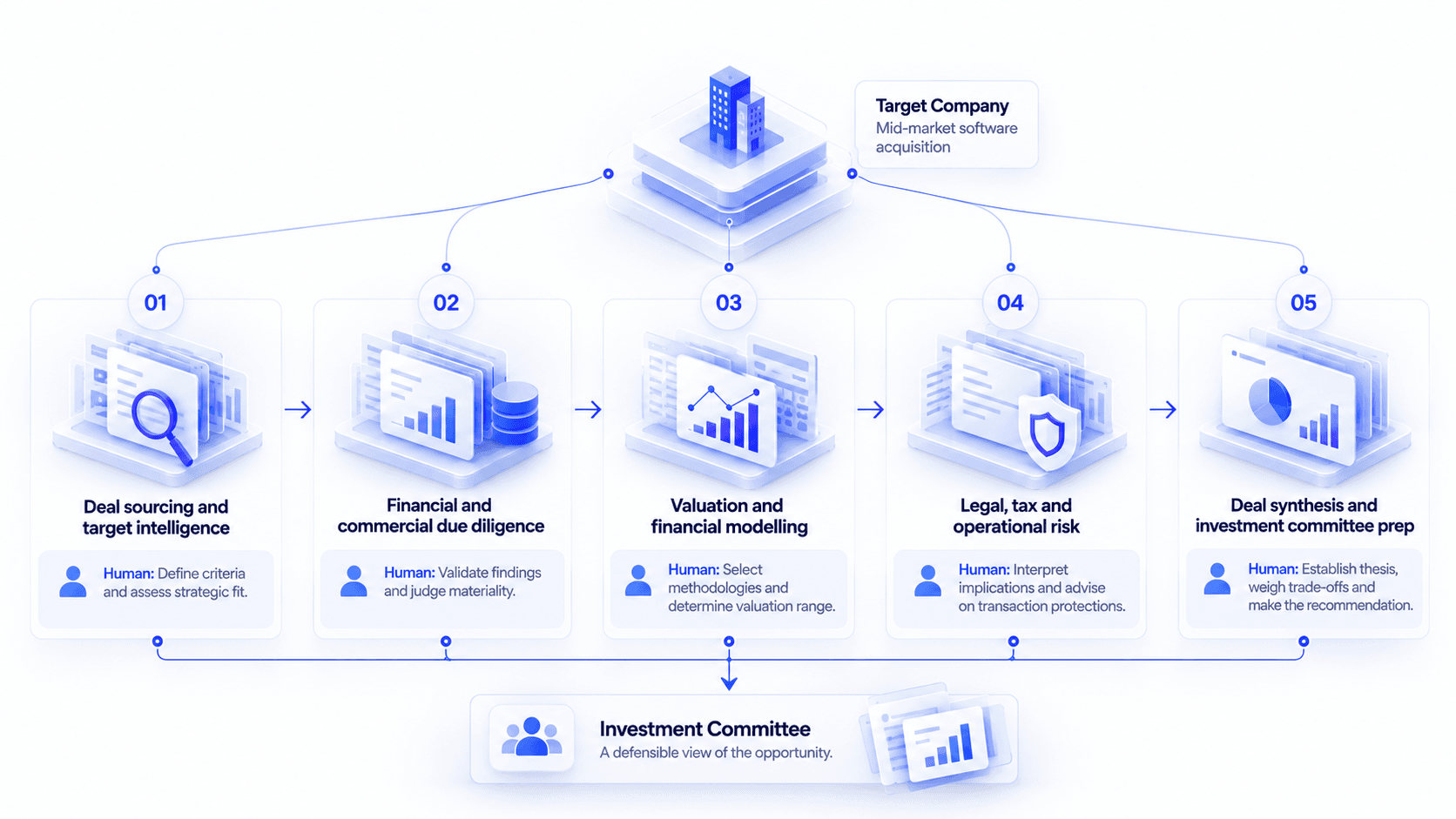
1. Deal sourcing and target intelligence
Agents gather public company information, market developments, competitor data and relevant transaction precedents. They help build a structured view of the target and identify questions requiring further investigation.
Human contribution, which defines acquisition criteria and assess strategic fit.
2. Financial and commercial due diligence
Agents extract relevant information from financial statements, management reports, customer records and commercial materials. They can flag inconsistencies, test assumptions and surface questions for deeper review.
Human contribution validates findings, challenges management assumptions and judges materiality.
3. Valuation and financial modelling
Agents can help organise comparable-company data, prepare initial valuation analyses, check model inputs and flag differences between operating assumptions and the diligence findings.
Human contribution lies in selecting methodologies, assessing scenarios and determining the appropriate valuation range.
4. Legal, tax and operational risk
Specialised agents can organise contract findings, identify clauses for legal review, map potential tax exposures and highlight operational dependencies. Findings can be routed to the relevant workstream rather than remaining buried in separate reports.
Human contribution interprets legal implications, determines risk severity and advises on transaction protections.
5. Deal synthesis and investment committee preparation
Agents bring findings together into a structured transaction narrative, identify unresolved questions and help prepare supporting materials. Conflicting assumptions can be flagged before they appear in the final presentation.
Human contribution is to establish the investment thesis, weigh trade-offs and make the recommendation.
The important distinction is that these workstreams do not become five independent automation projects. Their value increases when findings from one can inform the others.
Ten agents, one coordinated transaction
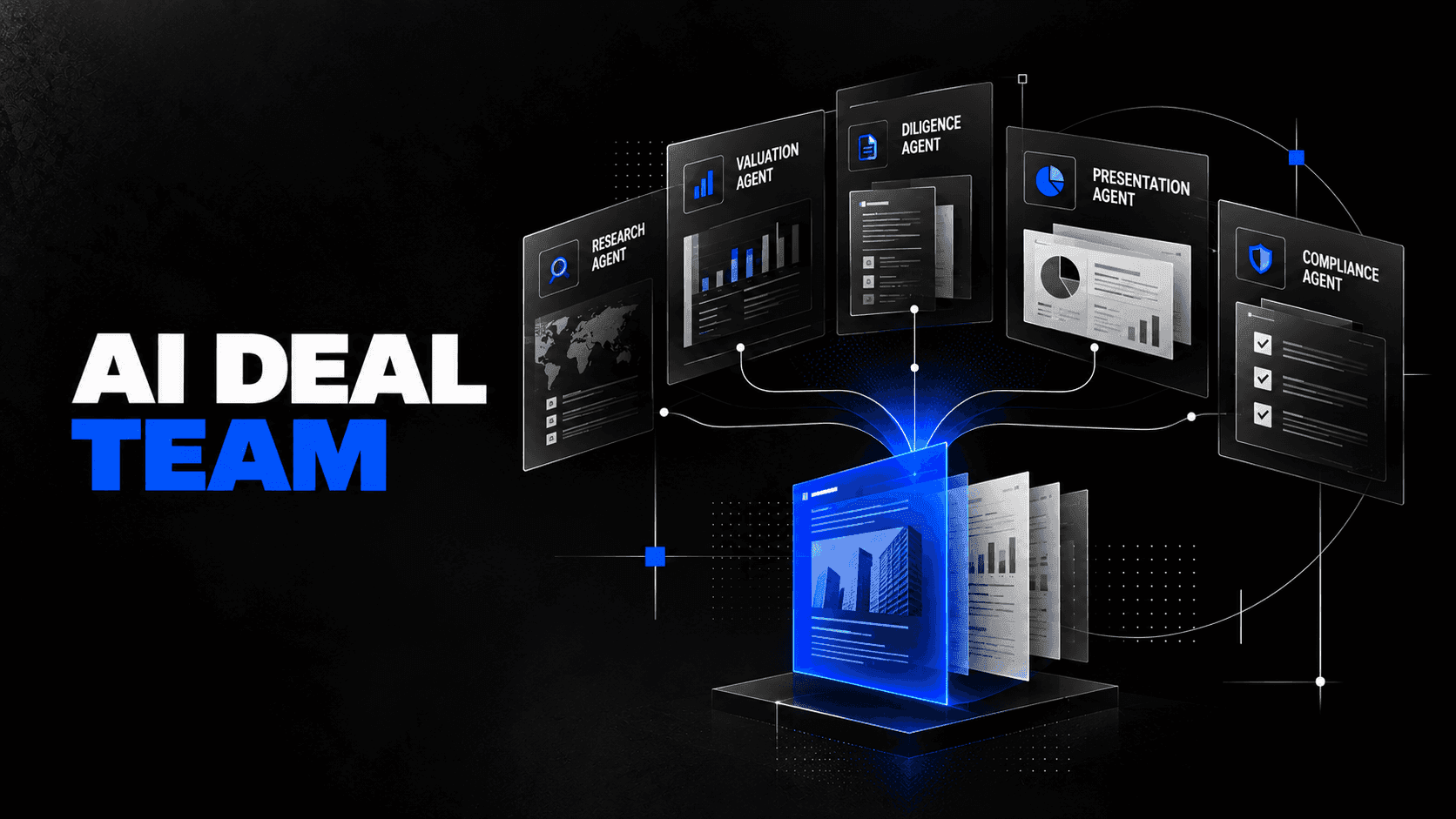
Five workstreams describe the business structure. Ten specialised agents illustrate how the execution layer might operate within it.
For example, a deal team could assign two agents to each workstream, with a coordinating layer managing dependencies and routing findings between them.
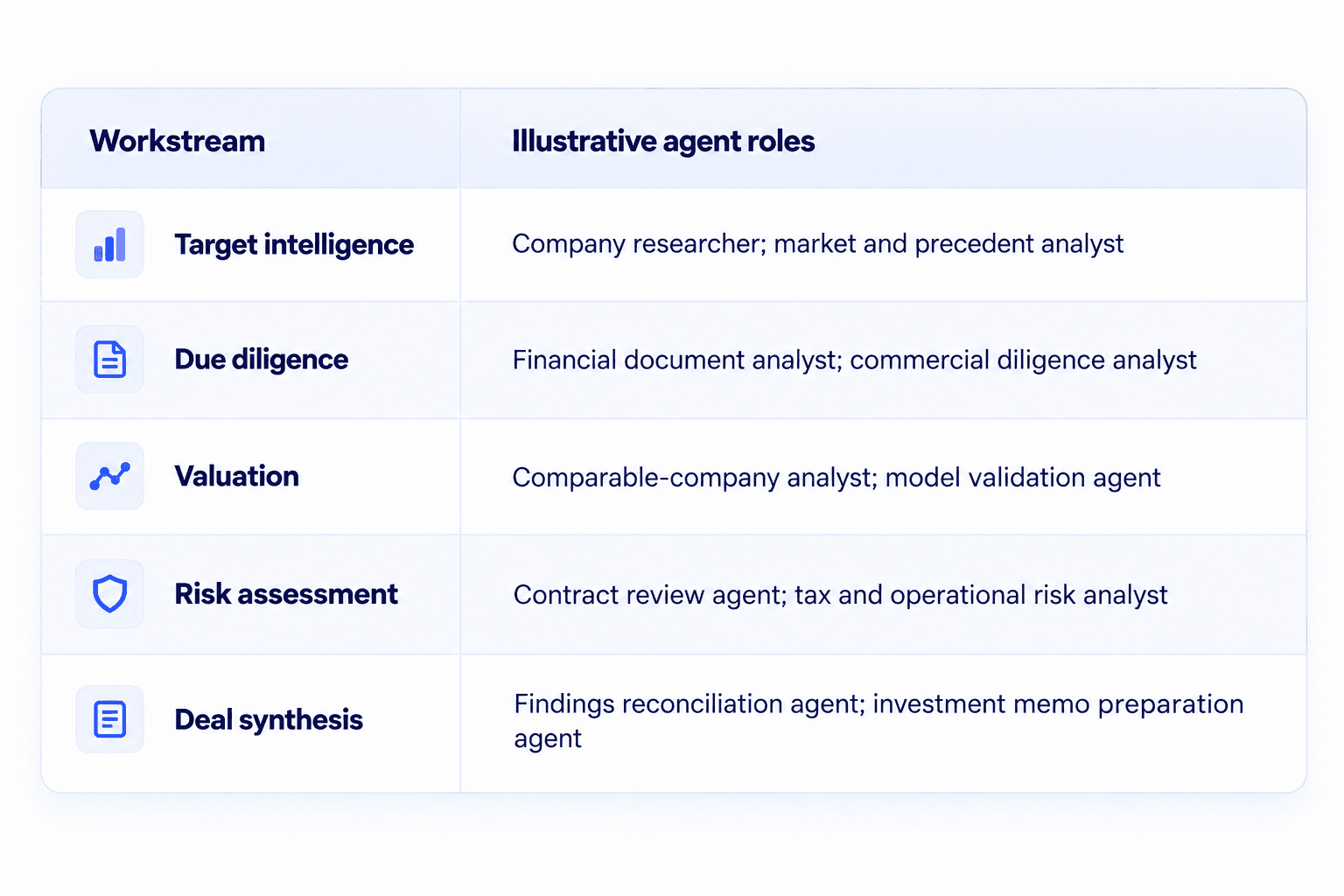
This is not a fixed configuration. Some transactions may need fewer agents, while complex cross-border acquisitions may require additional specialist roles.
What matters is the architecture behind them.
A researcher should not simply deliver a summary and stop. Relevant findings need to reach the financial analyst. If the analyst identifies an unexplained revenue variance, that question should return to the relevant evidence rather than disappear into another email thread. If the variance changes the valuation assumptions, the final investment memo needs to reflect that change.
The workflow becomes a chain of connected responsibilities rather than a collection of isolated outputs.
This is the difference between using AI to accelerate individual tasks and using agentic AI to coordinate a broader process.
The real test: When one finding changes everything
Return to our hypothetical software acquisition.
During diligence, an agent identifies that a significant portion of the target's revenue comes from a small group of customers. A separate review finds that several customer contracts contain renewal provisions that warrant closer examination.
Individually, these findings may look manageable. Together, they raise a more consequential question: how resilient is the company's recurring revenue?
In a disconnected workflow, analysts might discover these issues at different stages and reconcile them late in the process.
In a coordinated architecture, the concentration finding can trigger a deeper review of customer contracts, feed revised assumptions into the financial analysis and prompt the deal team to revisit the downside case.
The agents do not decide whether the acquisition should proceed. They help ensure that a relevant finding reaches the people and analyses it affects.
That is where coordination creates value. Not because AI removes uncertainty from a transaction, but because it can help surface the implications of that uncertainty earlier.
Why does human oversight remain central?
M&A is a high-stakes environment. A plausible-looking answer is not necessarily a correct answer, and a correctly extracted fact does not automatically support a sound investment conclusion.
AI-generated work must be assessed against source documents, validated against financial data and reviewed for inconsistencies. Permissions, confidentiality, audit trails and clear approval points are essential considerations when designing these workflows.
Research evaluating AI on investment banking tasks also highlights the difficulty of producing fully client-ready deliverables across complex, multi-document workflows. This reinforces the need to evaluate complete outputs, not just individual task performance.
A practical architecture therefore assigns agents defined responsibilities, limits what they can access or change, records how outputs are produced and escalates consequential decisions to people.
The aim is not to remove the deal professional from the process. It is to give that professional a clearer view of the work and more time to exercise judgement where it matters.
From disconnected tools to connected deal execution
For capital markets firms, the next phase of AI adoption will depend on more than access to powerful models. It will require systems that fit the way transactions actually unfold.
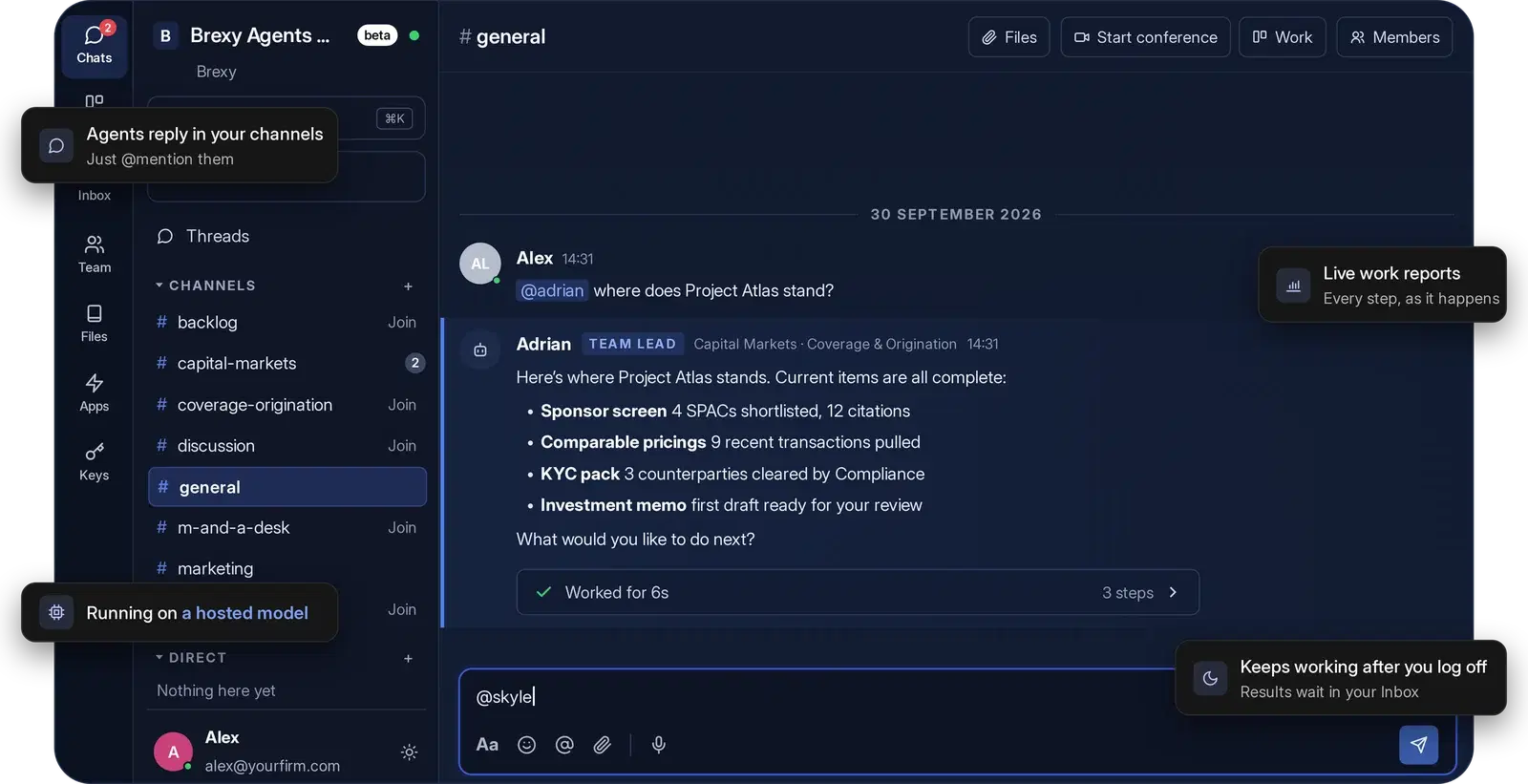
This is the problem that platforms such as BREXY Agent Studio are designed to address: bringing specialised agents into coordinated workflows so that work can move between tasks and teams, with human oversight retained where required.
For an investment banker, the value proposition is straightforward. Less time spent manually connecting outputs. Better visibility into work in progress. A more structured path from raw information to reviewable deal materials.
The opportunity extends beyond diligence. The same architectural thinking can support deal sourcing, pitch preparation, transaction execution and, eventually, aspects of post-merger integration.
The precise configuration will differ by institution, transaction and risk appetite. But the underlying principle remains the same: the value of an AI system should be judged not only by what it can complete but also by how effectively its work contributes to the larger objective.
The future of M&A is coordinated intelligence
A successful transaction will always depend on judgement, negotiation, relationships and the ability to make decisions under uncertainty. No agent architecture replaces those fundamentals.
What it can change is the operational machinery surrounding them.
When research, diligence, valuation, risk assessment and deal synthesis can exchange relevant findings through governed workflows, the team gains a better opportunity to identify issues early and spend its attention where it can have the greatest impact.
Ten agents are simply an illustration. Five workstreams are a way to organise the work. One deal is the outcome they must serve.
The real advance is not having more AI working on a transaction. It is having the work come together as one coherent transaction.