 Agent Studio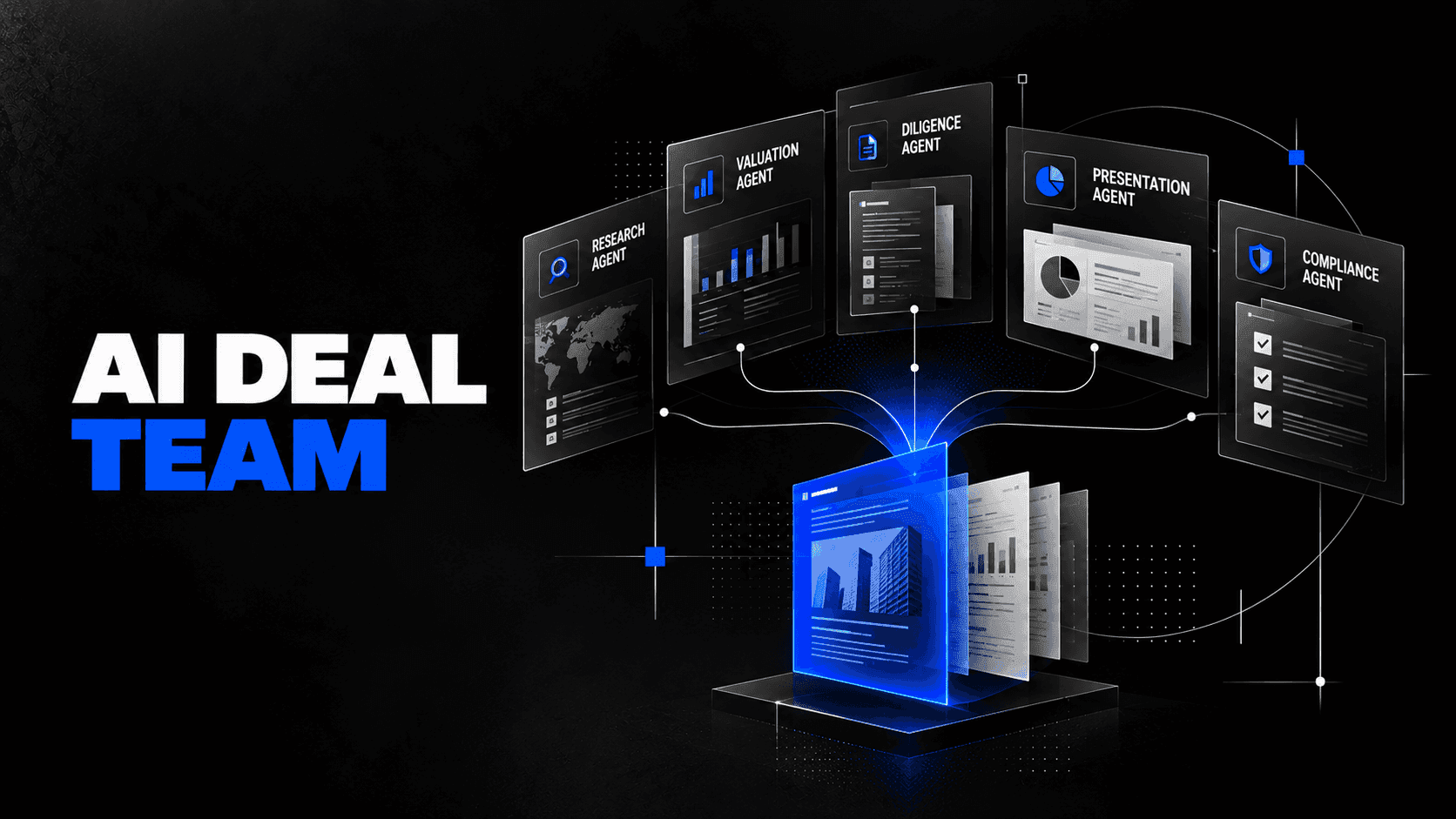
The Future of Deal Execution Isn't One AI. It's an Entire Team
Single AI assistants break under live deal pressure. See how AI agent teams run M&A deal execution end to end, with humans approving every output.
Ask any banker what a live deal looks like, and they won't describe one person working alone. They'll describe a team. An MD runs the client relationship. A VP manages the process. Associates build the model. Analysts pull comps, draft the CIM and work through the data room at 2 a.m. Compliance checks everything before it leaves the building.
That is why the first wave of AI for deal execution felt underwhelming. Firms were given a single AI assistant, one chat window that answers one question at a time, and asked to fit it into a process built for a team of twelve.
The next wave looks different. The future of deal execution isn't one AI. It's an entire team of specialised AI agents that divide the work, hand it to each other and report back to the humans who own the deal.
Deal Execution Has Always Been a Team Sport
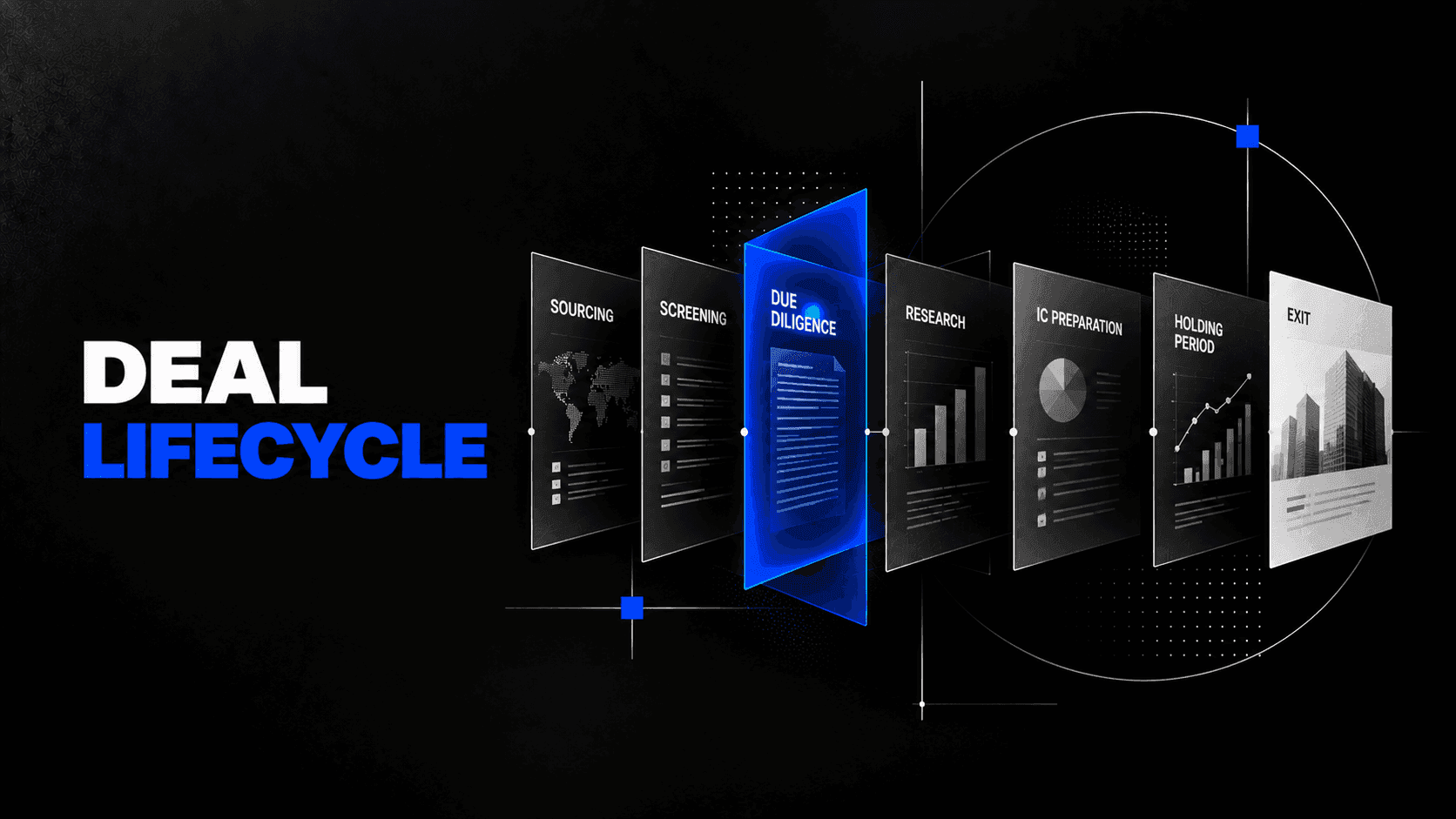
Deal execution is the hardest stretch of any transaction. Origination wins the mandate, and execution delivers it. In a typical sell-side M&A process, execution includes:
Building and refining the buyer universe
Preparing the teaser, CIM and management presentation
Running comparable company analysis and precedent transactions
Building and stress-testing the financial model
Managing the data room and answering diligence requests
Synthesising bids, preparing board materials and supporting negotiation
None of these is one job. Each is a set of connected jobs done by people with different skills, and each depends on the others. When the model changes, the CIM changes. When diligence uncovers an issue, valuation and board materials have to be updated.
That interdependence is the key point. Deal execution is a coordination problem as much as an analysis problem. Any AI that can't coordinate will hit a ceiling quickly.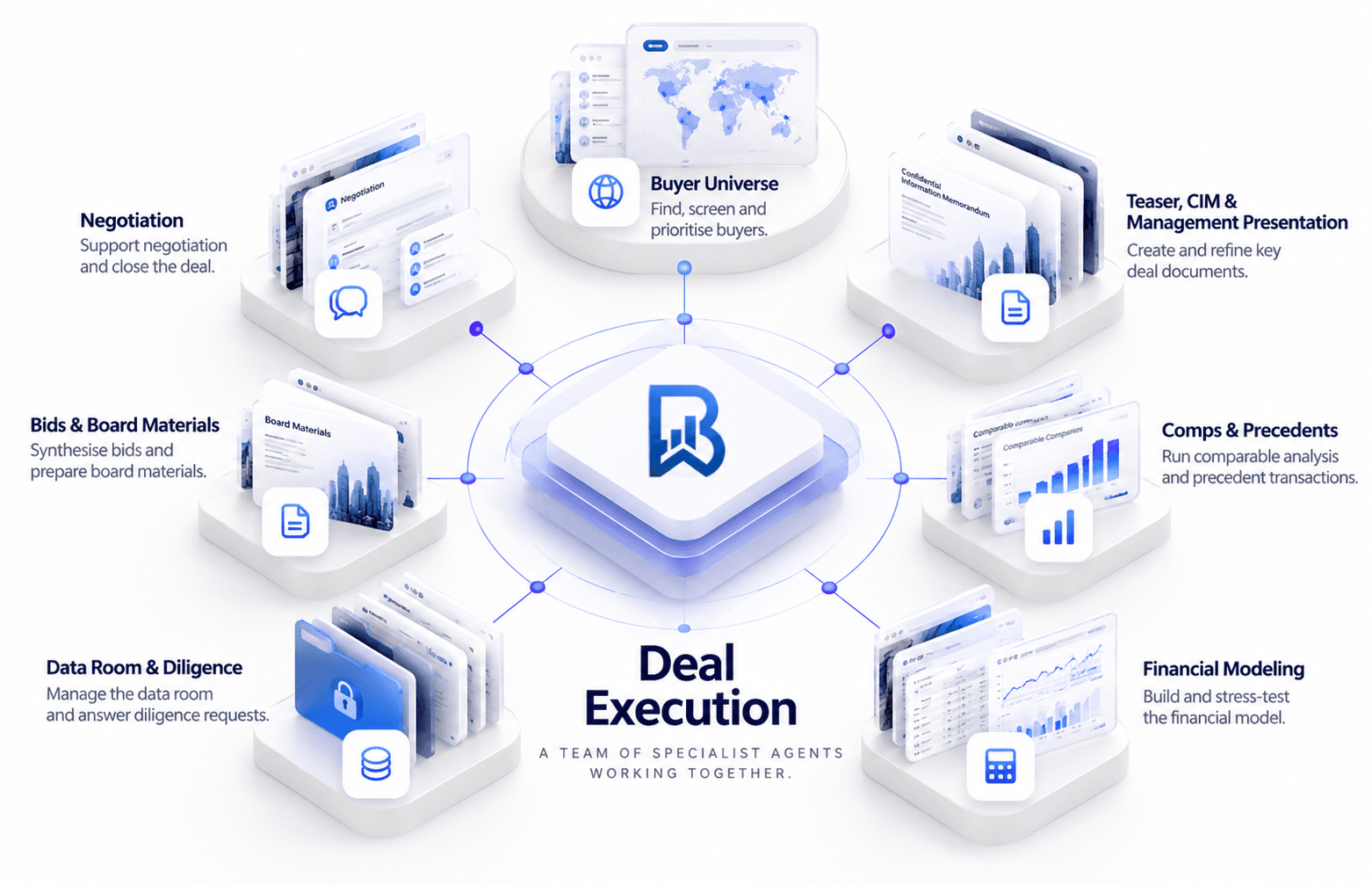
Why a Single AI Assistant Breaks Under Deal Pressure
Single AI assistants are very good at contained tasks. Summarise this filing. Draft this email. Explain this accounting treatment. Live deals rarely stay contained, though. Here is where the one-AI model breaks down.
It Loses the Thread on Long Workstreams
A deal runs for weeks or months across thousands of documents. One assistant juggling research, modelling, drafting and diligence in the same context gets confused. Earlier instructions fade, assumptions drift, and outputs stop matching each other.
One Generalist Can't Cover Every Specialism
A strong valuation analyst and a strong diligence analyst think in different ways. Asking one generalist AI to be both, plus a buyer researcher, a deck designer and a compliance reviewer, produces work that is passable everywhere and excellent nowhere.
There Are No Hand-Offs and No Accountability
Real deal teams work because of hand-offs. The analyst passes comps to the associate, and the associate passes the model to the VP. With a single assistant, you become the hand-off. You copy outputs from one prompt into the next and check whether anything broke along the way.
It Stops When You Stop
A chat assistant only works while you're typing. Deal timelines don't respect that. When you close your laptop, nothing moves until you open it again.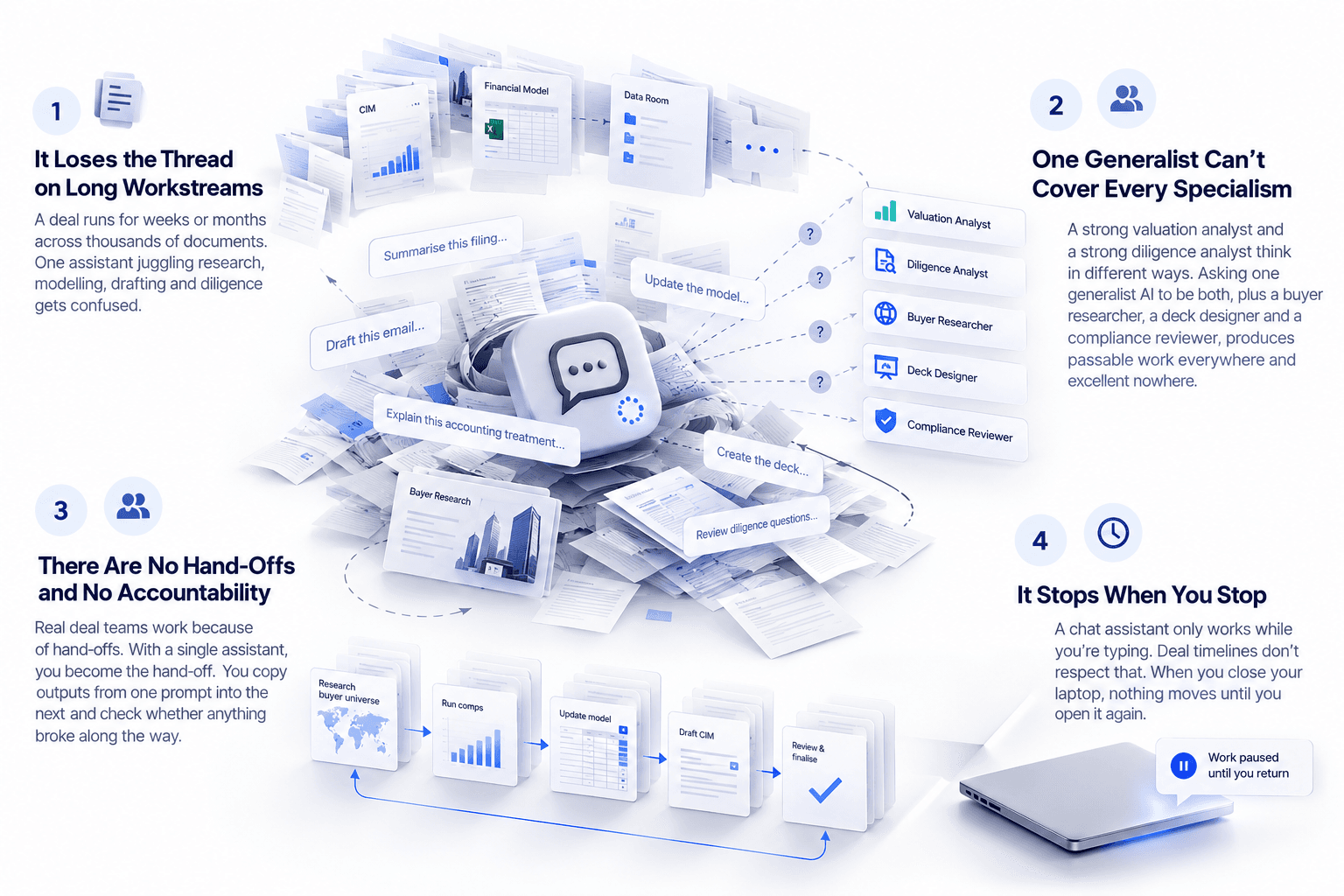
What Multi-Agent AI Looks Like in a Live Deal
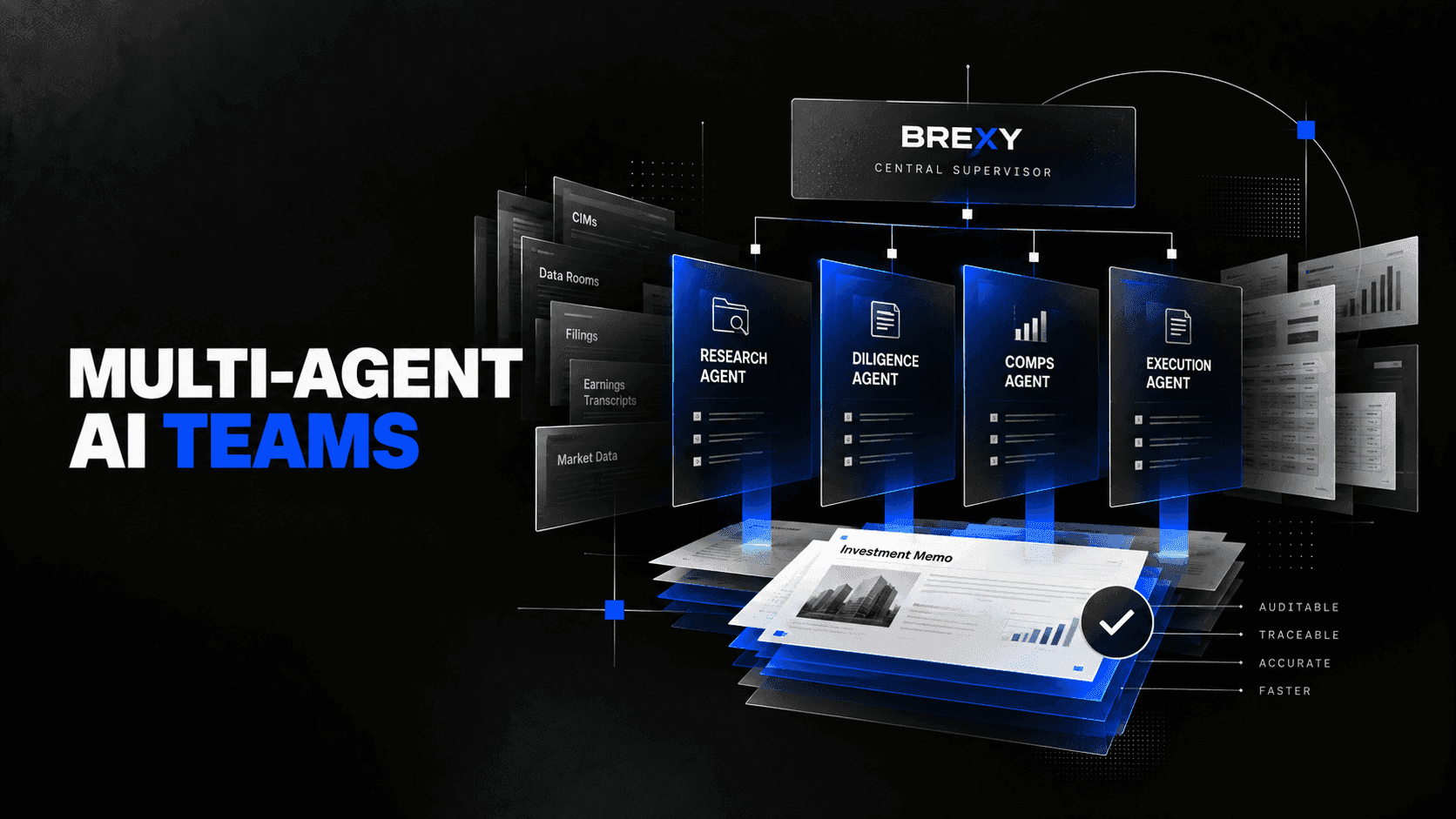
Multi-agent AI takes a different approach. Instead of one assistant doing everything, each AI agent has a defined role, its own skills and access to only the data its job requires. Agents are grouped into teams, a lead agent splits the work, and teammates hand pieces to each other the way people do.
Here is how an AI agent team might support a sell-side M&A process.
Step 1: The Brief
An MD briefs the M&A lead agent in a deal channel, the same way they'd brief a VP: "We're running a sale process for a mid-market industrial software company. Build the buyer universe and an initial valuation range."
Step 2: The Split
The lead agent breaks the brief into workstreams. A buyer researcher maps strategic acquirers and financial sponsors. A comparables researcher pulls trading comps and precedent transactions. A valuation lead brings those together into a range.
Step 3: The Hand-Offs
Agents talk to each other directly. The valuation agent asks the comps agent to remove an outlier. The buyer researcher flags a sponsor with a portfolio company in the same space, and the synergy analyst picks it up. None of this needs a human relaying messages.
Step 4: The Review
Before anything reaches the client, a compliance agent checks the work, and every number is traced back to its source document.
Step 5: The Approval
The finished output, with sources attached, lands in the deal team's inbox. Nothing ships until a human signs off.
The same pattern carries through the rest of the deal. A diligence agent works through the data room, a presentation agent turns findings into board-ready slides, and a timeline agent tracks every workstream against the process calendar.
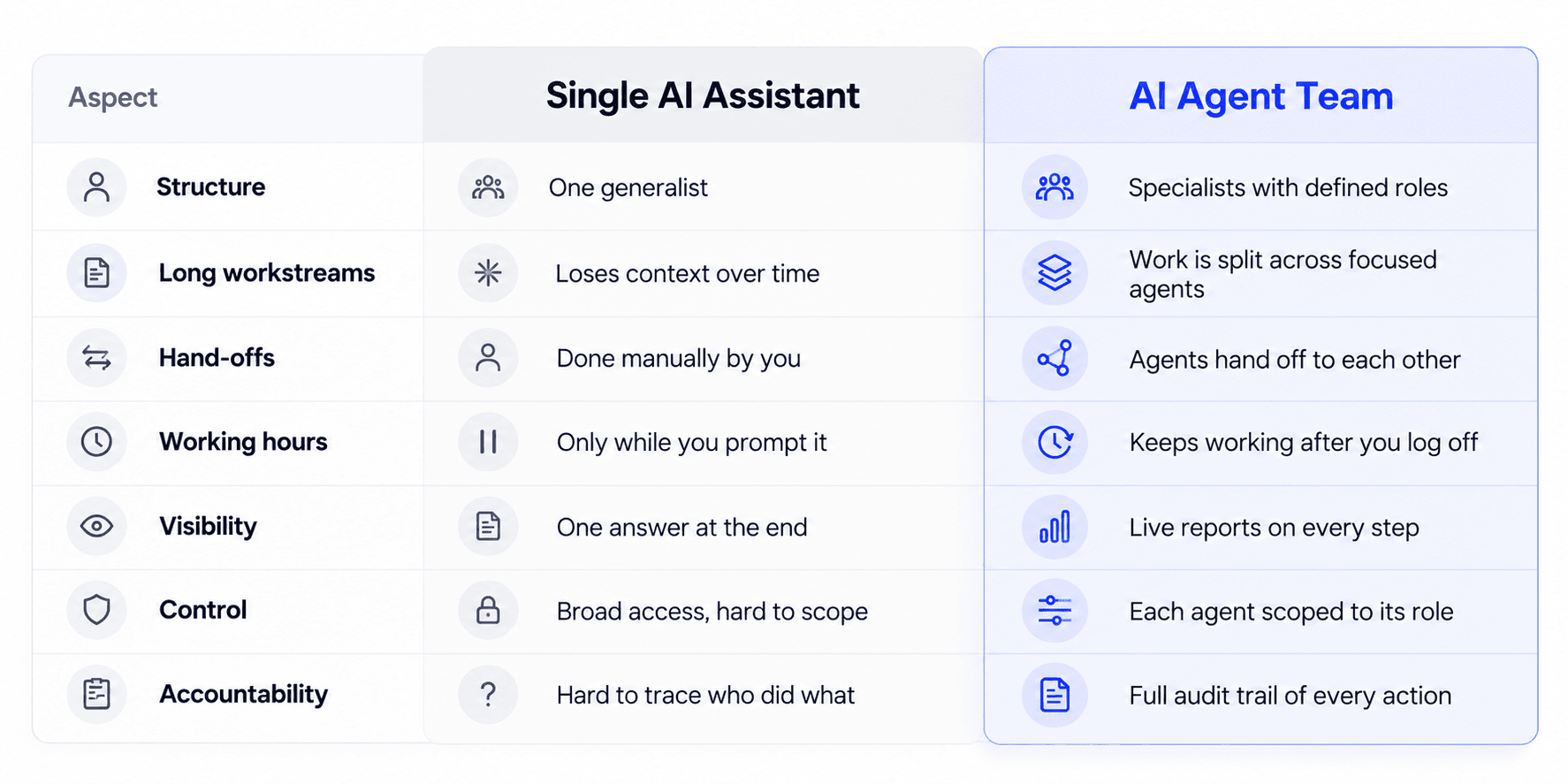
Single AI Assistant vs AI Agent Team: A Side-by-Side Comparison
Humans Stay in the Loop. That's the Point.
The fair concern with any AI in deal execution is control. Client confidentiality, regulatory exposure and reputational risk are too high to hand work to a black box.
That is why the agent-team model fits finance better than a single assistant does. Teams can be governed the way human teams already are:
Scoped access: Each agent sees only the data and tools its role needs.
Approval gates: Sensitive outputs and actions wait for an authorised person.
Audit history: Every input, decision, hand-off and output is logged and traceable.
Instant control: Any agent can be paused, have its access revoked or have its rules changed immediately.
AI agent teams don't replace bankers. They act as companions to them. They take on the hours of pulling, formatting, reconciling and checking so that deal professionals can focus on judgement, relationships and negotiation, which is where deals are won.
What to Look For in an AI Platform for Deal Execution
If you're evaluating AI agents for investment banking or private equity, these are the questions that matter most.
Can agents coordinate with each other, or only with you? If every hand-off runs through a human, you have bought a faster chatbot, not a team.
Are agents specialised by role? Look for distinct agents for research, valuation, diligence, capital markets and compliance, not one model given different prompts.
Is every output sourced? In deal work, a number you can't trace is a number you can't use.
Are you locked into one AI model? Models improve every quarter. Your platform should let you swap models per agent, run local models, or use subscriptions you already pay for.
Is it enterprise-ready? Ask about permissions, approval workflows, audit trails, security attestations and on-premises deployment.
How Brexy Agent Studio Approaches Deal Execution
Brexy Agent Studio was built on the idea at the centre of this article: lone bots get confused, but agent teams don't.
In Brexy, firms build teams of AI agents that coordinate like real employees across M&A, ECM, DCM, deal sourcing, due diligence and portfolio monitoring. There is a ready-made directory of specialists for every desk, including M&A leads, transaction associates, diligence analysts, valuation leads, buyer researchers, presentation designers and compliance reviewers. You can also define your own agents.
Every user gets BREXY, a personal agent that briefs you on what your teams did, routes new requests to the right team and asks for your approval when something needs you. Agents work in your channels, report progress live, run on any LLM and keep working after you log off. Results wait in your inbox, sourced and ready for review.
Control is built in: scoped access per agent, human approval gates, complete audit history, SOC 2 Type I attestation, and deployment in Brexy's cloud or inside your own walls.
Conclusion: Your Next Deal Team Is Already Being Built
The firms that win the next decade of dealmaking won't be the ones with the smartest single AI. They'll be the ones that learn to manage teams of AI agents alongside their people, with clear roles, clean hand-offs and humans in control.
You don't need the whole workforce figured out to start. Bring one live workstream to Brexy Agent Studio, and let your agent team scope it, split it and deliver it while BREXY keeps you updated.
Join the Brexy waitlist and get INVITE to the Brexy Agent Studio.
Frequently asked questions
What is AI for deal execution?
AI for deal execution means using artificial intelligence to support the work of delivering a transaction after a mandate is won. That includes buyer research, valuation, CIM drafting, due diligence, data room analysis and board materials.
How is multi-agent AI different from a single AI assistant?
A single AI assistant is one generalist responding to one prompt at a time. Multi-agent AI uses several specialised agents, each with its own role and skills, which divide work, hand off tasks to each other and report progress, much like a human deal team.
Can AI agents run a deal process end to end?
AI agent teams can handle large parts of the execution workload, including research, analysis, drafting and diligence. Humans still own judgement, client relationships, negotiation and final sign-off. The strongest setups keep a human approval step before any output is shared.
Are AI agents safe to use on confidential deal data?
That depends on the platform. Look for scoped permissions per agent, human approval gates, full audit trails, recognised security attestations and the option to deploy on your own infrastructure.
Will AI agent teams replace investment bankers?
No. They take on repetitive, time-heavy work so bankers can spend more time on judgement, client relationships and getting deals done.