AI for Private Equity: How Deal Teams Use It From Sourcing to Exit
How private equity firms use AI for deal sourcing, due diligence, investment research, IC memos and portfolio monitoring, and where it still falls short.
AI for private equity is the use of artificial intelligence to do the information-heavy work of investing: screening targets, reading CIMs and data rooms, building a market view, drafting investment committee memos and monitoring portfolio companies. It does not make the investment decision. It removes the hours between receiving a document and having a view on it.
Expectation is running ahead of results. In an EY study, 84% of private equity funds said they expect AI to transform their business significantly. BCG, looking at what firms actually achieved, found that most saw limited returns from AI in 2025 and few had changed how they operate.
This guide is about the gap between those two findings: where AI works inside a private equity firm today, where it does not, and how to start without losing a year to pilots.
What AI for Private Equity Actually Means
AI for private equity is any AI system applied to the research, analysis and reporting work of private market investing. In practice that means three kinds of tool, and firms often confuse them.
Data providers with AI features. PitchBook, S&P Capital IQ, Preqin. You are paying for the data. The AI helps you search for it.
General assistants. ChatGPT, Claude, Copilot. Good at drafting and explaining. They know nothing about your deal unless you upload it, and firm policy often says you cannot.
Finance-native platforms. Built around deal work. They read your documents, cite the passage behind every figure, and produce the memo or screening note instead of a chat answer.
Generative AI in private equity is the newer part of this. Earlier machine learning scored and ranked things. Generative models read and write, which means they can take a 150-page CIM and return a screening note. That is why adoption has moved from data science teams to deal teams.
Why Private Equity Firms Are Adopting AI Now
Three pressures, none of them new.
More opportunities than the team can read. A mid-market fund sees hundreds of teasers and CIMs a year and can look properly at a fraction.
Shorter diligence windows. Competitive auctions compress the time between receiving data room access and submitting a bid.
A growing reporting load. LPs ask for more detail, more often, in their own formats.
What changed is the tooling. AI now reads documents well enough to be trusted with a first pass, provided a person checks the work.
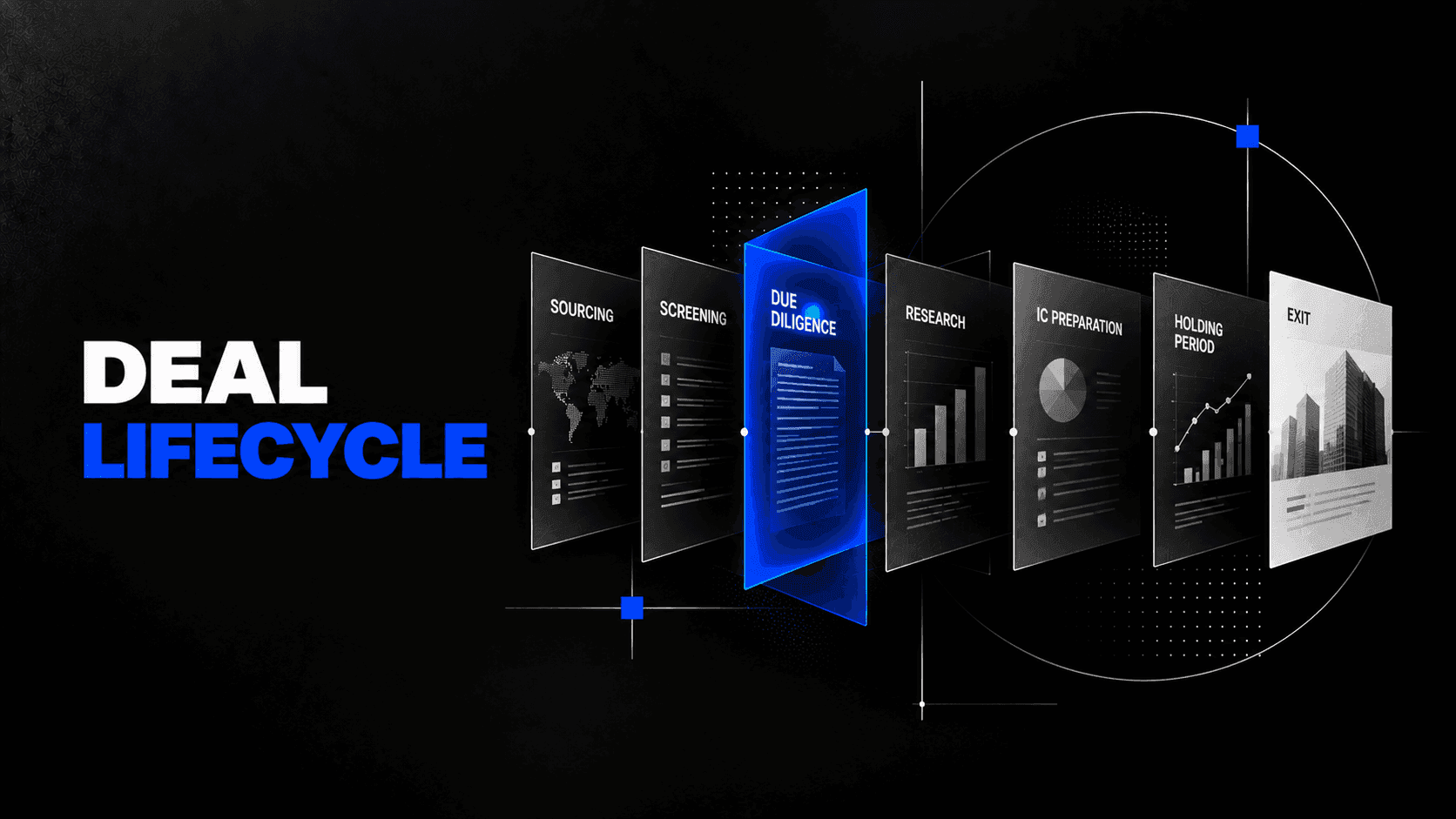
7 Use Cases of AI in Private Equity Across the Deal Lifecycle
The useful applications all share one feature. They remove reading, extracting and formatting, and they leave the judgment where it was.
Stage | What AI Does | What Stays With the Deal Team |
Sourcing | Screens the market against the thesis, ranks targets with reasons | Whether the owner will sell, and the relationship |
Screening | Reads the CIM, extracts financials, drafts the screening note | Whether to spend money on diligence |
Due diligence | Finds clauses, reconciles figures, flags inconsistencies | Whether a finding is material |
Research | Maps the market, profiles competitors, summarizes reports | The investment thesis |
IC preparation | Assembles verified findings into the memo structure | The recommendation |
Holding period | Standardizes portfolio reporting, flags changes | What to do about them |
Fundraising and LP reporting | Drafts reports and DDQ responses from approved material | What the firm says to its investors |
1. AI Deal Sourcing for Private Equity
Most firms' proprietary pipeline is really whoever the partners happen to know. AI deal sourcing turns the thesis into screening criteria, such as sector, geography, size, ownership and growth signals, and runs them across far more companies than an associate could cover. It ranks the results, gives a reason for each, and repeats the screen every week.
A fund looking for B2B software businesses in Southeast Asia with founder ownership and revenue above a set threshold gets a ranked longlist on Monday morning, including the forty companies nobody at the firm has met.
It does not tell you whether the owner will sell or whether they will take your call. Sourcing tools widen the pool. Relationships still win the deal. See how Brexy approaches AI deal sourcing.
2. CIM Analysis and First-Pass Screening
The first read of a CIM is the most repeated task in private equity and the easiest to standardize. CIM analysis with AI extracts the business description, historical financials, customer concentration, management's adjustments and the growth story, then drafts a one-page screening note against the fund's criteria.
The gain is consistency as much as speed. Every opportunity gets the same ten questions asked of it, so the Monday pipeline meeting compares like with like.
Treat management's adjusted EBITDA as a claim, not a number. A good tool separates reported figures from adjusted ones and lists every add-back for a person to challenge.
3. AI Due Diligence for Private Equity
Due diligence in private equity is a set of questions asked against a very large set of documents, which is exactly the shape of work AI handles well. Four uses hold up in practice:
Clause finding. Every change-of-control, termination and assignment provision across hundreds of contracts, each returned with its passage.
Reconciliation. Where the CIM and the audited accounts disagree, or two versions of a schedule differ.
Concentration analysis. Customer concentration once related-party revenue is stripped out.
Triage. Which of two thousand documents a partner should actually read.
AI surfaces the issue. It does not decide whether the issue is material or what it does to the price. That stays with the deal team and its advisers. More on AI due diligence across inconsistent, multi-jurisdiction data rooms.
4. Private Equity Investment Research and Market Mapping
An investment thesis rests on a view of the market: its size, its growth, who competes in it and what regulation is coming. Private equity investment research has always been a gathering exercise before it becomes a thinking one.
AI does the gathering. It pulls participants, positioning, recent transactions and the main themes from industry reports into a structured brief the team can challenge and edit. A team looking at a healthcare technology business starts from a drafted market map instead of a blank slide.
The brief is only as good as its sources, so insist that each claim links to one. A financial research platform should end in a document you can send, not a list of search results.
5. IC Memo Drafting and Investment Committee Preparation
The investment committee memo is where weeks of work get compressed into twenty pages, usually in the final two days. AI assembles verified findings into the firm's memo structure: thesis, market, financial performance, key risks, open questions.
The word that matters is verified. An IC memo drafted from unchecked output transfers errors into the one document the partners rely on. Used properly, the analyst checks findings as they arrive during diligence, and the draft then takes hours instead of days.
The recommendation, and the argument for it, stay with the deal team.
6. Private Equity Portfolio Monitoring and Value Creation
After close, the information problem returns in a different form. Monthly reporting arrives from a dozen portfolio companies in a dozen formats, and the same questions get asked every cycle.
Private equity portfolio monitoring with AI standardizes those reports, compares each metric with prior periods and with plan, and flags what moved: revenue, retention, margin, cash. The operating partner reads three exceptions instead of twelve packs.
On value creation, the honest position is that AI helps find the levers, such as pricing, procurement and churn, faster than it helps pull them. It has no view on whether a company is underperforming or simply early.
7. LP Reporting, Fundraising and DDQ Responses
The firm's own reporting is the least discussed use case and one of the most practical. Quarterly LP reporting, fundraising materials and due diligence questionnaires all reuse the same approved facts in slightly different formats.
AI drafts from that approved material. A DDQ response that took an investor relations team a week becomes a review exercise. What the firm tells its investors is still decided by people, and everything sent out is checked against the source.
Where AI in Private Equity Still Falls Short
Firms that are disappointed by AI usually expected it to have opinions. It does not, and four limits are worth stating plainly.
It cannot tell you if an owner is a seller. Timing, motive and trust are relationship work.
It cannot judge an add-back. It can list every adjustment in the quality of earnings. Whether a one-off is really a one-off is a judgment call.
Private company data is thin outside the US. In Southeast Asia, many good businesses barely appear in any database. A screen there is a starting list, not a complete one.
A number without a source is a liability. Any tool that cannot show the passage behind a figure is creating review work, not saving it.
How to Implement AI in a Private Equity Firm: A 5-Step Framework
Most failed pilots tried to change everything at once. The firms that get value start with one workflow and measure it.
Find the biggest bottleneck. Map where analyst hours actually go: screening CIMs, reviewing data rooms, consolidating research or preparing IC materials. Pick one recurring task with a clear output.
Check the data and the rules. Where does the information live, can the tool reach it, and is it permitted for this use? Settle access controls and confidentiality before any deal document is uploaded.
Pilot on a closed deal. Run the AI workflow on a transaction the team has already completed, so the output can be compared with work you trust. Never test a new tool on a live deal.
Measure accuracy, not enthusiasm. Track time spent, completeness, source traceability and how much correction the output needed. If the analyst rewrote most of it, the tool saved nothing.
Expand with named reviewers. If the pilot holds up, document the workflow, name who signs off each output, and move to the next bottleneck.
How to Evaluate AI Tools for Private Equity
A tool that writes well is not necessarily a tool that can handle a data room. Test AI tools for private equity on your own documents, against these seven criteria.
Evaluation Area | What to Check |
Source traceability | Can an analyst click any figure and see the passage it came from? |
Document handling | Does it cope with your real files: scanned PDFs, large data rooms, Excel models, second languages? |
Financial understanding | Give it two companies that define the same metric differently. Does it notice? |
Your own knowledge | Can it read past memos and internal research, with permissions respected? |
Data security | Is your data used for training? Where is it processed and stored? Which certifications, exactly? |
Permissions | Enforced per user or per workspace? On a live deal, per workspace means everyone sees everything |
Output | Does the work end in a chat answer, or in the screening note and memo your team actually sends? |
Most tools pass the demo. The third row is the one that separates a tool that understands finance from one that is only fluent in it.
How Brexy Supports Private Equity Teams
Brexy is an AI platform built for deal and investment teams by former bankers and investors. For a private equity firm, it covers the workflows above in one place.
Deal sourcing. Turn investment criteria into a target search, with a match rationale for every company and scheduled results delivered weekly.
CIM analysis and screening. Upload a CIM and get a screening note against your own criteria, with reported and adjusted figures kept apart.
Due diligence. Ask questions across the full data room, including contracts, financials and management materials, with every finding linked to its source passage.
Deal memos. Draft the IC memo in the firm's structure from findings the team has already verified.
Portfolio monitoring and LP reporting. Standardize portfolio company reporting and draft investor updates from approved material.
Brexy connects to the data providers a team already licenses, including PitchBook and S&P Capital IQ, and to the firm's own documents. It is SOC 2 Type I compliant, with permissions enforced per user. It is headquartered in Singapore, so cross-border deals with inconsistent disclosure are the main case the product is built for, not an edge case.
Where AI in Private Equity Pays Off, and Where to Start
AI in private equity works where the job is reading, extracting, reconciling and drafting. It does not work where the job is judgment, relationships or accountability, and it was never going to.
The firms seeing returns are not the ones using AI everywhere. They picked one bottleneck, measured the result honestly and insisted that every figure trace back to a source. Start there.
See Brexy on a Deal You Have Already Closed. Bring a CIM or a data room from a past transaction and compare the output with your own work.
Frequently asked questions
What Is AI for Private Equity?
AI for private equity is the use of artificial intelligence to support deal sourcing, CIM screening, due diligence, investment research, IC memo preparation, portfolio monitoring and LP reporting. It handles reading, extraction and drafting. Investment judgment stays with the deal team.
How Is AI Used in Private Equity Due Diligence?
AI is used to find clauses across contracts, reconcile figures between documents, analyze customer concentration and triage large data rooms, returning each finding with its source passage. It does not decide whether a finding is material. That remains with the deal team and its advisers.
Can AI Replace Private Equity Analysts and Associates?
No. AI replaces tasks such as spreading financials, first-read CIM summaries and formatting. It does not replace judgment on add-backs, relationships with owners and management, or accountability for the recommendation. The role shifts toward verification and analysis.
What Are the Best AI Tools for Private Equity?
It depends on the job. Data providers such as PitchBook and S&P Capital IQ supply private market data. General assistants help with drafting. Finance-native platforms, Brexy among them, read deal documents and produce sourced deliverables. Most firms use one from each group, and the right test is a pilot on your own closed deal.
Is It Safe to Upload Deal Documents to an AI Tool?
Only after five answers in writing: whether your data is used to train models, where it is processed and stored, how long it is kept, which security certifications the vendor holds, and whether permissions are enforced per user. Involve compliance before the pilot, not after.
Is AI Useful for Small and Mid-Market Private Equity Firms?
It is often most useful there. A team of six has no analyst bench to absorb the reading and formatting, so removing that layer directly increases how many opportunities the firm can evaluate properly.
How Should a Private Equity Firm Get Started With AI?
Pick one recurring workflow with a clear output, such as CIM screening. Pilot it on a closed deal, measure accuracy and correction time against your existing process, name a reviewer for every output, and expand only when the results hold up.