AI for Investment Banking: 10 Workflows Deal Teams Are Actually Using
The 10 investment banking workflows where AI works today, from research to due diligence to live deal execution, and where it still falls short.
AI for Investment Banking: 10 Workflows Deal Teams Are Actually Using Right Now
Quick answer: AI for investment banking is not automating deals. It is automating the information layer underneath them: research, extraction, document search and first drafts. The ten workflows where it earns its keep today are company research, company profiling, financial statement analysis, comparable company analysis, due diligence, deal sourcing, M&A synthesis, pitchbook preparation, live deal execution and cross-deal knowledge management. Valuation, negotiation and client relationships remain human.
Key takeaways
- The highest-return workflow available today is AI due diligence document search. Highest volume, lowest ambiguity, most measurable payoff.
- AI builds the longlist, not the shortlist. Comparable company selection remains a judgment call.
- Source traceability is the buying criterion. An extracted figure you cannot click back to the filing is a liability, not a time saving.
- For cross-border deal execution out of Singapore and APAC, the gain is largest in multi-jurisdiction diligence, where document volume and disclosure inconsistency are highest.
- Underneath all ten sits AI document analysis. Evaluate that layer first, because every workflow above it inherits its weaknesses.
What AI Actually Does in Investment Banking
Most content about AI for investment banking makes it sound as though every part of a deal is about to be automated. It is not. What is genuinely changing is narrower and more useful: the hours a deal team spends finding, extracting and cross-checking information before anyone can apply judgment to it.
That is the part AI is good at, and the volume involved is not trivial. In a survey of more than 200 finance professionals, UpSlide found bankers spending up to 40 hours a week on manual tasks. That is an entire working week, every week, spent on work that produces no judgment.
Valuation calls, negotiation strategy and client relationships are not going anywhere near a model, and any vendor claiming otherwise is selling something.
It is worth separating two claims that often get blurred together. The first is that AI can read and organise large volumes of financial documents faster than a person. That claim is true and has been demonstrated repeatedly. The second is that AI can decide what those documents mean for a specific transaction. That claim remains unsupported, and the distance between the two is where most disappointing deployments end up.
Adoption has already moved past the question of whether this works. Deloitte's 2025 study of 1,000 corporate and private equity leaders found 86 percent had integrated generative AI into their M&A workflows, with 35 percent of those adopters applying it to due diligence specifically. The open question is no longer whether to use it, but which workflows justify it.
What follows are the ten places where investment banking AI tools are earning their keep today, and where they still fall short. At the end of this blog, we will cover where Brexy sits in that picture, and what to look for in AI investment banking software built for deal teams.
1. AI for Company and Sector Research
An analyst is asked to cover a name or a sub-sector by Friday. The information exists in annual reports, transcripts, investor decks, equity research reports and sell-side notes, but it is scattered across a dozen sources, and half the job is confirming that a data point is current before using it.
This is where natural-language search across documents pays off immediately. Instead of running keyword searches file by file, a banker can ask: Pull management commentary on pricing pressure from the last two quarters across these five names, grouped by company, with sources.
The output is not the finished memo. It is a research base with the receipts attached, which is the part that used to consume the morning.
The distinction that matters in practice is between a summary and a starting point. A summary compresses what a document says and asks to be trusted. A starting point organises what several documents say and shows where each claim came from, so the analyst can disagree with it. Only the second is useful at this stage of the work.
Where it helps: first-pass coverage, sector primers, pre-call briefings.
Where it does not: deciding what the research means for your client.
2. AI Company Profiles that do not Start from a Blank Page
Nobody builds a company profile from nothing anymore. They start from a first draft and edit it down. The risk is doing that with a tool that has no idea what geographic exposure or customer concentration mean in a banking context, and which returns something generic. Ask a general-purpose model to compare five companies' business models and you will often get surface-level differences that read well but say little.
Ask it to also flag where the disclosures are thin, contradictory or dated, and you are closer to what an associate actually needs before a first client call. That difference between finance-native and general-purpose is most of the gap between output you can use and output you rewrite.
A practical test when evaluating any tool on this workflow: give it two companies that report the same metric under different definitions and see whether it notices. A general model will compare the numbers. A finance-native one should flag that they are not comparable.
3. AI Financial Statement Analysis
This is the one nobody argues about.
Pulling the same line item across five years of filings, or the same three metrics across a peer set, is tedious, repetitive and error-prone by hand. It is exactly the work AI financial statement analysis is reliable at, provided the source document sits visible next to every number it extracts.
This is also the input layer for AI financial modeling. An AI financial model is not a model produced autonomously and handed over. It is extraction and spreading done quickly enough that the banker spends their time on assumptions rather than data entry. Firms comparing financial modeling software on this workflow should ask one specific question: what happens when a filing is restated. That is where most tools quietly fall apart.
The failure mode here is not AI getting a number wrong occasionally. It will, sometimes. The failure mode is a team trusting an extracted figure that never gets checked against the actual filing before it lands in a model. Any workflow worth using makes that check a five-second click, not a ten-minute hunt back through the PDF.
4. AI Comparable Company Analysis: Longlist, not Shortlist
A comparable company is not simply a company in the same SIC code. It is a judgment call involving business model, geography, growth stage, and often relationships the banker already holds in that sector.
AI comparable company analysis is well suited to the part before that judgment: surfacing a broader candidate pool and organising available multiples with sources attached. It is poorly suited to deciding which four names belong in the memo.
Where this goes wrong: teams that allow the AI-generated shortlist to become the final comp set without anyone asking why a name is on it. The value is a bigger longlist reviewed faster, not a shorter review.
One habit worth building into the process. Require a one-line reason for every name that survives to the final set, and a one-line reason for every name cut. It takes ten minutes and it makes the screen defensible when a client asks why a particular peer is missing.
5. AI Due Diligence: The Workflow that is Production-Ready Today
If there is one workflow on this list to prioritise first, it is this one. The volume problem is measurable. A mid-market acquisition now generates somewhere between 5,000 and 12,000 data room documents, and analysis by Bayes Business School puts average due diligence at 203 days, up 64 percent over a decade. In a late 2025 survey of 150 senior dealmakers by SRS Acquiom and Mergermarket, 73 percent expected diligence to become more complex again over the following one to two years.
Against that, deadlines have not moved. The cost of missing a change-of-control clause buried on page 40 of contract number 212 is real, and it usually surfaces long after signing. Document-level search and question answering across an approved data room is where the advantage of AI due diligence over manual review is largest and least controversial.
AI document analysis is the capability underneath this, and it is the one to test hardest during an evaluation. When comparing AI document analysis tools, three questions separate them: whether scanned documents are handled as reliably as native ones, whether every answer carries a citation back to a specific page, and whether document permissions are respected at the level of the individual user rather than the workspace.
Tasks it handles well today:
- Surfacing every contract containing a change-of-control or termination clause
- Flagging customer concentration figures across a document set
- Identifying inconsistencies between two versions of the same disclosure
- Answering a specific diligence question with the source passage attached
- Comparing a CIM against the underlying documents to find claims the data room does not support
The reported time savings are consistent with that. Bain found that more than 60 percent of the private equity firms it interviewed already use at least one generative AI tool for sourcing, screening or diligence, and that early adopters spend roughly a day summarising data where the same work previously took a week.
None of this replaces the lawyer or the banker deciding whether a clause is a problem. It replaces the four hours it used to take to find the clause.
For due diligence specifically, source traceability and access controls are not optional extras. They are the entire point. The answer is worthless if the deal team cannot verify where it came from.
6. AI Deal Sourcing: A Wider Net, the Same Relationship Work
Screening companies against revenue, margin and geography criteria used to mean stitching together two or three databases and a great deal of spreadsheet work. AI deal sourcing compresses that into a query and widens the pool a human might have missed.
It does nothing for the part that actually starts a deal: the relationship, the timing, and the read on whether an owner is genuinely sellable. Treat AI sourcing as coverage expansion, not pipeline generation.
The same limit shows up after close. Private equity portfolio monitoring faces an almost identical information problem, since quarterly reporting arrives from a dozen companies in a dozen formats and the same questions get asked each cycle. Retrieval solves the gathering. It has no view on whether a portfolio company is underperforming or simply early.
7. AI for M&A Analysis: Fast Synthesis, No Opinion on Price
Target research, precedent transactions, competitor moves and publicly discussed synergies all sit in different places. Pulling them into one view is a legitimate time saving.
What AI should never do on an M&A team is go anywhere near the thesis: what a buyer should pay, how a negotiation should be sequenced, or whether a deal makes strategic sense. That is not a capability gap that closes with a better model. It is a decision that depends on context no document set contains.
This is also the workflow where confident output is most dangerous. A synthesis of precedent transactions will read as authoritative whether or not the precedents are genuinely comparable, and the reader has no way of telling from the output alone. Comparability is a judgment, and it has to be made by someone who knows the sector.
8. AI Pitchbook Preparation
The unglamorous truth about pitchbooks is that most of the time goes into gathering and formatting research the banker already roughly knows, not into the narrative.
AI closing that gap, by pulling company, market and competitor research into a working draft, mostly returns time for the part that matters: the positioning and the client-specific angle a generic research pack will never capture.
Every fact that moves from a draft into a client deck still needs a human to check it. That is not a caveat. That is the job.
9. AI in Live Deal Execution
Once a deal is live, the questions repeat. What does the latest draft say about indemnification. Has this term changed since last week's version. Where is the source for that number in the model.
Retrieval across the deal's own document set, rather than a fresh search each time, is what saves time here, because the same three questions arrive from three different people on three different days.
There is a second benefit that matters more than the time saved. When everyone queries the same document set, everyone gets the same answer. Three people running three separate searches on a live deal will occasionally arrive at three slightly different versions of a term, and reconciling that costs more than the original search ever did.
10. AI Knowledge Management Across Deals
Most firms have done this analysis before, somewhere, for someone. The problem is that it sits in a closed deal folder nobody remembers the name of.
Making prior research, comp sets and diligence findings searchable across deals sounds smaller than the other nine. It is the one that compounds. Every closed deal makes the next one faster, instead of every deal starting from a blank page.
The caveat: old research needs a fresh read before reuse. A comp set from 2023 is not wrong, it is simply not current, and treating it as current is its own kind of risk.
For lean teams the long-run return here is the highest on the list, because this is the only workflow that improves the firm's position rather than the speed of the current task. It is also, predictably, the one most firms defer, since the payoff lands on the next mandate rather than this one.
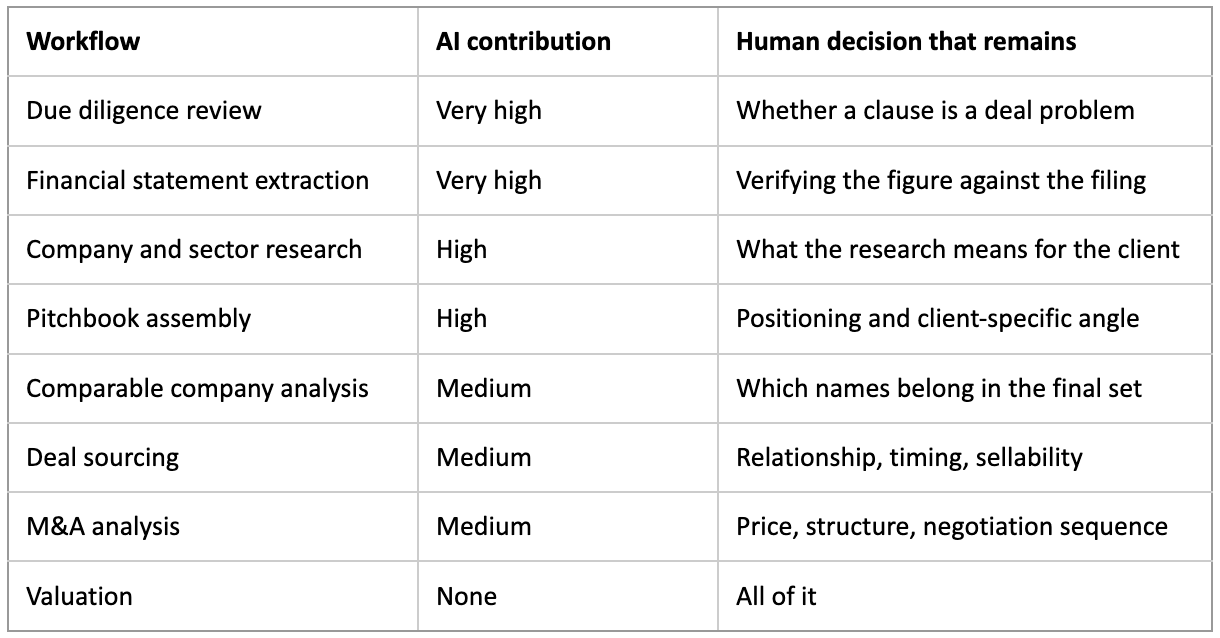
Where AI Adds Most Value, and Where it Adds Least
AI for Investment Banking in Singapore and APAC
The ten workflows above apply anywhere. What changes in Singapore and across APAC is the weight each one carries.
Cross-border mandates are the norm rather than the exception. A single transaction may involve a target in Indonesia or Vietnam, a holding structure in Singapore, and a listing venue in the United States. Each jurisdiction brings its own disclosure standards, filing formats and language.
Three consequences follow.
- Due diligence volume is higher and less consistent: A data room assembled across three jurisdictions contains documents of varying quality, in varying formats, prepared to varying standards, and frequently scanned rather than native. This is precisely the situation where document-level search outperforms manual review by the widest margin.
- Comparable company sets are harder to build: Regional peers may be thinly covered, privately held, or disclosed under a different accounting standard. A broader, faster-assembled longlist matters more here than in a market where the peer set is obvious.
- Listing route analysis carries more weight: For teams weighing SGX listing requirements against a Nasdaq route, or evaluating a de-SPAC in Southeast Asia or a reverse takeover structure, the research burden sits in precedent transactions and regulatory filings across multiple regimes. That is retrieval work, and it is where AI removes hours rather than minutes.
One caution specific to the region. MAS expectations around data handling, alongside varying data residency rules across Southeast Asia, mean that where documents are processed and stored is a real evaluation criterion, not a procurement formality. Any platform under consideration for live deal documents should answer that question before it answers questions about speed.
What this Means for the Banker
AI in this list performs one job across ten different contexts: finding, extracting and organising information faster than a person can, while leaving the underlying source visible.
It does not perform valuation. It does not negotiate. It does not build the client relationship.
The workflows where it adds the most value are the ones with the most documents and the least ambiguity, namely due diligence and financial extraction. The ones where it adds least are the ones closest to judgment: pricing a deal, deciding who to approach, reading a room.
This is also why the question of whether an AI financial analyst exists yet has an unsatisfying answer. Not in the sense the phrase implies. What exists is a very fast research layer that an analyst directs, and firms that buy the first description tend to be disappointed by the second.
That split is worth being honest about, because the firms getting the most from AI right now are not the ones treating it as a junior banker. They are the ones treating it as a very fast, very literal research assistant whose work needs checking.
How Brexy Approaches AI for Investment Banking
Brexy is built specifically for transactional bankers and deal teams. Not a general-purpose chat tool pointed at finance, but a platform built around the constraints that matter in this work: source traceability on every extracted figure, access controls appropriate for live deal documents, and workflows mapped to research, due diligence and deal execution rather than generic document question answering.
Take the investment memo, which touches four of the workflows above at once. The research has to be gathered, the comparable set assembled, the financials pulled from filings, and the whole thing written up in a form someone will take into a meeting. Brexy runs that as a single job rather than four, and what comes out is a working deliverable with every number traceable back to the document it came from. Auditable financial models, memos, diligence materials and board-ready decks, produced inside the systems and financial data platforms the team already uses.
Headquartered in Singapore, Brexy is built with cross-border mandates in mind, where a single transaction spans multiple jurisdictions, disclosure regimes and listing venues, and where a CIM prepared to one standard is diligenced under another. Deployment is shaped around the firm rather than configured by it, which is why the people running it are former bankers and investors rather than support engineers.
On the constraints that matter for the workflows above: outputs carry traceability back to the source document, access controls are built for live deal material rather than general document sharing, and Brexy is SOC 2 Type I compliant. For teams operating under MAS expectations and Southeast Asian data residency rules, those are evaluation criteria rather than footnotes.
Frequently asked questions
Will AI replace investment bankers?
No. AI automates the research, extraction and retrieval layer of the job. Valuation judgment, negotiation and client relationships remain firmly human, because those are not bottlenecked by information access, which is the problem AI actually solves.
What is the best AI use case in investment banking right now?
AI due diligence document search. It has the clearest volume problem, since data rooms are large and timelines short, the lowest ambiguity, since a clause either exists in a document or it does not, and the most measurable payoff.
Can AI analyse financial statements accurately?
AI can locate and extract figures reliably when the source document is visible alongside the output. Every material number should still be checked against the original filing before it enters a model or a client deck. Treat AI extraction as a fast first pass, not a final answer.
Can AI build a financial model?
AI financial modeling is best understood as accelerated extraction and spreading rather than autonomous model building. The structure, the assumptions and the judgment remain with the banker. When comparing financial modeling software on this, test how each handles a restated filing.
Is it safe to run a data room through AI tools?
Only with the right controls. Confidentiality, access permissions and source traceability matter more in due diligence than almost anywhere else in banking, because the documents are the most sensitive a firm handles. Evaluate any tool on those grounds before evaluating it on speed.
Can AI build a comparable company set on its own?
AI can build a longer candidate list faster. It cannot decide which four or five names belong in the final set. That call depends on judgment about the business model and relationships that is not contained in the filings.
What should firms look for in AI document analysis tools?
Three things. Whether scanned documents are handled as reliably as native files, whether every answer carries a citation back to a specific page, and whether permissions are enforced per user rather than per workspace. AI document analysis sits underneath every other workflow, so weakness here propagates everywhere.
How is AI for investment banking used in Singapore and APAC?
The workflows are the same, but cross-border mandates change the weighting. Deal teams in Singapore apply AI most heavily to multi-jurisdiction due diligence, SGX and Nasdaq listing preparation, and screening targets across Southeast Asian markets where disclosure standards vary. Data residency and MAS expectations around document handling are additional evaluation criteria in this region.
What should a firm evaluate before adopting an AI tool for deal work?
Three things: whether outputs trace to a specific source document, whether access controls match the sensitivity of the documents involved, and whether the workflow matches how the team actually works, rather than whether the tool answers a question convincingly.
How is AI for investment banking different from a general chatbot?
A general chatbot answers a question. A platform built for banking shows where the answer came from, respects who is permitted to see which document, and fits into research, due diligence or deal execution as an actual step rather than a side conversation.