 AI Studio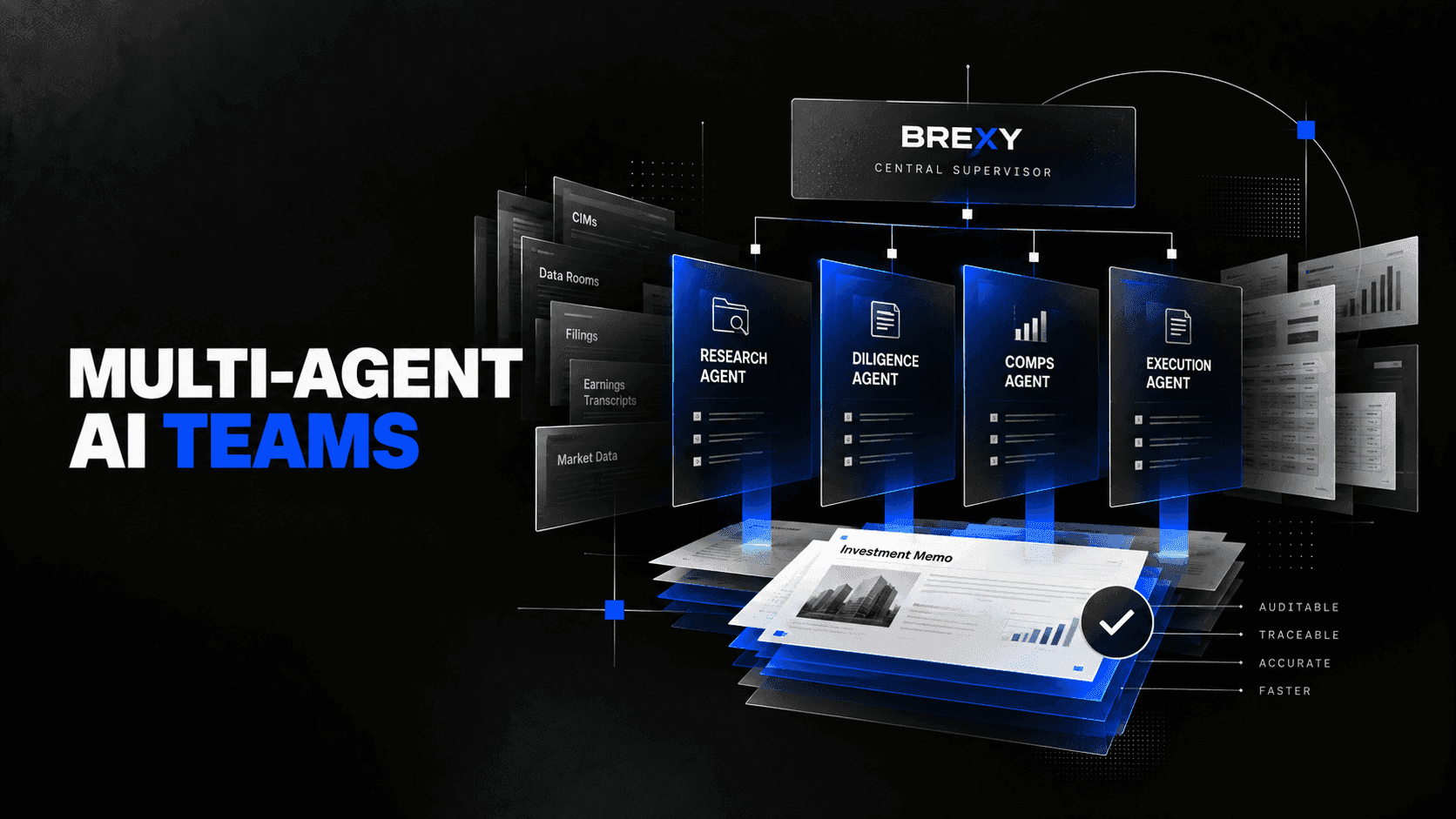
Beyond the Single Prompt: Why Multi-Agent AI Teams Are Redefining Capital Markets
Discover why single-prompt LLMs fail under deal pressure and how multi-agent AI teams automate M&A due diligence, comps, and financial research with 100% source auditability.
In the high-stakes environment of capital markets, speed without precision is a liability. Investment banking deal teams and private equity investment committees routinely process thousands of pages of unstructured filings, confidential information memorandums (CIMs), earnings transcripts, and data rooms under aggressive deadlines.
Over the past two years, enterprise finance professionals have actively experimented with general-purpose AI for investment banking. While single-prompt artificial intelligence tools excel at drafting quick text summaries or answering surface-level questions, they break down when applied to complex financial workflows.
A single prompt cannot cross-reference a 200-page data room against three years of regulatory filings, pull precedent transaction sets, and build a board-ready diligence matrix simultaneously. When deal pressure is high, generic tools often produce unverified figures, hallucinated metrics, or overly broad generalizations that fail investment committee standards.
To unlock true operational efficiency, financial institutions are shifting away from standalone chatbots and adopting multi-agent AI workforces built specifically for deal execution.
The Structural Limits of General-Purpose AI in Deal Work
To understand why traditional generative tools struggle in capital markets, one must look at how financial analysis actually happens inside an advisory firm or fund.
A human deal team does not rely on one individual to execute every phase of a transaction concurrently. Tasks are distributed across specialized roles:
Research Specialists aggregate market trends, regulatory filings, and macroeconomic data.
Diligence Lead Analysts scrub data rooms, extract risk factors, and flag inconsistencies in disclosures.
Valuation Associates pull comparable company sets and precedent transaction multiples.
Execution Directors synthesize findings into structured investment memos.
When an analyst attempts to force a single artificial intelligence model to handle all of these stages through a single wall of text, context window fragmentation occurs. The system loses track of granular financial nuances, fails to account for footnotes, and provides outputs without clear lineage.
In capital markets, an unverified finding is a liability. If a financial metric cannot be traced back to the exact page, table, or transcript paragraph it originated from, it cannot be used in a live deal context.
The Multi-Agent Solution: Collaborative AI Architectures
Rather than relying on one generalist model, modern platforms focus on multi-agent AI financial analysis. In this architecture, specialized artificial intelligence agents operate as a cohesive deal team. Each agent is configured with domain-specific logic, optimized for a targeted financial task, and managed by a central supervisor engine.
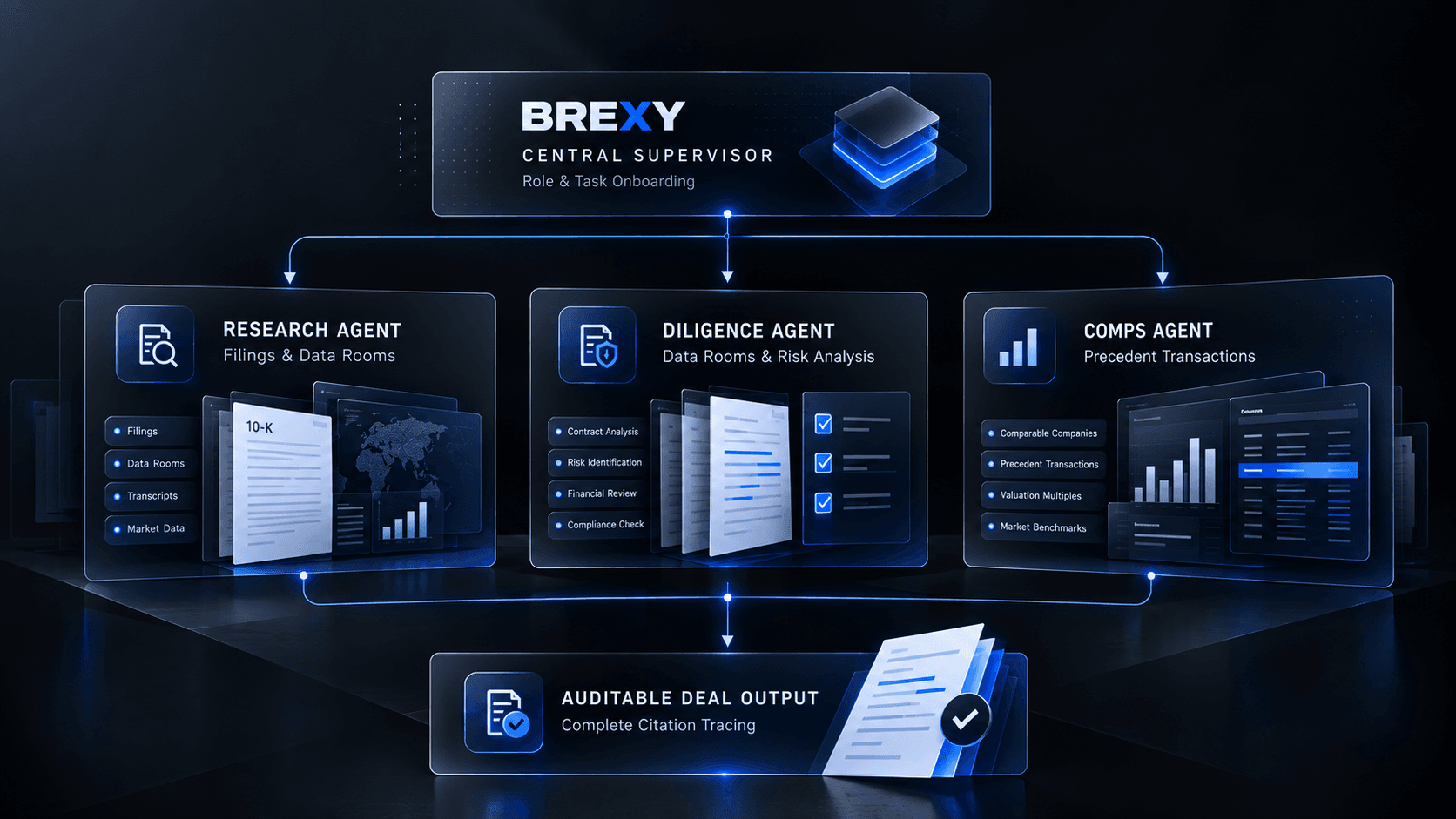
When a professional initiates a workflow, the orchestration engine breaks the assignment down into discrete, executable steps:
Role-Based Assembly: The system evaluates the user mandate (such as M&A advisory, growth equity evaluation, or debt capital markets) and assembles the appropriate agent roster.
Parallel Execution: The Diligence Agent scrubs unstructured PDF data rooms for restrictive covenants and hidden liabilities while the Comps Agent queries live market databases for valuation multiples.
Context Cross-Verification: Agents validate results against one another, checking transaction data against historical SEC disclosures before synthesizing final outputs.
Deterministic Source Tracing: Every figure, ratio, and risk narrative is dynamically hyperlinked to the exact line item in the underlying source document.
Core Financial Workflows Transformed by AI Teams
1. M&A Due Diligence and Data Room Analysis
Manually reviewing inconsistent documents across complex data rooms consumes hundreds of billable analyst hours. Platforms specializing in AI financial due diligence process unstructured filings, historical financial statements, and operational decks simultaneously. They highlight revenue concentration risks, working capital adjustments, and liability exposures in minutes rather than days.
2. Comparable Company and Precedent Transaction Sets
Building valuation comps requires rigorous normalization. AI agents ingest financial disclosures, extract operating metrics, adjust for one-time items, and organize transaction sets into standardized financial models while retaining full mathematical transparency.
3. CIM Teardowns and Investment Memos
Instead of spending late nights reformatting company overviews into internal templates, deal teams use CIM analysis software and artificial intelligence workforces to analyze materials, evaluate management projections against historical performance, and draft initial investment committee memos.
Zero Compromise on Verification and Security
For institutional financial deployment, execution capabilities mean little without enterprise-grade security and strict governance controls.
Platforms built for capital markets automation operate under rigid privacy architectures:
Document Isolation: Customer data rooms and proprietary deal documents are strictly partitioned and never used to train public foundational models.
Compliance Standards: Systems are engineered to meet SOC 2 Type I security standards, ensuring robust access management across active transaction teams.
Zero-Hallucination Guardrails: Outputs are strictly grounded in uploaded source materials, eliminating speculative generation and enforcing full auditability.
The Next Era of Financial Productivity
The future of financial technology is not about asking professionals to learn complex prompt engineering. It is about providing dealmakers with intelligent, role-aware AI workforces that understand the underlying structure of capital markets work.
By delegating repetitive research, document parsing, and valuation structuring to specialized artificial intelligence teams, advisory firms and investment managers allow their teams to focus on high-value strategic execution, negotiation, and client relationship management.
Experience Brexy Agentic Studio
Stop wasting valuable hours choosing individual agents or writing complex prompts.
With Brexy Agentic Studio, you simply tell our system your role and assignment. Brexy assembles your dedicated AI deal team, executes complex financial tasks across your deal documents, and delivers fully auditable, investment-grade outputs in minutes.