 Agent Studio
The 100-Hour Pitch Book Is Dead. Meet the AI Agents Behind the Next Deal Team.
Learn how sovereign multi-agent swarms replace manual pitch book preparation, financial statement spreading, and M&A due diligence with zero hallucinations.
The 100-Hour Pitch Book Is Dead. Meet the AI Agents Behind the Next Deal Team.
It almost always begins on a Tuesday late afternoon with an unexpected email or message from a managing director: a prospective client pitch or an urgent confidential information memorandum (CIM) review due on Friday morning. Over the subsequent 72 hours, an elite team of young professionals spends dozens of continuous hours manually spreading financial statements, hunting down footnoted adjustments across hundreds of pages of SEC filings, normalizing trading comps from scratch, and adjusting PowerPoint alignment boxes at 3:00 AM.
The primary output of all this high-stakes manual labor? A 60-page pitch book or teaser document that is frequently skimmed by senior deal makers in under ten minutes.
The traditional financial pitch book assembly line is remarkably inefficient, prohibitively expensive, and constantly exposed to human error under high-fatigue conditions. But more importantly, it is fundamentally disconnected from how modern capital markets execute transactions.
The initial era of enterprise generative AI relied on typing conversational prompts into basic, single-agent chat boxes. That era is over. Today, forward-thinking deal teams are deploying sovereign multi-agent swarms that function as autonomous digital deal teams across M&A, Equity Capital Markets (ECM), Debt Capital Markets (DCM), and private equity desks.
Welcome to the future of agentic deal execution.
The Broken Promise of First-Generation Financial Chatbots
When large language models first arrived in institutional finance, technology teams rushed to deploy generic, single-agent chatbots across deal desks. The initial expectation was that an analyst could simply upload a 300-page data room folder or a complex bond prospectus, type "Build an LBO summary and draft a pitch book," and receive a transaction-ready deliverable in seconds.
Instead, institutional finance hit an immediate wall. First-generation chatbots created more review work than they saved for three structural reasons:
1. Hallucinated Figures Destroy Deal Trust
Single-agent LLMs are architected to predict the most probabilistically plausible next text token, not to enforce rigorous mathematical integrity. In M&A due diligence, a single hallucinated EBITDA multiple, an invented debt covenant, or a misplaced decimal point in customer concentration figures can corrupt an entire valuation model, derail an investment committee (IC) memo, and permanently damage a firm's reputation.
2. The Absence of Verifiable Attribution
Generic chat interfaces return synthesized conversational paragraphs without proving where any specific metric originated. An investment banking analyst or private equity associate cannot take an unverified chat response to a managing director or an investment committee. Every single number presented in institutional finance must possess a traceable paper trail.
3. Linear, Single-Threaded Processing vs. Real-World Deal Complexity
Real deal execution does not take place in a single conversational text thread. A complete transaction workflow requires multi-threaded, parallel execution: while one team member spreads historical financial statements, another parses supplier contracts for change-of-control provisions, a third maps out competitive market landscapes, and a fourth models debt service coverage ratios. A single chatbot trying to process all these tasks sequentially in a single prompt window suffers from context window degradation and logical collapse.
To eliminate the 100-hour pitch book grind, capital markets do not need a better chat box. They require autonomous digital deal teams built on sovereign multi-agent swarms, powered by deterministic line-item citations, model-agnostic flexibility, and complete enterprise data sovereignty.
What Is a Sovereign Multi-Agent Swarm?
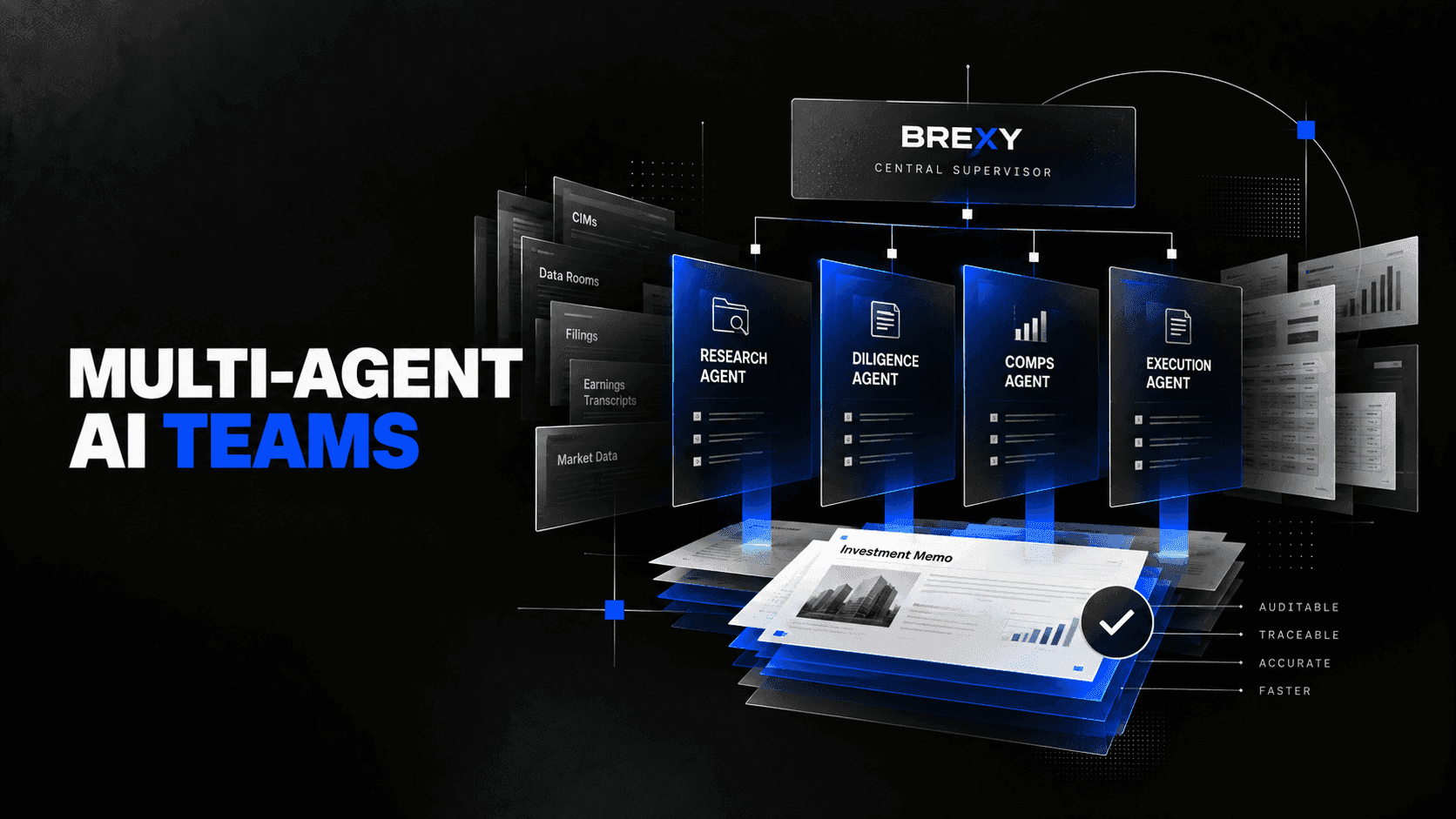
In a sovereign multi-agent swarm architecture, complex financial execution is not forced into a single prompt box. Instead, the workflow is distributed across a coordinated swarm of specialized AI agents that collaborate within shared digital channels alongside human professionals.
Rather than asking one generalist model to handle reading, calculating, auditing, and slide drafting simultaneously, the platform provisions specialist agents with narrow, highly enforced roles, domain-specific skill sets, and granular data access permissions:
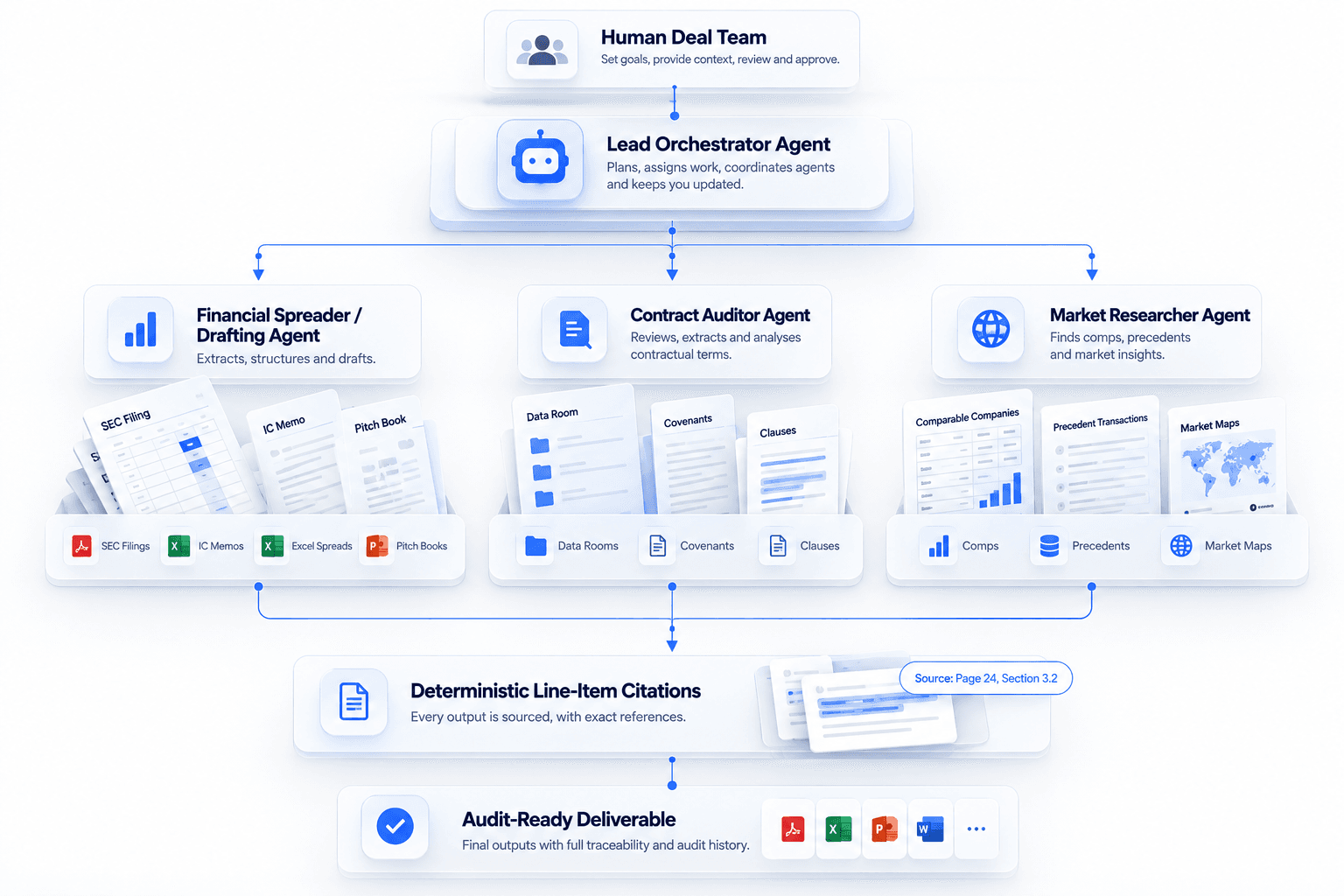
Specialist Agent Roles Inside the Swarm:
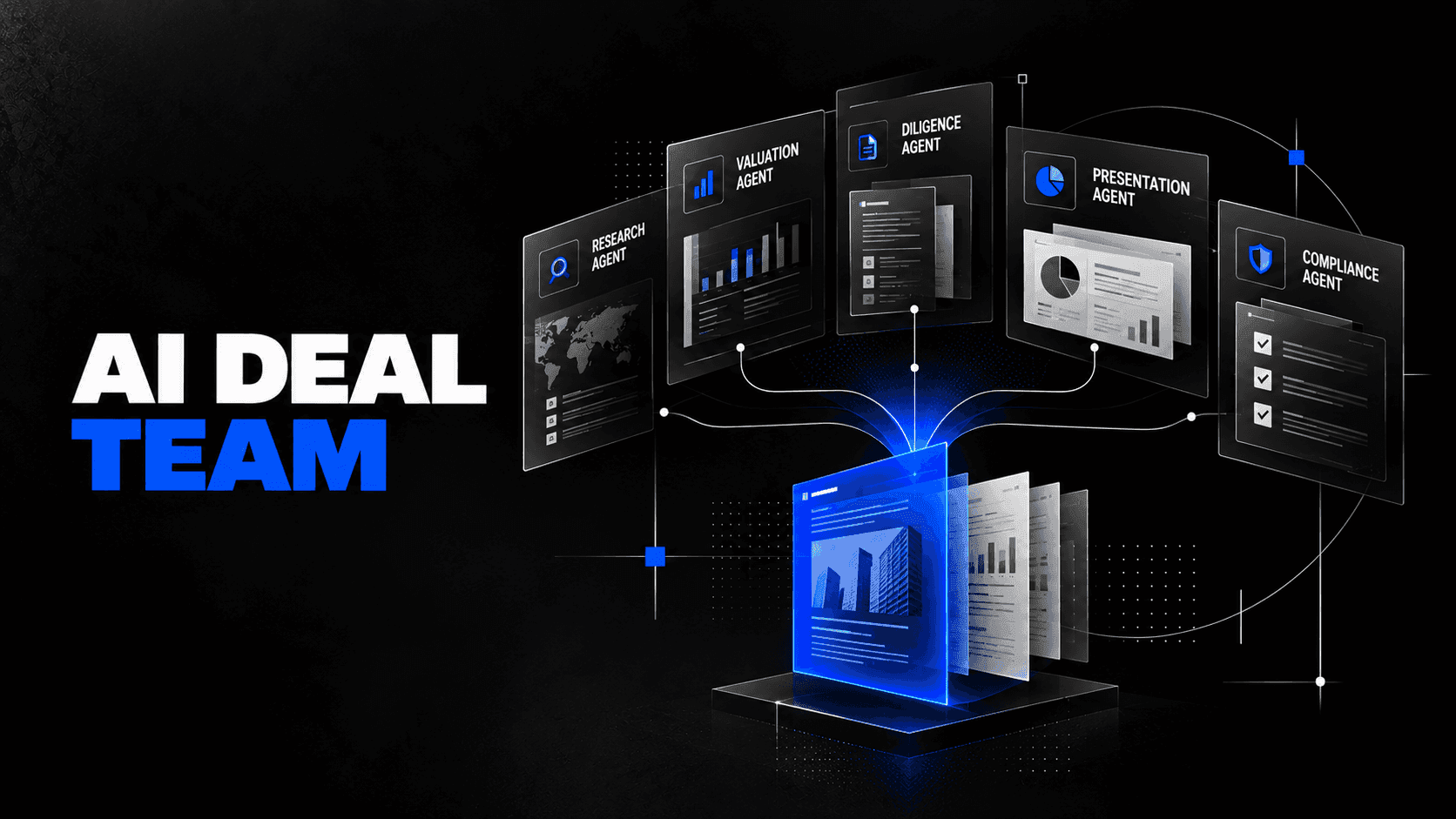
The Lead Orchestrator Agent: Receives the initial transaction brief from the human deal maker, decomposes the transaction requirements into discrete operational workstreams, delegates tasks across specialist agents, and coordinates cross-desk progress in real time.
The Financial Spreading Agent: Ingests raw SEC filings, audited annual reports, and Excel financial models. It systematically separates reported figures from management's adjusted add-backs, maintaining absolute mathematical boundary rules.
The Contract & Due Diligence Agent: Continuously scans data room repositories, executing precision clause finding across change-of-control provisions, termination penalties, exclusivity terms, and customer concentration limits.
The Market Intelligence Agent: Interfaces with accredited market data feeds and firm internal research repositories to synthesize competitive positioning maps, historical transaction comps, and macroeconomic risk factors.
The Drafting & Presentation Agent: Compiles verified outputs from the specialist agents into the firm's standardized pitch book decks, CIMs, or formal investment committee memos.
The Non-Negotiable Standard: Deterministic Line-Item Citations
Throughout this entire multi-agent orchestration, every extracted metric, calculated ratio, or summarized finding carries deterministic line-item citations.
When a banker or investor views an EBITDA figure, a leverage ratio, or a contract risk summary inside Brexy Agent Studio, they do not have to take the model's word for it. Clicking directly on the metric opens the underlying source document, highlighting the exact page, line item, footnote, or paragraph from which the data was derived.
Breakdown of Multi-Agent Workflows Across Capital Markets Desks
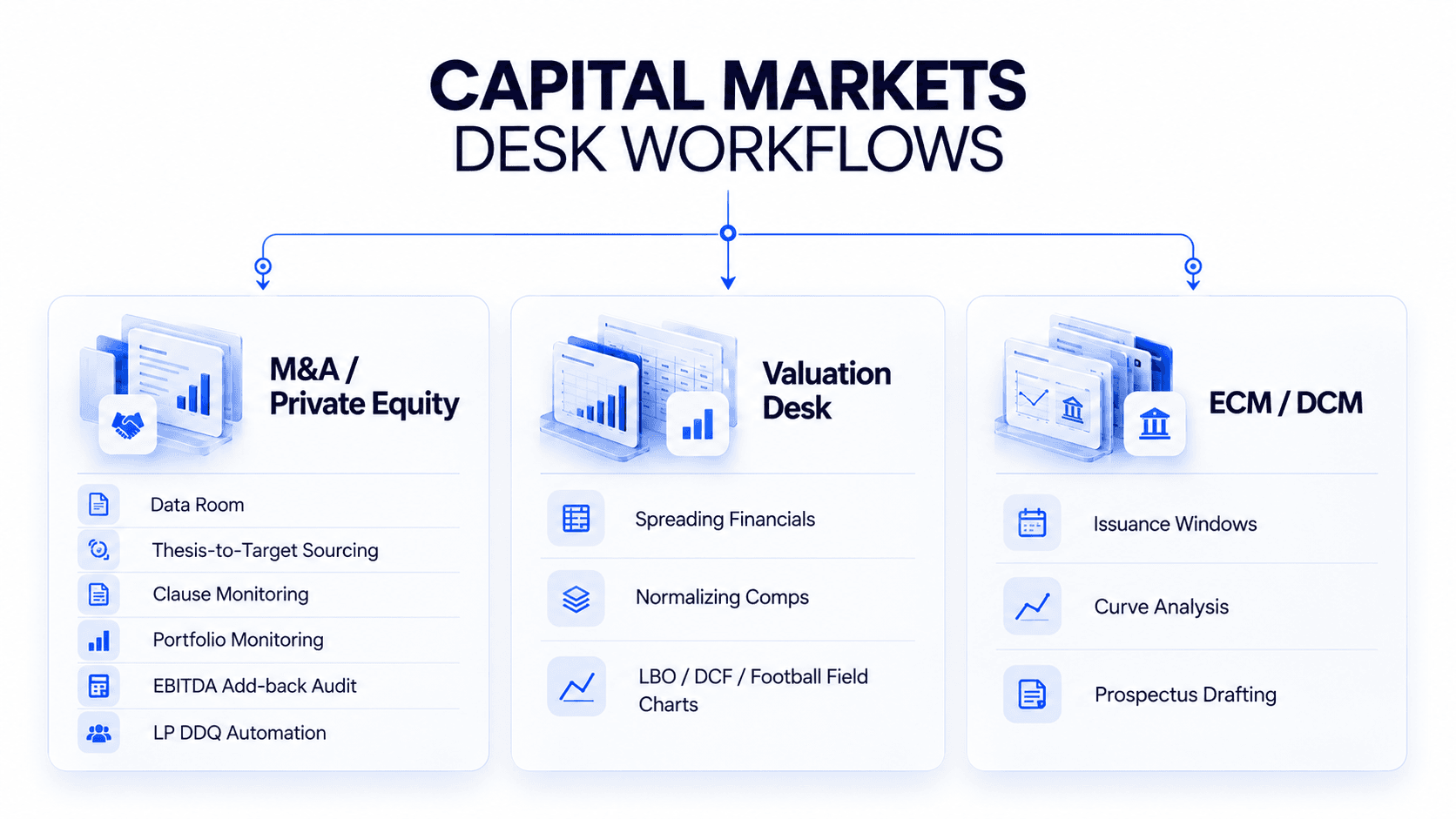
1. The M&A Due Diligence Desk
In traditional M&A due diligence, junior bankers spend weeks reviewing virtual data rooms containing tens of thousands of unstructured files. The M&A agent swarm automates document triage, line-item reconciliation, and clause extraction:
EBITDA Add-back Audit: The swarm systematically identifies every management adjustment, categorizes non-recurring expenses, and surfaces footnoted claims for human review.
Contract Risk Triaging: Across thousands of vendor and customer contracts, agents automatically highlight change-of-control triggers, assignment restrictions, and customer concentration thresholds.
Red Flag Summary: Synthesizes cross-document discrepancies between preliminary teaser claims and audited financial statements into an actionable screening note.
2. Financial Modeling Automation & Valuation Comps
Manual financial statement spreading is one of the most tedious tasks in investment banking. The financial modeling automation swarm executes quantitative extraction with zero mathematical guessing:
Normalized Financial Spreading: Ingests multi-period balance sheets, income statements, and cash flow statements, standardizing accounting variations across target entities.
Trading Comps & Precedents: Automatically pulls peer metrics, trading multiples, and transaction precedents, populating valuation tables without manual copy-pasting.
Dynamic Valuation Output: Feeds cleaned underlying metrics directly into LBO, DCF, and football field valuation chart structures.
3. Equity Capital Markets (ECM) & Debt Capital Markets (DCM)
Capital markets desks require rapid synthesis of public filings, market conditions, and regulatory disclosures:
Issuance Window Analysis: Agents evaluate market volatility metrics, peer issuance performance, and macroeconomic indicators to recommend optimal capital raising windows.
Yield Curve & Covenant Parsing: In DCM, agents analyze existing debt structures, evaluate bond covenants, and model debt service impact across varying interest rate scenarios.
Prospectus Drafting: Automates initial drafting for registration statements and offering circulars, linking every disclosure statement back to verified company filings.
4. AI for Private Equity: Sourcing to Holding Period
In private equity, agent swarms operate continuously across the entire investment lifecycle:
Thesis-Driven Deal Sourcing: Converts investment thesis parameters (e.g., founder-owned B2B software targets in Southeast Asia with 10M–50M ARR) into target lists, ranking matches with clear rationale.
IC Memo Preparation: Assembles diligence findings into structured investment committee memos, taking drafting times down from days to hours.
Portfolio Monitoring & Value Creation: Post-acquisition, agents standardize monthly financial reporting across diverse portfolio companies, flagging margin compression, customer churn, or budget variances for operating partners.
5-Step Strategic Framework: Implementing Agentic AI Without Pilot Fatigue
To avoid getting trapped in endless proof-of-concept cycles, financial institutions should implement multi-agent platforms using a structured, phased methodology: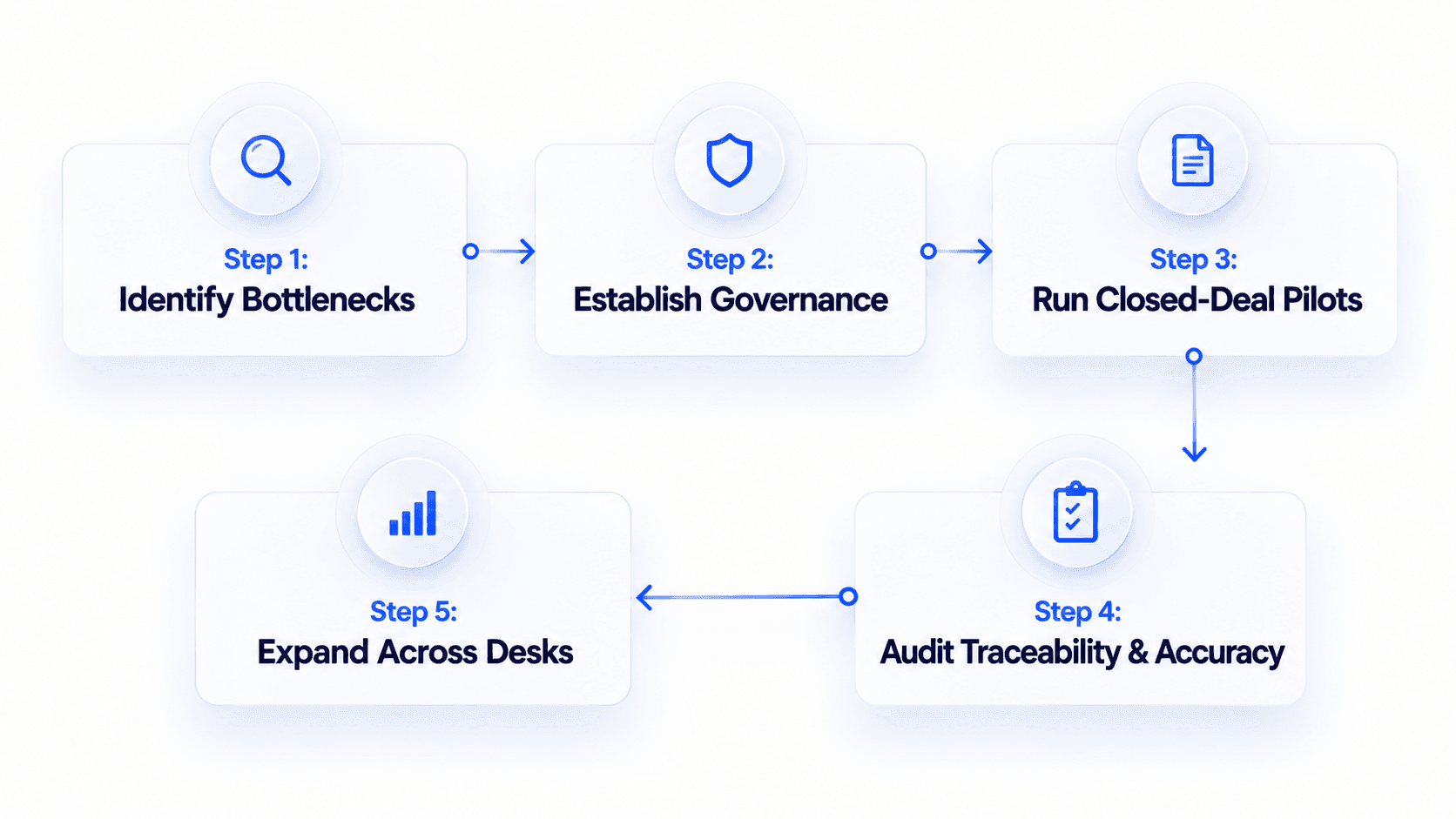
Step 1: Identify the Highest-Volume Bottleneck
Map analyst time allocation across deal teams. Identify recurring, document-heavy workflows with clear outputs—such as CIM screening, trading comps creation, or M&A due diligence document parsing.
Step 2: Establish Data Governance & Model Sovereignty
Settle data privacy and security requirements before testing tools. Ensure the platform provides model-agnostic deployment options, allowing your firm to run agent workflows on top of hosted private models or existing enterprise subscriptions with complete SOC 2 compliance.
Step 3: Run Parallel Pilots on Closed Transactions
Never test new agent infrastructure on live, high-stress transactions. Run the multi-agent swarm on a transaction your firm completed six months ago. Compare the swarm's speed, accuracy, and line-item attribution against the historical work delivered by human analysts.
Step 4: Measure Traceability and Correction Time
Evaluate success based on auditability rather than prose generation. Did the agent swarm provide deterministic line-item citations for every metric? How much manual correction was required from senior team members?
Step 5: Expand Deployment with Named Human Approvers
Once validated, roll out specialized agent swarms across desks. Formalize workflow rules requiring designated human professionals (managing directors, partners, or senior associates) to review and sign off on all agent-generated deliverables.
Comparing Financial AI Architectures
Understanding the structural differences between legacy tools, generic chatbots, and sovereign multi-agent swarms is essential for enterprise procurement: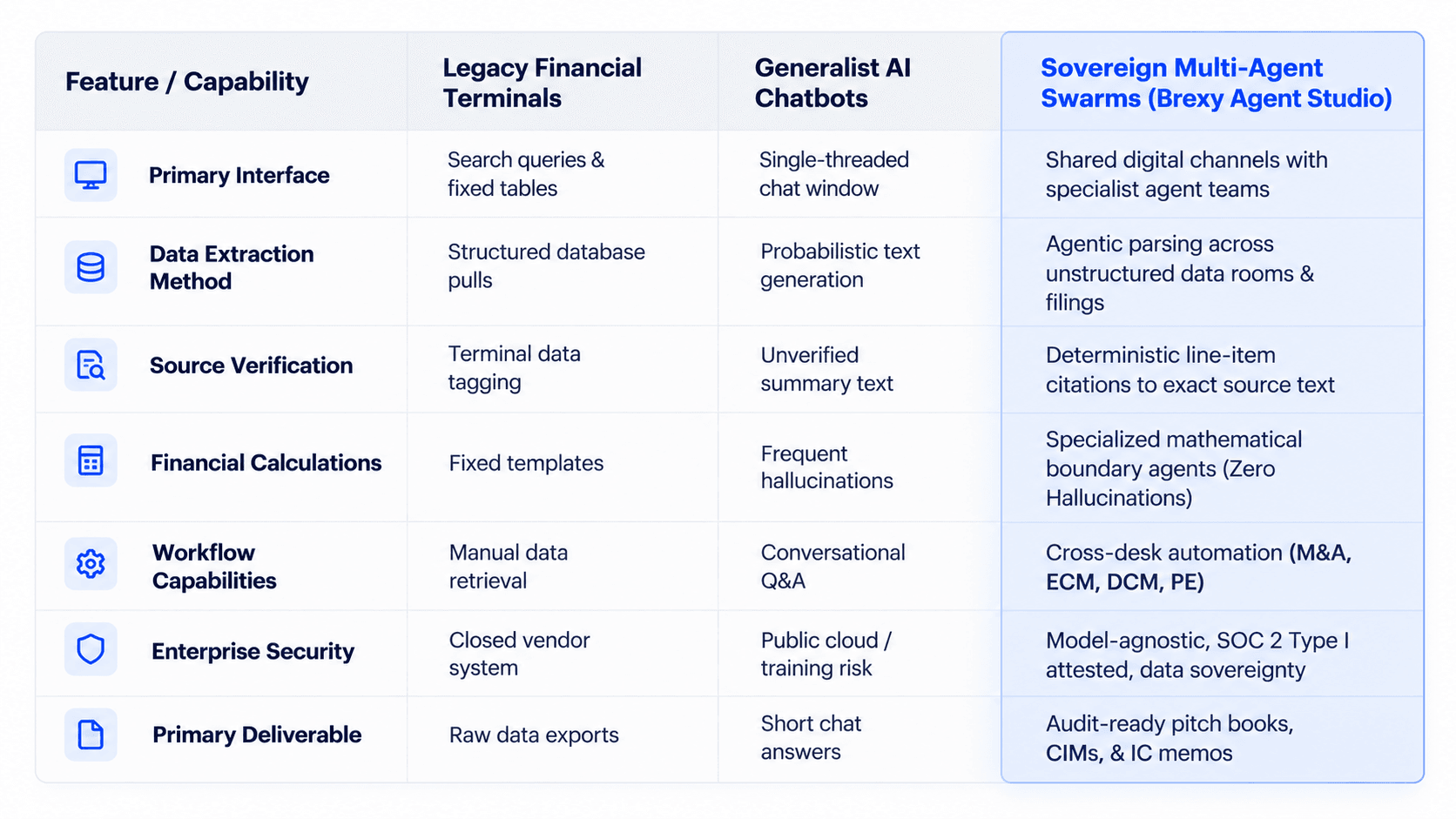
Why Human Judgment Remains Sovereign
Eliminating the manual 100-hour pitch book grind does not mean replacing human deal makers. On the contrary, it elevates their role.
In Brexy Agent Studio, human judgment remains 100% sovereign. Specialist AI agents take over the heavy, repetitive information processing: reading thousands of data room pages, extracting figures, standardizing financials, and compiling initial draft structures.
This frees human professionals to focus on the high-value aspects of capital markets that software can never replicate:
Evaluating qualitative management capabilities and founder vision.
Structuring creative transaction terms and capital structures.
Building deep, trust-based client relationships across Singapore, Wall Street, and global financial centers.
Negotiating complex valuation gaps and transaction terms.
Making final risk-weighted investment decisions.
No pitch book, CIM, or investment committee memo generated inside Brexy Agent Studio can be exported or distributed without explicit sign-off from an authorized human deal maker.
The Era of Agentic Execution Is Here
The 100-hour pitch book is dead because institutional deal teams can no longer afford to burn thousands of valuable analyst hours on manual data spreading and alignment formatting.
By transitioning from basic conversational chatbots to sovereign multi-agent swarms, capital markets institutions are collapsing deal execution timelines from weeks to hours, removing hallucination risks, and providing their professionals with modern tools for high-stakes decision making.
Deploy pre-built agent teams, experience zero-hallucination financial processing, and transform how your deal teams operate.
Frequently asked questions
What is pitch book automation in investment banking?
Pitch book automation refers to using specialized software and sovereign multi-agent swarms to automate the time-consuming tasks involved in pitch book creation. This includes financial statement spreading, trading comps generation, precedent transaction gathering, market mapping, and slide formatting, allowing investment banking analysts to focus on higher-level strategic analysis.
Why do traditional AI chatbots fail at creating financial pitch books?
Generalist AI chatbots fail in capital markets because they rely on single-threaded conversational prompt boxes that frequently generate hallucinated metrics, lack deterministic line-item citations, and cannot process multi-document data rooms simultaneously. Complex deal execution across M&A, ECM, and DCM requires coordinated multi-agent workflows rather than conversational chat answers.
How do AI agents eliminate hallucinations in pitch book preparation?
Brexy Agent Studio eliminates hallucinations by enforcing deterministic line-item citations. Every financial figure, EBITDA multiple, or covenant detail extracted or calculated by the sovereign multi-agent swarm provides a direct hyperlink back to the audited source page, paragraph, and line item in the underlying filing or prospectus.
Can AI agents handle complex financial modeling and valuation comps?
Yes. Specialized agents within a multi-agent swarm can parse raw SEC filings, normalize financial metrics, separate reported EBITDA from management adjustments, and populate DCF, LBO, and trading comps models automatically while maintaining enterprise data auditing standards.
How do multi-agent swarms differ from single-agent chatbots?
A single chatbot attempts to solve an entire complex task in one prompt window. A sovereign multi-agent swarm breaks a complex workflow into distinct roles (e.g., Lead Orchestrator, Financial Spreader, Contract Auditor, Market Researcher). These specialized agents co-work concurrently in shared channels, passing verified outputs to one another just like a physical deal team.
What role do human bankers play when using Brexy Agent Studio?
Human professionals retain full sovereignty and final decision-making authority. AI agents for investment banking perform the heavy lifting of reading, extracting, reconciling, and drafting, but no pitch book, confidential information memorandum (CIM), or investment committee memo is published or sent to clients without explicit sign-off from an authorized human deal maker.
Is it secure to upload confidential M&A deal documents into Brexy Agent Studio?
Yes. Brexy AI is built for regulated financial institutions and is SOC 2 Type I attested. The platform is model-agnostic, meaning proprietary deal data can be processed on top of a firm's existing model subscriptions or hosted private cloud infrastructure without data leaking or being used for LLM training.
How long does it take to generate a pitch book using AI agents?
While traditional pitch book drafting can take junior banking teams up to 100 hours over several days, deploying a sovereign multi-agent swarm in Brexy Agent Studio reduces the initial research, data room parsing, valuation spreading, and slide drafting phase to under one hour, requiring only human review and final adjustments.
Which desks benefit most from AI agent teams?
Agent teams are designed for cross-desk collaboration across institutional finance, including M&A due diligence, Equity Capital Markets (ECM), Debt Capital Markets (DCM), private equity deal sourcing, credit risk analysis, and portfolio monitoring.