 Agent Studio
How AI Agent Teams Transform PE, VC, and Investment Banking
Explore how AI agents automate investment research, deal sourcing, due diligence, financial modeling, and portfolio monitoring across PE, VC, and investment banking.
The New Era of AI Agents for Investment Research
In institutional capital markets, investment associates and analysts have long shouldered the manual administrative drag of deal execution. From parsing 300-page confidential information memorandums (CIMs) to cross-referencing footnote disclosures and building valuation models, the traditional apprenticeship model in private equity, venture capital, and investment banking has relied heavily on late-night human leverage.
As agentic AI in finance evolves beyond generic chat interfaces, AI agent teams are stepping in as the new digital "associates" for institutional deal teams. By deploying a specialized digital analyst AI agent for investment research, firms can eliminate monotonous grunt work, accelerate investment research automation, and liberate investment associates to focus on high-value convictions, deal structuring, and founder relationships.
What Is an AI Agent Team in Investing?
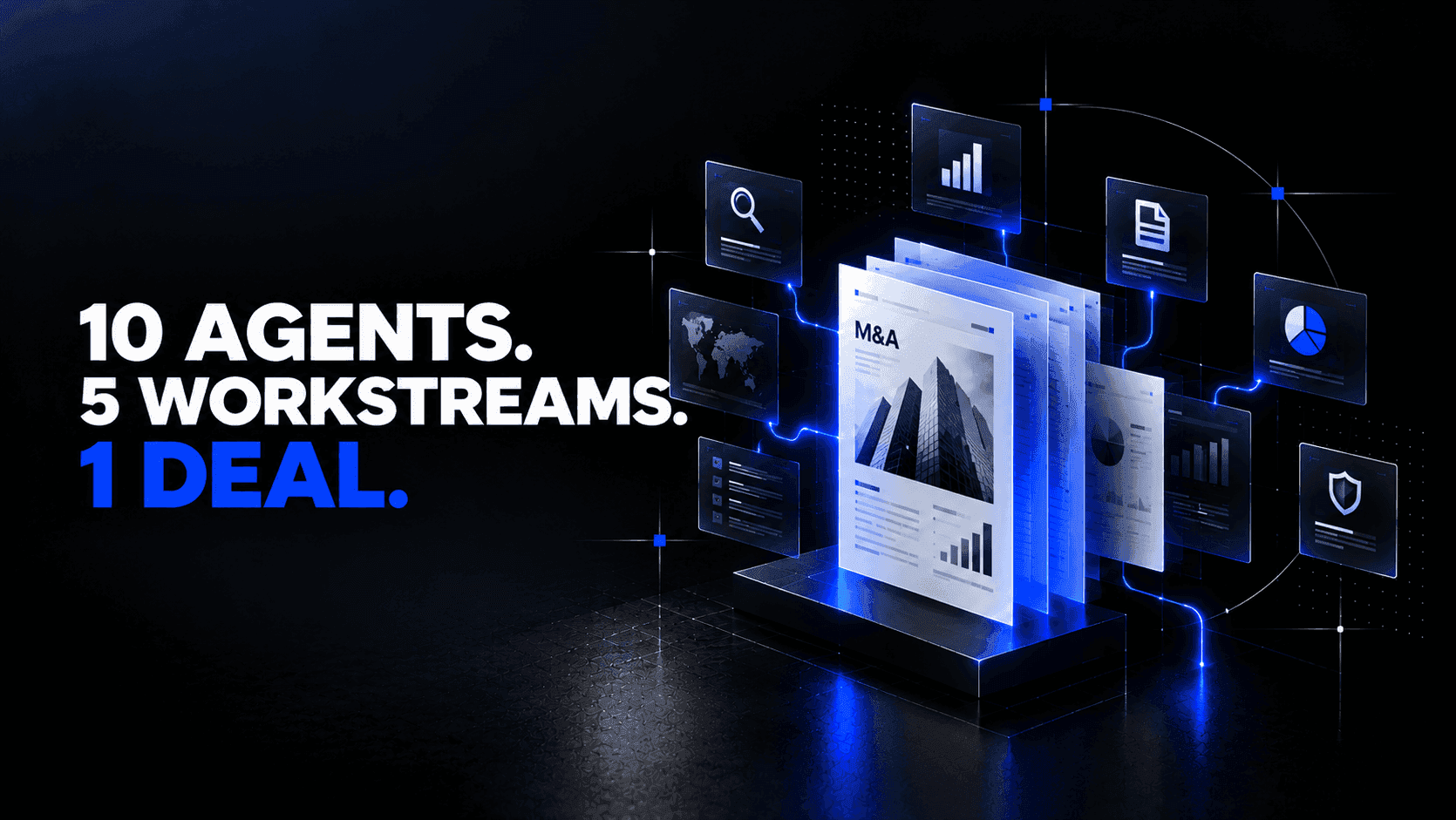
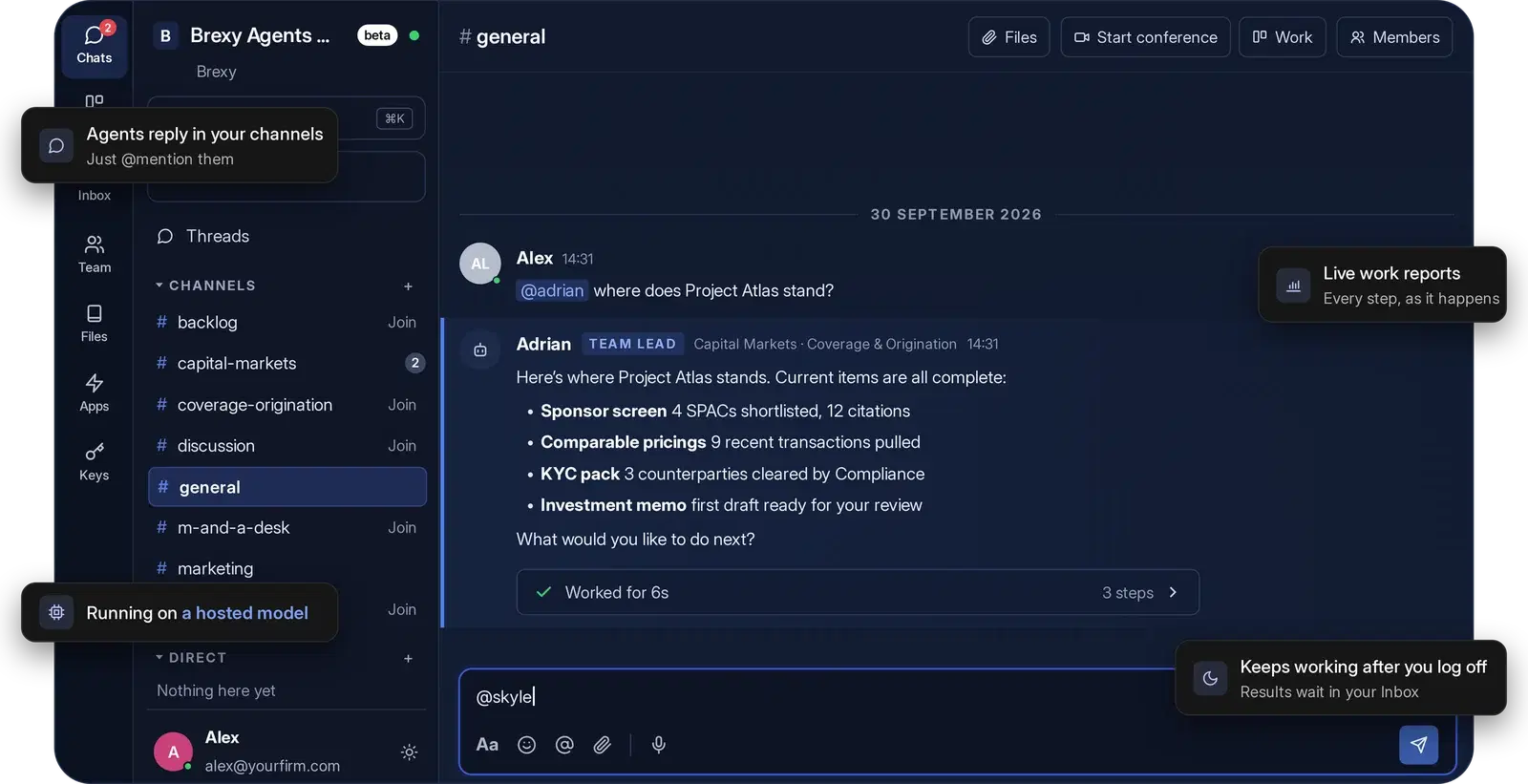
An AI agent team is a synchronized network of specialized AI workers designed to execute complex, multi-step financial workflows under human guidance. Rather than relying on a single, generalist AI chatbot, investment firms deploy dedicated AI agents for investment research where each agent manages a specific stage of the operational sequence.
Core Roles Across an AI Agent Team
AI Deal Sourcing Agent: Scans startups, sector announcements, funding rounds, and market signals for automated AI deal sourcing.
Investment Research Agent: Collects company profiles, historical financials, market reports, and competitive positioning for market intelligence AI.
AI Due Diligence Agent: Scans virtual data rooms, executes automated data room analysis, and flags missing legal disclosures or contract risks.
Financial Analysis Agent: Normalizes GAAP and non-GAAP financials, assists with financial modeling automation, and identifies balance sheet anomalies.
Investment Committee Memo Agent: Synthesizes multi-agent outputs into a structured investment committee memo complete with direct line-item citations.
Portfolio Monitoring Agent: Tracks post-investment KPIs, operational risks, and market news using portfolio monitoring AI.
Human Investor: Functions as the ultimate supervisor, exercising judgment, validating assumptions, and making final investment decisions.
Chatbots vs. AI Agent Teams: Why the Structural Difference Matters
Traditional AI chatbots operate on simple prompt-response loops. While a generalist bot can summarize text, an AI agent team executes end-to-end strategy across investment banking automation workflows.
The true value lies in multi-agent orchestration: one agent extracts raw filings, another validates numbers, a third conducts financial statement analysis, and a fourth formats the final deliverable. This eliminates manual hand-offs and shifts institutional focus from data assembly to high-level strategic interpretation.
How AI Agent Teams Fit Into the Investment Lifecycle
From initial deal screening to post-close portfolio management, deploying AI in private equity and venture capital accelerates turnaround times while preserving analytical rigor.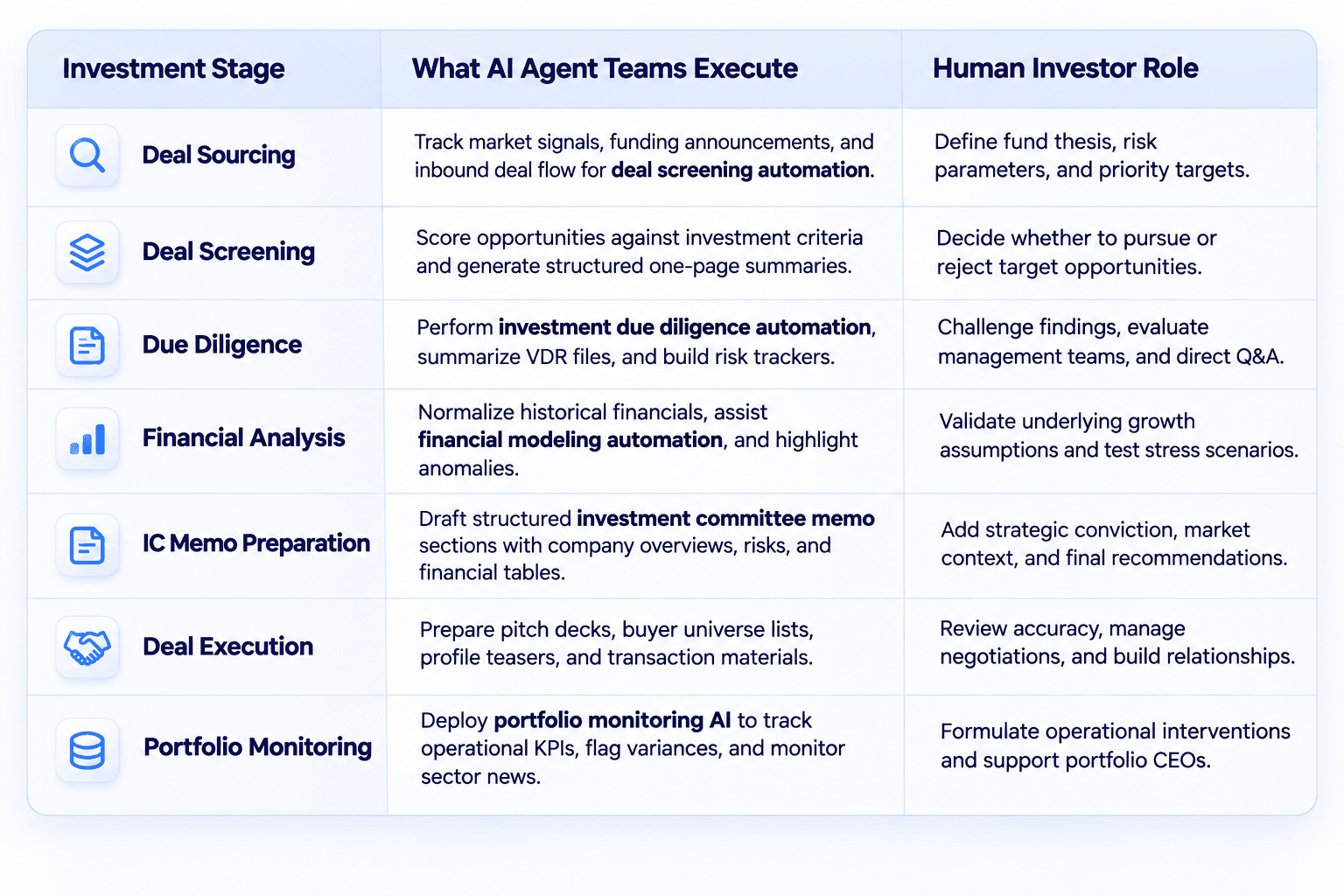
Practical Applications: AI in Private Equity and Venture Capital
Venture Capital AI Workflows
Automated Pitch Deck Screening: Screen inbound startup decks against active fund thesis criteria using deal screening automation.
Founder & Market Profiling: Synthesize founder backgrounds, customer traction, TAM size, and competitive threats automatically.
Missing Metric Detection: Flag inconsistent valuation claims or incomplete financial metrics prior to partner meetings.
Drafting First-Pass IC Memos: Generate structured initial draft memos alongside targeted management question lists.
Private Equity AI Tools
Financial Extraction & Standardization: Automate historical financial extraction across non-standard target company reporting.
Margin & Working Capital Auditing: Identify customer concentration risks, revenue churn signals, working-capital spikes, and non-GAAP add-back anomalies.
VDR & CIM Document Analysis: Execute deep data room analysis across CIMs, IP disclosures, vendor diligence reports, and regulatory filings.
Portfolio KPI Monitoring: Deploy private equity AI tools to track portfolio company performance metrics and flag margin degradation early.
What AI Agent Teams Replace (And What Requires Human Oversight)
Deploying AI agents for investment research accelerates manual labor, but maintaining strict AI governance in investing requires a continuous human-in-the-loop AI architecture.
What AI Agent Teams Accelerate
High-volume document parsing and VDR folder indexing.
Financial statement normalization and formula inputs.
First-draft investment committee memo assembly.
KPI tracking and automated market news scanning.
What Remains Purely Human
Investment Conviction: Qualitative evaluation of founder integrity, team dynamics, and market intuition.
Relationship Building: Negotiating terms, building rapport with founders, and managing board relations.
Strategic Judgement: Assessing macro market cycles, reputational risk, and complex deal structuring.
Final Decision Accountability: Exercising critical approval authority and standing behind investment decisions.
How to Deploy AI Agent Teams in Your Firm
To safely implement agentic AI in finance, investment firms should follow a structured execution roadmap:
Select a Single Pilot Workflow: Start with a document-heavy process such as deal screening automation, data-room summarization, or first-draft investment committee memo preparation.
Define the Exact Deliverable: Specify output standards, whether a one-page deal teaser, a diligence risk matrix, or an LBO model input sheet.
Connect Enterprise Data Sources: Integrate secure VDR repositories, CRM platforms, SEC filing feeds, and internal research databases.
Establish Strict AI Governance: Set clear permission boundaries, define escalation triggers, and enforce AI governance in investing standards.
Enforce Line-Item Citations: Require every output claim and metric to link directly back to a verifiable source document page or cell.
Maintain Human Accountability: Ensure an investment associate or partner reviews exceptions, validates assumptions, and approves final outputs.
Measure Operational ROI: Track time-to-screen metrics, diligence turnaround velocity, and risk identification precision.
Conclusion: AI Agent Teams for Scalability, Humans for Discernment
The future investment associate is not disappearing; their role is evolving toward high-level AI orchestration. Instead of spending 80% of their day collecting and formatting data, associates will direct AI agent teams, cross-check research findings, cultivate founder relationships, and sharpen strategic investment theses.
By pairing human discernment with sovereign multi-agent automation, investment teams can scale pipeline capacity ten-fold without adding administrative headcount.
Ready to transform your investment workflows? Try Brexy AI today and request a demo to deploy your first agentic deal team.
Frequently asked questions
What is an AI agent team in investment research?
An AI agent team is a network of specialized AI agents for investment research that collaborate on multi-step workflows like deal screening, due diligence, financial statement normalization, and IC memo drafting.
Can AI agents replace investment associates?
No. While AI agent teams automate repetitive document review and data formatting, human investment associates remain indispensable for strategic conviction, negotiation, founder relationship building, and final investment judgment.
How do AI agent teams assist with due diligence?
They execute automated investment due diligence automation by scanning virtual data rooms, extracting key metrics, flagging missing disclosures, identifying contract risks, and building diligence trackers with line-item citations.
Are AI agents useful for private equity and venture capital?
Yes. Venture capital AI workflows focus on inbound deck screening, founder background analysis, market research, and draft IC memos. Private equity AI tools assist with financial statement normalization, VDR risk auditing, customer churn detection, and portfolio KPI tracking.
Can AI agents write an investment committee memo?
They can generate structured first-pass drafts containing company overviews, financial summaries, industry benchmark tables, and risk flags. However, human investors must review, challenge, and add qualitative conviction to finalize the investment committee memo.
How do you keep AI agent teams accurate and compliant?
By implementing strict AI governance in investing, utilizing approved enterprise data sources, enforcing human-in-the-loop AI review controls, and requiring direct line-item citations for all extracted data.
What is the best first use case for deploying AI agents in an investment firm?
The most effective starting point is deal screening automation or VDR data room analysis. Both workflows are document-heavy and yield immediate, measurable time savings without removing human decision accountability.