 Agent Studio

Is This The End of Prompting? How AI Agent Teams Automate Financial Work
Discover why finance leaders are moving from one-off prompts to AI agent teams. Learn how to delegate tasks to AI agents for financial reconciliation automation, month-end close automation, and financial reporting automation.
A prompt gets you a draft. A delegation gets you a finished deliverable. That distinction is quietly revolutionizing how modern finance operations handle closings, balance sheet reconciliations, and executive board reporting.
Just when corporate controllers and CFOs were learning how to query large language models with prompts, the paradigm shifted. Modern finance leaders are no longer satisfied with single-turn chatbots that deliver disconnected answers. Instead, AI agents in finance have leveled up to execute complex, multi-step financial work automation, simultaneously coordinating accounts payable automation, three-way invoice matching, balance sheet reconciliations, variance analysis, and audit trail preparation.
The era of basic prompting has reached its structural limits. In 2026, the competitive advantage belongs to organizations that master AI workflow automation by deploying coordinated AI agent teams.
Crucially, agentic AI in finance is not designed to replace financial analysts and controllers; it is designed to eliminate manual data entry, allowing professionals to supervise outcomes rather than burning out on administrative grunt work.
Most finance leaders have run the same early experiment: someone pastes a trial balance into a general chatbot, asks for a variance summary, and receives an impressive paragraph in seconds. It feels like a breakthrough. But that illusion shatters when you are confronted with forty bank accounts to reconcile, three ERP subledgers to tie out, and a strict month-end close automation calendar that cannot rely on copy-pasting answers between browser tabs.
This marks the fundamental operational gap between prompting and delegating. A prompt retrieves unstructured text; learning to delegate tasks to AI agents produces an audit-ready financial deliverable. That distinction explains why high-performing teams are replacing isolated chatbots with autonomous AI agent teams, coordinated, supervised systems that manage end-to-end finance operations while preserving human review and AI governance in finance.
Why One-Off Prompts Fail at True Financial Work Automation
Prompting is an interactive tool, but it possesses an inherent operational bottleneck: every prompt is a single-turn interaction. A human analyst must provide the contextual background, verify the output against source files, paste it into an ERP or spreadsheet, and engineer the subsequent prompt. The human remains the manual bottleneck stitching disconnected steps together.
Institutional finance operations are never single-step tasks. Consider a standard operational workflow in financial reconciliation automation:
Ingest raw bank feeds, ERP subledgers, and credit card gateway exports.
Normalize disparate currency, date, and transaction formats.
Apply rule-based transaction matching across thousands of line items.
Investigate timing breaks and currency variances across systems.
Propose adjusting journal entries with explicit supporting documentation.
Route high-materiality breaks to the controller for formal sign-off.
A standard conversational chatbot can summarize an individual break, but it cannot execute the entire sequence. This structural limitation explains why so many early pilots for finance automation stall after initial demos. While task speed improves slightly, overall cycle time remains stagnant because manual handoffs remain untouched.
The Three Structural Breakdowns of Prompt-Based Automation:
No Process Memory: Each conversational session starts without persistent context. Organizational policies, materiality thresholds, and chart-of-accounts rules must be re-entered repeatedly.
No Immutable Audit Trail: Chat logs fail regulatory compliance checks. A financial auditor cannot rely on unverified conversational text that lacks deterministic data provenance.
No Ownership of Outcomes: A language model answers only the immediate question asked; it assumes zero accountability for whether an entire ledger reconciliation is completely reconciled.
Solving these operational bottlenecks requires specialized architecture: AI agents for accounting built with distinct functional roles, unified working context, and continuous human-in-the-loop AI supervisory controls.
What Are AI Agent Teams? Understanding Agentic AI in Finance
AI agents in finance are autonomous software systems engineered to achieve explicit operational objectives across complex, multi-step environments. They read unstructured documents, connect directly to ERP data integration endpoints, navigate financial spreadsheets, execute rule-bounded logic, and maintain full activity logs.
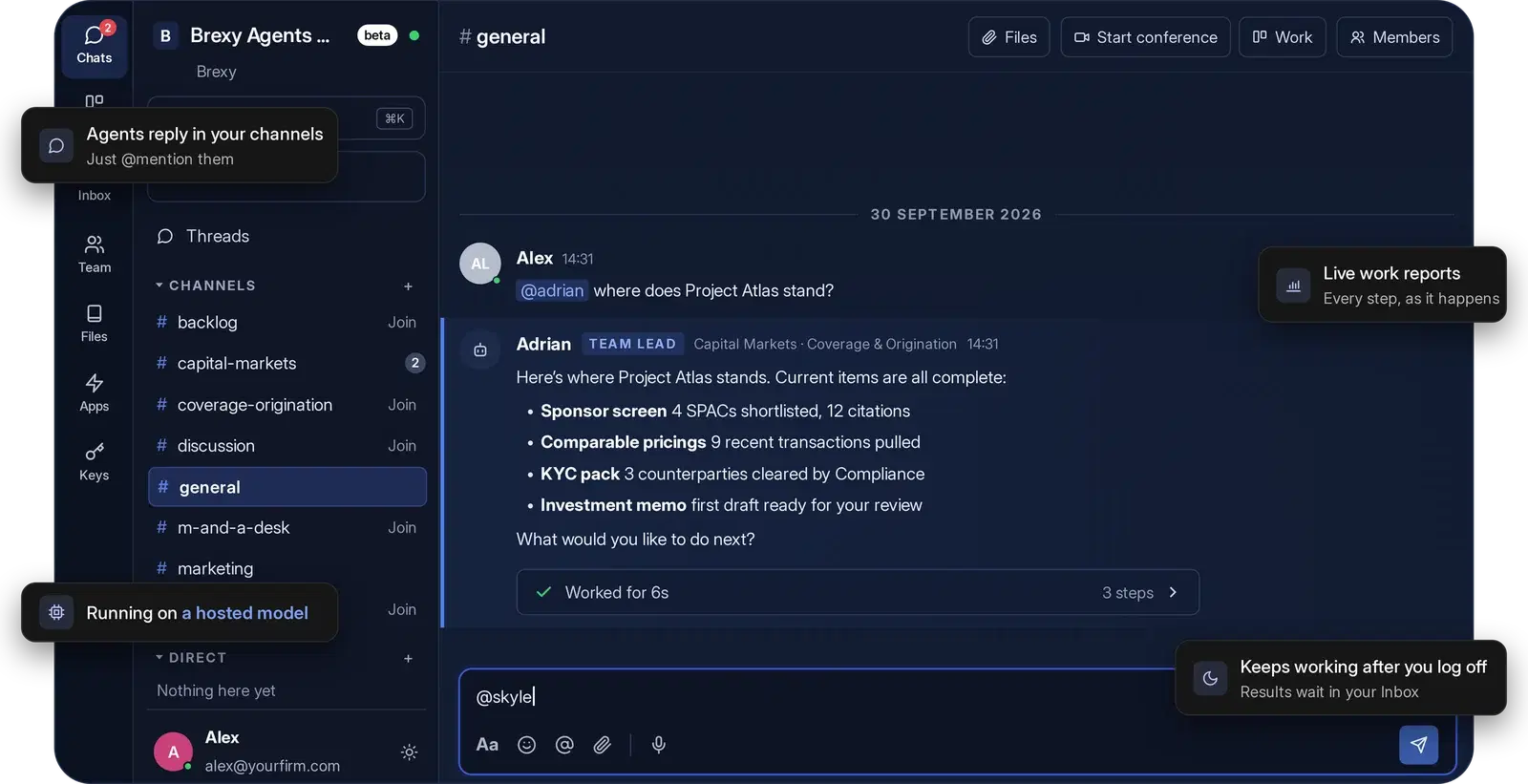
Unlike a standard chatbot, an agent does not pause for manual instructions at every turn. It scopes the required assignment, plans the analytical steps, executes the workflow, and flags operational exceptions for management review.
AI agent teams scale this capability across an enterprise. Rather than deploying a single monolithic model to handle every task, organizations configure modular swarms of specialized AI agents for accounting that collaborate like an institutional accounting department:
Data Collection Agent: Automatically pulls bank statements, subledger exports, invoice PDFs, and vendor documentation from secure portals.
Matching & Reconciliation Agent: Executes financial reconciliation automation, applies tolerance thresholds, and isolates unreconciled discrepancies.
Investigation Agent: Researches ledger variances, cross-checks vendor payment histories, and drafts proposed adjusting journal entries.
Compliance & Review Agent: Evaluates proposed journal entries against corporate accounting policy, verifies supporting documentation, and prepares audit-ready binders.
Workflow Coordinator Agent: Directs execution sequencing, monitors close calendar milestones, and escalates edge cases to senior controllers.
This collaborative structure represents the true power of agentic AI in finance. The objective is not to build a single infallible model, but to mirror real-world accounting workflows through specialized division of labor, peer review, and continuous supervisory oversight—at institutional speed and scale.
Prompting vs. Delegating: How to Delegate Tasks to AI Agents
Learning to delegate tasks to AI agents requires the same management discipline used when onboarding a junior financial analyst. The critical skill shifts from clever prompt engineering to rigorous operational specification.
Prompting vs. Delegating in Enterprise Finance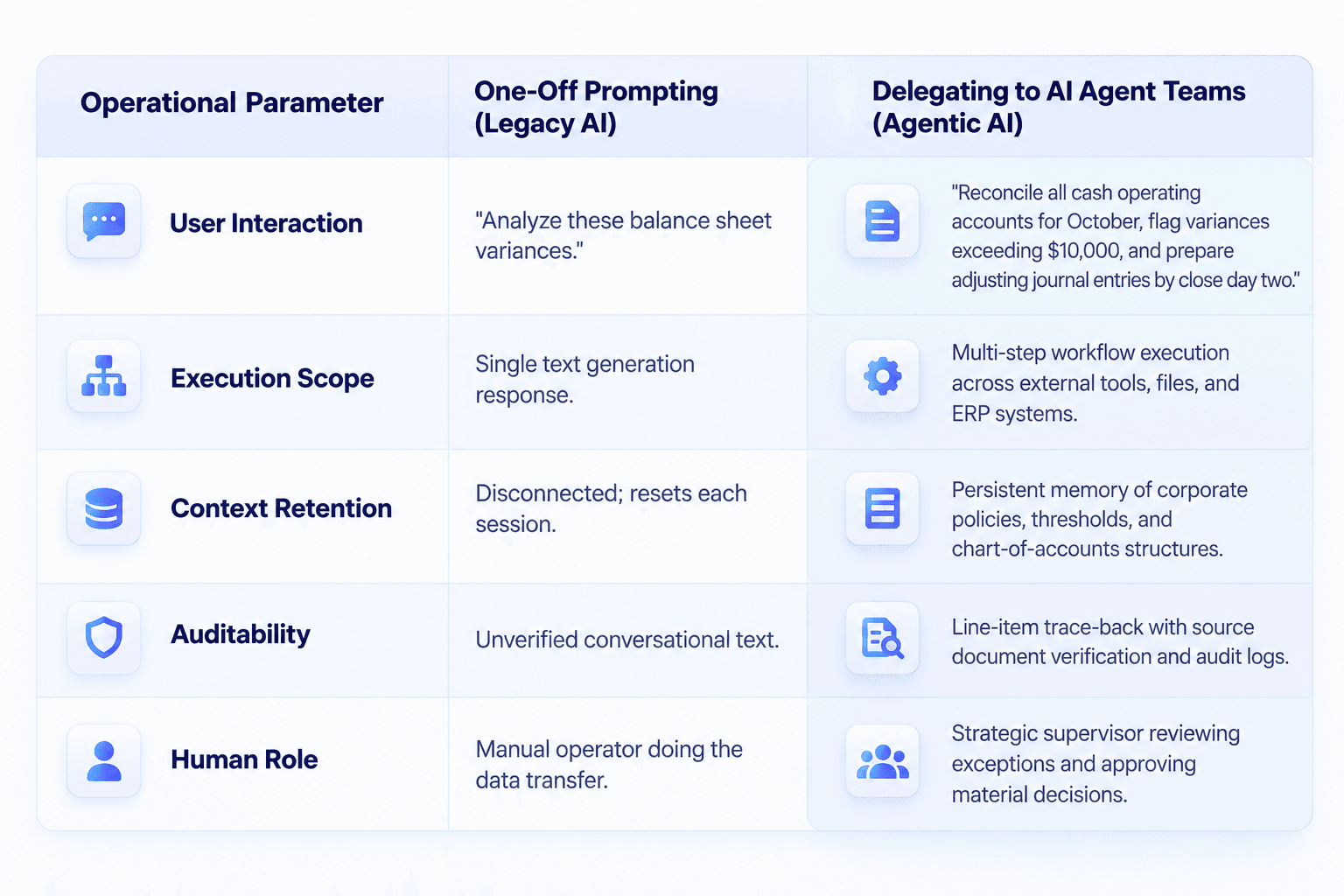
When you delegate tasks to AI agents, you establish five operational guardrails:
The Defined Outcome: Establish clear completion criteria (e.g., "Complete the three-way AP match for October and generate the exception schedule").
The Decision Rules: Codify operational tolerances, approved journal entry types, variance thresholds, and account structures.
The Operational Boundaries: Explicitly define autonomous execution limits versus actions that mandate human approval (e.g., auto-reconcile breaks under $500, but require controller sign-off for any balance write-off).
The Audit Standard: Mandate that every generated calculation or proposed adjustment links directly to underlying transaction line items.
The Escalation Path: Define exact notification routing when policy conflicts, duplicate invoices, or system breaks are detected.
Because financial controllers already understand control environments and procedural rigor, they are uniquely equipped to direct AI workflow automation far more effectively than software developers.
High-Value AI Agent Use Cases Across Finance Operations
The most profitable AI agent use cases share four characteristics: high transaction volume, strict procedural rules, multi-step dependency chains, and heavy manual handoff friction.
1. Financial Reconciliation Automation
Traditional rule engines struggle when reference numbers are missing or payment formats differ. With financial reconciliation automation, agents autonomously clear the straightforward 90% of bank, intercompany, and subledger transactions. For remaining breaks, agents investigate remittance slips, evaluate timing discrepancies, draft adjusting entries, and present the reviewer with a prioritized exception queue rather than an unstructured mess.
2. Month-End Close Automation
Close management is primarily an operational coordination challenge. Deploying month-end close automation via specialized agents enables real-time tracking of close checklist items, automatic follow-ups with task owners, pre-close accrual calculations, and early notification of critical path delays. Controllers obtain live visibility into close velocity without running manual daily sync meetings.
3. Accounts Payable Automation
While legacy OCR solutions frequently fail on non-standard invoice formats, modern accounts payable automation powered by agents introduces cognitive adaptability. Agents perform automated three-way matching against purchase orders and receiving documents, chase missing approvals across departments, and detect potential duplicate billings or fraudulent vendor bank details before payment runs occur.
4. Financial Reporting Automation
The final mile of financial consolidation is notoriously labor-intensive. With financial reporting automation, agents ingest validated trial balances, assemble board-ready management reporting packages, update operational commentary based on actual financial drivers, verify mathematical consistency across schedules, and generate initial MD&A drafts for CFO review.
5. Cash Flow Forecasting AI
Static cash models built manually in spreadsheets are outdated the day they are finished. Cash flow forecasting AI leverages agents that continuously read accounts receivable aging buckets, supplier payment schedules, and real-time bank balances. Treasurers receive dynamic, rolling working capital forecasts that explain week-over-week liquidity fluctuations automatically.
6. Exception Handling in Finance
The greatest drain on accounting team capacity lies in edge cases—unidentified wire transfers, entries that violate accounting policy, and sudden margin anomalies. In exception handling in finance, agents triage unusual items, compile relevant transaction history, formulate proposed remediation steps, and assign them directly to the appropriate stakeholder.
Overseeing & Governance of AI in Finance
Finance operations cannot permit unmonitored automation. Implementing human-in-the-loop AI does not impede operational velocity; it concentrates senior executive judgment precisely where risk is highest.
Robust AI governance in finance requires five non-negotiable architectural controls:
Tiered Operational Autonomy: Agents execute low-risk, reversible tasks independently (e.g., transaction matching under materiality limits), compile proposals for medium-risk tasks, and operate strictly as recommendation engines for high-risk decisions.
Segregation of Duties: The specific agent that compiles an adjusting journal entry must never possess permission to approve or post it to the general ledger. Controls must replicate institutional accounting policies.
Comprehensive Audit Trails: Every system query, analytical calculation, data transformation, and human approval must be permanently recorded in an immutable audit ledger, ensuring seamless internal and external audit reviews.
Granular Access Control: Agents must operate under strict least-privilege role permissions, utilizing secure credentials and isolated database environments that prevent data contamination.
Drift & Performance Monitoring: Finance operations leaders must track model accuracy, false-positive exception rates, and human override frequencies to continuously optimize operational efficiency.
When implemented with institutional discipline, rigorous governance transforms compliance from a bureaucratic hurdle into a strategic competitive advantage.
Measuring Finance Team Productivity and Real ROI
Deploying AI agent teams is fundamentally about expanding institutional capacity, not merely cutting headcount. Measuring improvements in finance team productivity requires tracking hard operational benchmarks:
Close Cycle Reduction: Days required to close books and post reconciliations.
Labor Reallocation: Hours previously spent on balance sheet reconciliations reallocated to FP&A and variance analysis.
Processing Velocity: Cycle time for three-way invoice matching and payment run authorization.
Data & Audit Quality: Percentage of items touchless-matched without manual human intervention.
Balance Sheet Health: Aging reduction of unallocated breaks and unreconciled suspense accounts.
Audit Minimization: Reduction in post-close audit adjustments and external compliance rework.
When routine manual reconciliations and data-gathering workflows are handled by autonomous agents, finance professionals reallocate their working hours toward commercial negotiations, pricing analysis, strategic forecasting, and operational partnership across business units.
How to Start Your Finance Transformation Safely: An 8-Step Blueprint
Executing a successful finance transformation through finance automation does not require a disruptive overhaul of your entire ERP infrastructure. High-performing teams follow an iterative adoption roadmap:
Select a Contained Workflow: Begin with a high-volume, rules-based operational bottleneck, such as high-frequency bank reconciliations or AP invoice verification.
Document Standard Operating Procedures: Define exact decision trees, variance thresholds, and review gates. This documentation serves as the operational brief for your agent swarm.
Deploy in Shadow Mode: Run the AI agent teams in parallel with existing manual processes to benchmark accuracy, compare conclusions, and validate performance without operational risk.
Establish Strict Guardrails: Enforce explicit limits on transactional authorization, write-off thresholds, and payment execution capabilities.
Introduce Supervised Delegation: Transition low-risk transactional matching to autonomous agents while maintaining mandatory sign-off from human controllers.
Enforce Human-in-the-Loop Reviews: Require mandatory human oversight for material ledger entries, anomalous variance outliers, and regulatory tax disclosures.
Maintain Immutable Logging: Ensure all agent decisions, calculations, and underlying source files are linked for comprehensive AI governance in finance.
Quantify and Scale: Measure reductions in close cycle days, reconciliation backlogs, and manual processing hours before expanding automation into financial reporting and FP&A.
Approaching implementation as an evolution of your operational model ensures that your team embraces agentic systems as powerful virtual assistants that eliminate routine administrative burdens.
The Strategic Shift: From Prompting to Autonomous Execution
Prompting introduced corporate finance to the potential of artificial intelligence. Autonomous delegation is how enterprise finance teams will capture tangible return on investment.
By deploying specialized AI agent teams that manage complete operational workflows—from financial reconciliation automation and month-end close automation to financial reporting automation and exception handling in finance—forward-thinking organizations are leaving manual copy-paste cycles behind.
The finance leaders defining the next decade are not those engineering clever conversational queries. They are the controllers, CFOs, and operations executives who master how to delegate tasks to AI agents with clear outcomes, strict guardrails, and uncompromising human oversight.
If your team is still trapped prompting single questions inside isolated chat windows, it is time to upgrade your operational model. Select a workflow, define what success looks like, and begin delegating.
Automate Your Finance Workflows with Brexy Agent Studio
Accelerate balance sheet reconciliations, eliminate manual close delays, and equip your analysts with autonomous, audit-ready agent swarms.
Start Your 30 Days FREE Trial Now : https://studio.brexy.ai/
Frequently asked questions
What is the difference between prompting AI and delegating to AI agent teams?
Prompting involves a human user querying an AI model for a single text response or summary, requiring continuous manual intervention between steps. Delegating to AI agent teams assigns an autonomous system a multi-step financial outcome—such as reconciling an entire subledger or preparing close schedules—executing across multiple tools within predefined rules and approval thresholds.
What workflows can AI agents in finance automate today?
Modern AI agents in finance excel across high-volume, structured finance operations, including accounts payable automation, bank and balance sheet reconciliations, month-end close automation, cash flow forecasting AI, operational variance analysis, financial reporting automation, and automated exception handling in finance.
Will autonomous AI agents replace finance and accounting professionals?
No. Agentic AI in finance is designed to eliminate high-volume manual execution such as data extraction, transaction matching, and tie-out validation. Finance professionals remain essential for strategic judgment, interpreting accounting policy, business partnering, and providing formal governance through human-in-the-loop AI sign-offs.
How is data security and compliance maintained with AI agents for accounting?
Institutional deployments ensure compliance by implementing AI governance in finance: enforcing SOC 2 compliance, strict zero-data-retention standards, zero model training on proprietary corporate financials, least-privilege role permissions, segregated approval controls, and end-to-end audit logging.
How should an enterprise begin its finance transformation with AI agents?
Organizations should start with an isolated, well-documented process such as three-way invoice matching or cash reconciliation. Run the agent team in shadow mode alongside human analysts to verify analytical accuracy, establish escalation thresholds, and scale execution only after governance controls are proven.
Why is human-in-the-loop AI critical for financial work automation?
Financial reporting demands zero-tolerance accuracy and strict regulatory compliance. A human-in-the-loop AI architecture ensures that while agents accelerate manual preparation and data gathering, human controllers retain final approval over adjusting journal entries, material variances, and audit-sensitive disclosures.
How do AI agent teams accelerate the month-end close?
Through month-end close automation, agents track close checklist dependencies in real time, automate routine accrual calculations, follow up on outstanding task submissions across departments, and flag unlinked ledger breaks early, preventing last-minute reporting bottlenecks.
What is the fundamental difference between an AI chatbot and an AI agent in finance?
A chatbot answers questions via conversation, leaving execution to the user. An AI agent in finance completes the assignment: connecting to ERP databases, executing calculation logic, updating spreadsheets, logging audit trails, and generating deliverables for executive review.