 Agent Studio

Models Got Smarter. Coordination Didn't. Here's What Comes Next.
Smarter models still fail at hand-offs. Learn why AI agent coordination is the next frontier for capital markets teams, and what comes next.
You can now rent the sharpest analyst brain in history for the price of a software subscription. It reads a 400-page data room before your coffee cools. It drafts a clean first pass of a memo in seconds.
And your deal still closes late.
If AI models are this smart, why does the work still feel this slow?
The answer isn't intelligence. It's AI agent coordination: the unglamorous, unsexy, deeply human-looking problem of getting many capable agents to work together as a team. Models got smarter. Coordination didn't. And that gap is where the next era of agentic AI will be won.
The Smartest Model in the Room Still Can't Run the Room
Over the past few years, AI models got dramatically better at reading, reasoning and writing. Every release raised the ceiling on what a single AI agent can do on a single task. “Summarise this filing. Build these comps. Draft this section.”
But deal work was never a single task. It's a chain of them, passed between people with different roles, different tools and different standards of proof. Research feeds valuation. Valuation feeds the deck. The deck feeds the committee. Somewhere in the middle, compliance wants to know where every number came from.
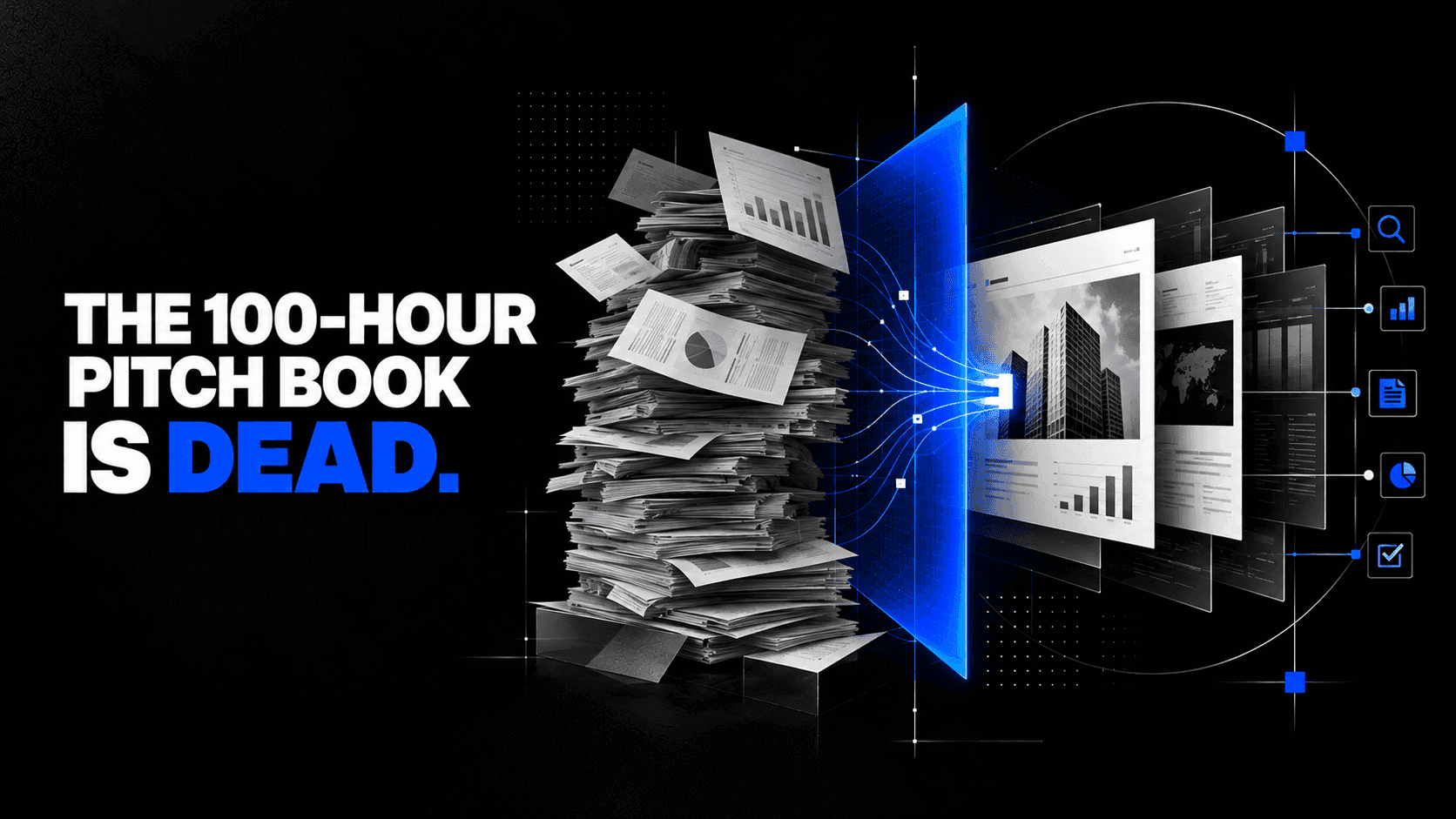
A brilliant model can ace every link and still lose the chain. That's the gap. Model intelligence went up. Multi-agent AI coordination stayed roughly where it was: a human copy-pasting between tabs at 11pm.
Intelligence Is a Component. Coordination Is the System.
Think of any great deal team. It isn't great because it has the single smartest person in the building. It happens to be great because people know who owns what, hand off the work cleanly, share one version of the truth, and flag a problem instead of quietly absorbing it.
Now look at how most teams use AI today. One assistant for drafting. Another for searching filings. A third baked into the slide tool. Each is capable. None talk to the others. The human is the integration layer: the API between the AI tools, paid in sleep.
That isn't an agentic workflow. That's a very expensive game of calling-texting-emailing which is paid with time.
Where Multi-Agent AI Actually Breaks
Most failures in multi-agent AI don't happen inside a model. They happen between them. Four show up again and again:
Lost context. The research agent knows the target restated its revenue. The drafting agent never heard. The deck goes out completely wrong (confidently)
Duplicated work. Two agents, or two people prompting two agents, pull the same comps. Nobody notices until the numbers don't tie.
No shared source of truth. Each tool keeps its own version of the facts, so every output needs reconciling before anyone can trust it.
No owner. When something goes wrong, nobody, human or agent, is clearly responsible for the result.
Notice that none of these are "the model wasn't smart enough". Better reasoning doesn't fix a missing hand-off. You can't prompt your way out of a chart problem.
A Deal Is a Relay, Not a Sprint
Capital markets work, which makes this obvious. A single transaction can cross M&A, equity capital markets, debt capital markets, valuation, deal execution and compliance. Each has its own language and its own checkpoints. It is not about any one lap. It's the passing of the baton that matters.
In human teams, we solved this with roles, channels, process and seniority. Analysts brief associates, associates brief VPs, and everyone knows who signs off. Agentic AI needs the same scaffolding, or it just produces more fast work that nobody can trust.
This is why "give everyone a chatbot" hasn't transformed deal teams the way the demos promised.
A chatbot answers a question.
A deal needs a team.
What Good AI Agent Coordination Looks Like
If coordination is the missing layer, what does it look like when it works?
Five principles keep showing up.
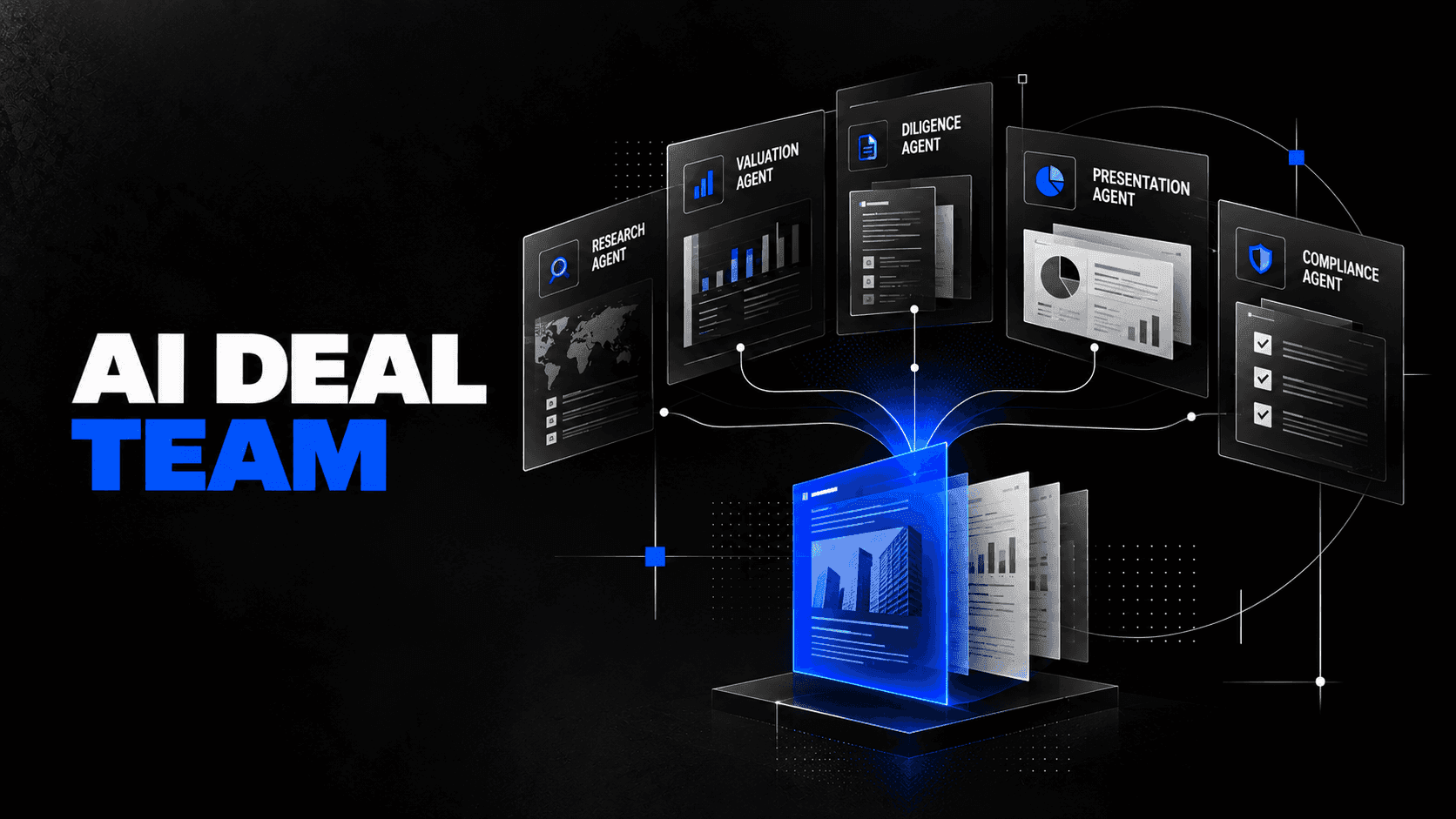
1. Specialists, not generalists. An agent built for valuation should think like a valuation specialist. An agent built for compliance should think like a compliance officer. Specialisation makes outputs reviewable, because you know what each agent is supposed to be good at.
2. A shared workspace. Agents and people should work in the same place, on the same brief, with the same documents. When context lives in one workspace, it stops leaking between tools.
3. Hand-offs between agents. The point of a multi-agent AI system is that agents work with each other, not just with you. If every hand-off still routes through a human, you've automated the typing and kept the chasing.
4. Traceability by default. Every claim should point back to the document it came from. In capital markets, an unsourced number isn't a draft. It's a liability.
5. People approve the final result. Autonomy without accountability doesn't survive contact with a regulator, a client or an MD. The goal isn't to remove judgement from the loop. It's to move the judgement to where it matters most.
Why is Investment Banking the Proving Ground?
Investment banking is where the coordination gap hurts most. The work is document-heavy, deadline-driven and unforgiving of error. The process is multi-step, the stakes are real, and the cost of a mistake lands on a named human.
It's also a culture that already understands the model we're describing. Bankers know what a good team looks like: clear roles, clean hand-offs, one source of truth and someone who owns the outcome. They've been building that by hand, at 2am, for decades. Agentic AI for investment banking simply makes it possible to build that structure into the workflow itself.
If agents can coordinate well enough to earn trust here, the pattern travels. Finance is the hardest test, which makes it the best one.
What Comes Next: From Assistants to Agent Teams.
Here's where we think this goes.
From single assistants to specialist teams. The unit of AI work shifts from "one model, one prompt" to "a team with a brief. " You'll assign a workstream, not a question.
From prompting to briefing. The skill that matters is writing a good brief: define what done looks like, name the sources, and say what to flag. That's management, and it's learnable.
From tool sprawl to one roof. The winning platforms won't be the ones with the most features. They'll be the ones where agents, people, documents and integrations live in one place, so context never has to be re-explained.
From speed to defensibility. Faster output is table stakes. The new differentiator is output you can defend line by line.
From replacing people to promoting them. When agents handle the pagination, people reach the judgement work sooner. Junior bankers get delegation reps earlier. Senior bankers get more time with clients.
How We're Building It at Brexy
Brexy was built by former bankers and investors, so this problem isn't abstract to us. We've lived the relay.
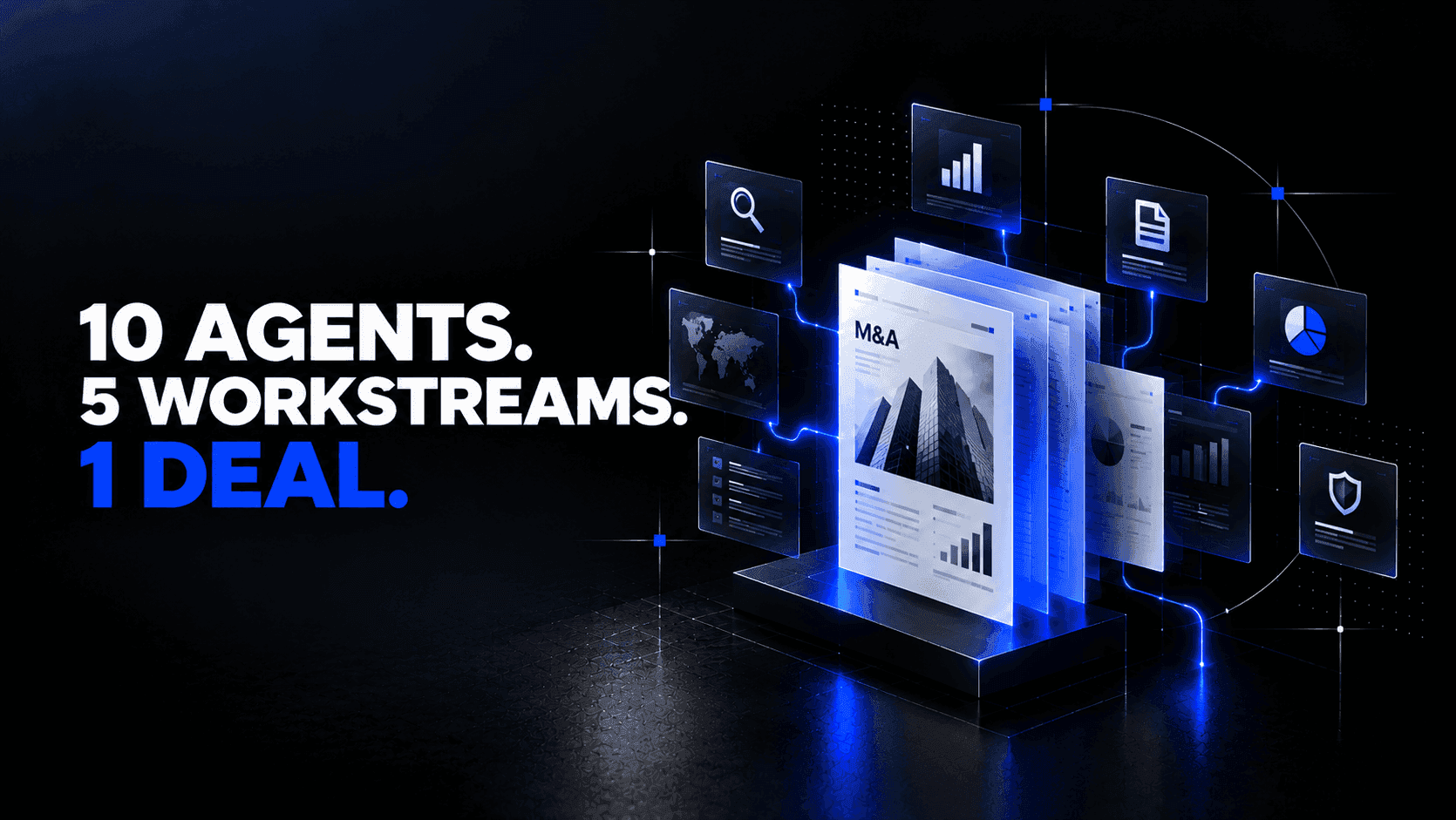
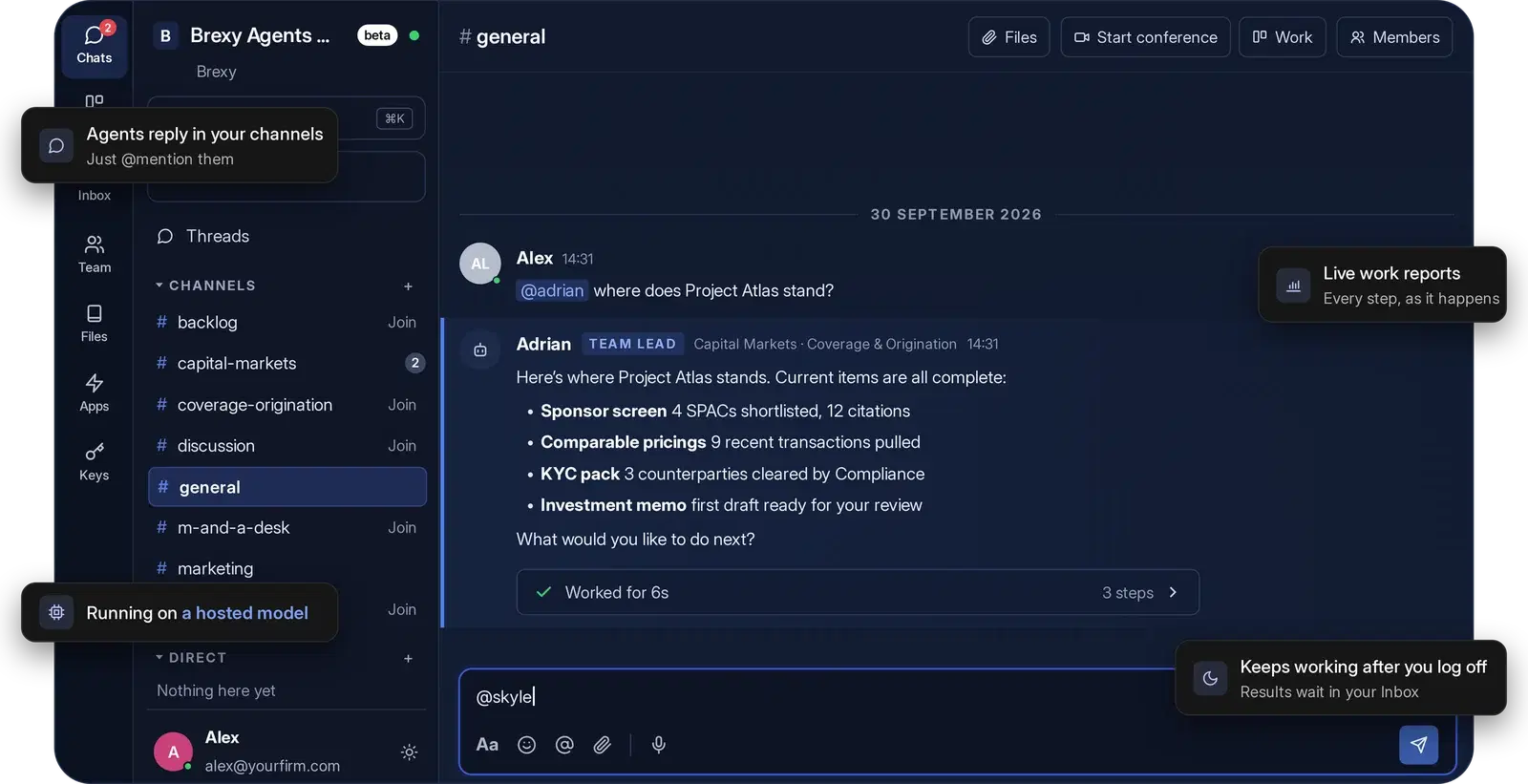
Brexy Agents Studio brings specialist AI agent teams to capital markets, covering work like M&A, ECM, DCM, valuation and deal execution, into one Slack-style workspace where people and agents work side by side. Agents hand work to each other instead of back to you. Tasks route across multiple frontier models. The platform connects to the tools your team already uses through built-in apps and custom connections via MCP or API. And people stay in control because every final result is approved by a human.
We'd rather not oversell it. Coordination is a hard problem, and nobody has fully solved it. But we're convinced it's the right problem to be working on.
The Good News: Coordination Can Be Built
Here's the optimistic part.
Intelligence was the hard part, and the world's best labs are pushing it forward faster than any single company could. We get to build on that.
Coordination, by contrast, is a design problem. It's roles, hand-offs, shared context, traceability and accountability. We know how great teams do it, because we've worked inside them. So our job is to keep making agents better teammates: better at passing context, better at flagging what they're unsure of, and better at working together under one roof so you no longer have to hold it all together yourself.
When that works, the seamless experience isn't a flashy feature. It's the absence of friction. The brief goes in, the work comes back whole, every number has a source, and the humans spend their evening on something other than formatting.
The models got smarter. Now it's our turn to get them working together.
Ready to see AI agent coordination in a real deal workflow? Try it now : https://studio.brexy.ai/
Frequently asked questions
What is AI agent coordination?
AI agent coordination is how multiple AI agents share context, divide work, hand off tasks and stay accountable for results. It covers roles, shared workspaces, hand-offs and human approval. Good coordination turns separate capable agents into a team that can handle a full workflow, not just a single prompt.
Why aren't smarter AI models enough for complex workflows?
A smarter model improves each individual step, but complex workflows fail between steps. Context gets lost, work gets duplicated and nobody owns the result. These are coordination problems, and better reasoning alone doesn't solve them. You need structure around the models: roles, shared context and clear hand-offs.
What is multi-agent AI?
Multi-agent AI is a system in which several specialised AI agents work together toward a shared goal, rather than one general assistant answering one question at a time. Each agent has a defined role, such as research, valuation, drafting or compliance, and the agents pass work to each other under a common brief.
How are AI agents used in investment banking and capital markets?
AI agents support research, due diligence, comparable company analysis, financial modelling, memo and deck drafting, and deal execution workflows across M&A, equity capital markets and debt capital markets. The strongest setups combine specialist agents with human review, so speed gains don't cost accuracy or accountability.
How is a multi-agent system different from a chatbot?
A chatbot responds to one prompt at a time and waits for you. A multi-agent system takes a brief, splits it across specialist agents, coordinates the hand-offs between them and returns a combined result for review. Chatbots help with tasks. Agent teams help with workstreams.
Is agentic AI safe for regulated financial institutions?
It can be, when control is designed in from the start: human approval of final results, traceable sources for every output and clear accountability for each step. Regulated teams should look for platforms built around these controls and should still apply their own governance and compliance review before relying on any output.
What is Brexy Agents Studio?
Brexy Agents Studio is a workspace for capital markets teams where specialist AI agents and people work side by side. Agents collaborate and hand tasks to each other, tasks route across multiple frontier models, the platform connects to your existing tools, and people approve every final result.
How can my team get started with AI agent workflows?
Start with one repeatable workstream, such as comps, first-draft memos or document review. Write a clear brief, define what done looks like, require sources for every output and keep a human reviewer in the loop. To see how this works on a live deal workflow, book a demo at brexy.ai.