 Agent Studio
M&A Desk AI Agent Team
Take an M&A mandate from first screen to decision. Build and profile target lists, quantify synergies and accretion/dilution, run the diligence tracker, and assemble decision-ready materials with the risks stated plainly.
What is an M&A Desk AI Agent Team?
An M&A Desk AI Agent Team is a group of specialised AI agents that work together on acquisition target screening, deal economics, due diligence coordination and decision-ready deal materials.
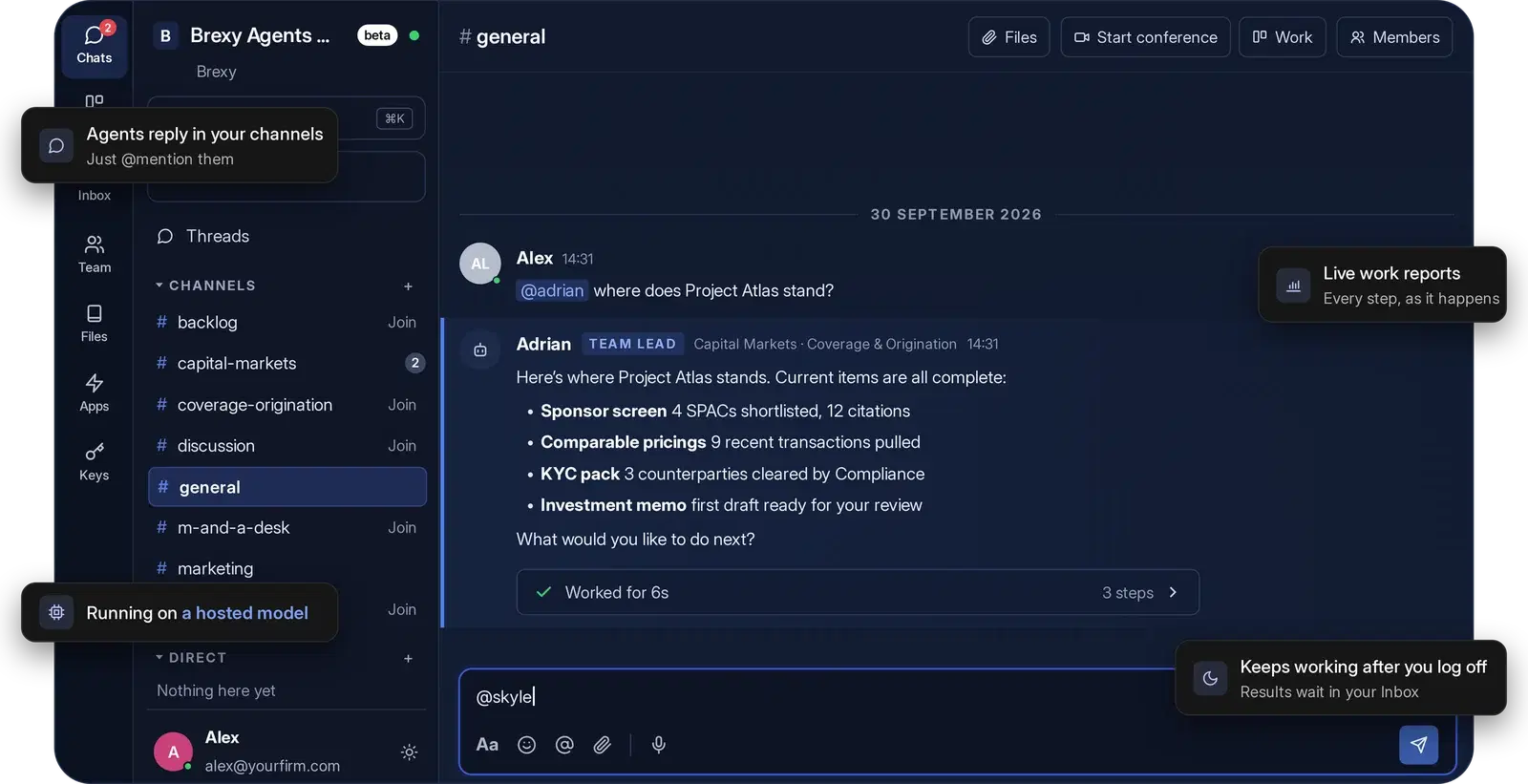
In Brexy, the team takes an M&A objective and breaks it into specialist tasks. It then screens, quantifies and tracks the work, and returns structured deal materials for you to review.
Overview
An M&A mandate is not one job. Framing the strategic rationale, screening targets, quantifying synergies, chasing diligence items and pulling it all into one recommendation are connected, but each one needs a different kind of work.
Instead of asking a general-purpose AI to do everything, Brexy gives each part of the mandate to a specialised agent. An M&A lead frames the rationale and assembles the decision materials. That makes the work easier to review and gives you clearer visibility into the criteria, assumptions, open items and sources.
Your deal team specialises. Your AI team should too.
Meet the M&A Desk AI team
Frames the strategic rationale and screening criteria with the client context, then assembles the decision materials: rationale, economics, diligence status and risks, stated plainly.
Builds long lists of acquisition candidates against explicit criteria, such as sector, size, geography and technology fit, and filters them down to profiled short lists.
Quantifies synergies, integration costs and accretion/dilution under explicit, stated assumptions.
Runs the diligence tracker: request lists, open items, owners and red flags.
One question can use multiple agents
Example: summarise two precedent deals, each figure sourced and dated, with anything not publicly confirmed labelled as such.
SLSkyler, M&A Lead
Frame what the summaries need to cover and set the standard of evidence.
MDM&A Desk
Research each deal from filings and other public sources, with every figure tied to its source and as-of date.
MDM&A Desk
Label anything that is not publicly confirmed, instead of presenting it as fact.
SLSkyler, M&A Lead
Assemble the deal summaries for your review.
From a question to finished work
Skyler frames the strategic rationale and screening criteria with your context. The Target Screening Analyst delivers a profiled short list. For the priority targets, the Synergy Analyst quantifies the economics under explicit assumptions. Once a target advances, the Due Diligence Coordinator opens the tracker and chases open items. Skyler then assembles the decision materials.
The goal is not just an answer. It is sourced, reviewable work you can take to the next step.
Another example: deal economics
Cross-sell into the acquirer’s customer base.
Overlapping infrastructure and functions.
One-off costs to combine the businesses.
Shown at different levels of synergy delivery.
A figure from an unverified report, labelled as such rather than stated as fact.
The Synergy Analyst builds the economics on assumptions that are stated openly, not buried, so you can challenge each one. The numbers come back with their sources and as-of dates, ready for the decision materials.
A typical M&A Desk workflow
The workflow moves from a strategic idea to a decision-ready recommendation.
Frame the rationale
Skyler, M&A LeadSet the strategic rationale and the screening criteria with the client context.
Screen the targets
Target Screening AnalystDeliver the profiled short list, built against explicit criteria.
Quantify the economics
Synergy AnalystFor priority targets, quantify synergies, integration costs and accretion/dilution under explicit assumptions.
Run the diligence
Due Diligence CoordinatorOnce a target advances, open the tracker and chase open items, owners and red flags.
Assemble the decision
Skyler, M&A LeadCombine the rationale, economics, diligence status and risks into one recommendation for your review.
Sources, assumptions, open items and labelling
Deal work is only as useful as the evidence and assumptions behind it.
Every figure in a deliverable carries its source.
Every figure carries its as-of date.
Nothing is presented as fact without the specific deal, filing or data point behind it.
Synergies, integration costs and accretion/dilution are quantified under assumptions that are clearly stated.
Anything not publicly confirmed is labelled as such.
Request lists, open items, owners and red flags sit in one tracker, so nothing waits in someone’s inbox.
Who is it for?
Support M&A mandates from target screening to decision materials, with sourced precedent research and explicit deal economics.
Screen acquisition candidates against your own criteria and quantify what a deal could be worth.
Build long lists, profile short lists and keep diligence organised across live opportunities.
Support strategic and financial decisions with stated assumptions you can challenge.
Reduce repetitive screening, modelling and tracker work while keeping control over the final recommendation.
Work with the context you already have
Brexy can work with the context available through your projects, knowledge, files, connectors and previous work. Your AI team starts from the client context, criteria and information relevant to the mandate.
Confidentiality and control
Deal information stays confidential. Material non-public information never moves between deals or channels.
You stay in control. The AI team does the screening, quantification and tracking, and prepares the work. Anything external-facing goes to a human for approval before it leaves the team. You review the output, check the sources, challenge the assumptions and approve what moves forward.
Brexy does not make investment decisions. It removes the repetitive work around them.
What can you ask Brexy to do?
Click any request to copy it.
Target Screening
Deal Economics
Due Diligence
Decision Materials & Precedents
Frequently asked questions
An M&A AI Agent is an AI system specialised in M&A work such as target screening, synergy analysis and due diligence coordination. In Brexy, it works as part of a larger M&A Desk Agent Team.
Yes. Brexy’s Target Screening Analyst builds long lists of acquisition candidates against explicit criteria, such as sector, size, geography and technology fit, and filters them down to profiled short lists.
Yes. The Synergy Analyst quantifies synergies and integration costs under explicit, stated assumptions, so you can see and challenge what drives the numbers.
Yes. The team quantifies accretion/dilution under explicit assumptions, and shows the sources and as-of dates behind its figures.
Yes. The Due Diligence Coordinator runs the tracker, including request lists, open items, owners and red flags, and chases open items once a target advances.
Yes. The team supports precedent-transaction research, with each figure sourced and dated, and anything not publicly confirmed labelled honestly.
Yes. Deal information stays confidential, and material non-public information never moves between deals or channels.
An agent team divides a complex mandate among specialised agents. Separate agents handle screening, deal economics and diligence tracking, while an M&A lead frames the rationale and assembles the decision materials. That makes the work easier to review.
No. The AI team does the work and prepares the materials. You review, challenge and approve the output.
No. Describe your M&A objective, and Brexy brings the relevant specialist agents into the workflow.
Start with the mandate. Build the deal around it.
Give Brexy the strategic rationale, the screening criteria and the client context you have. The M&A Desk Agent Team brings together the screening, economics, diligence and decision-ready assembly work required.
Ready to put the team to work?
Open Brexy Agent Studio, describe your M&A objective, and the right agents join the workflow.
Try M&A Desk in Brexy →