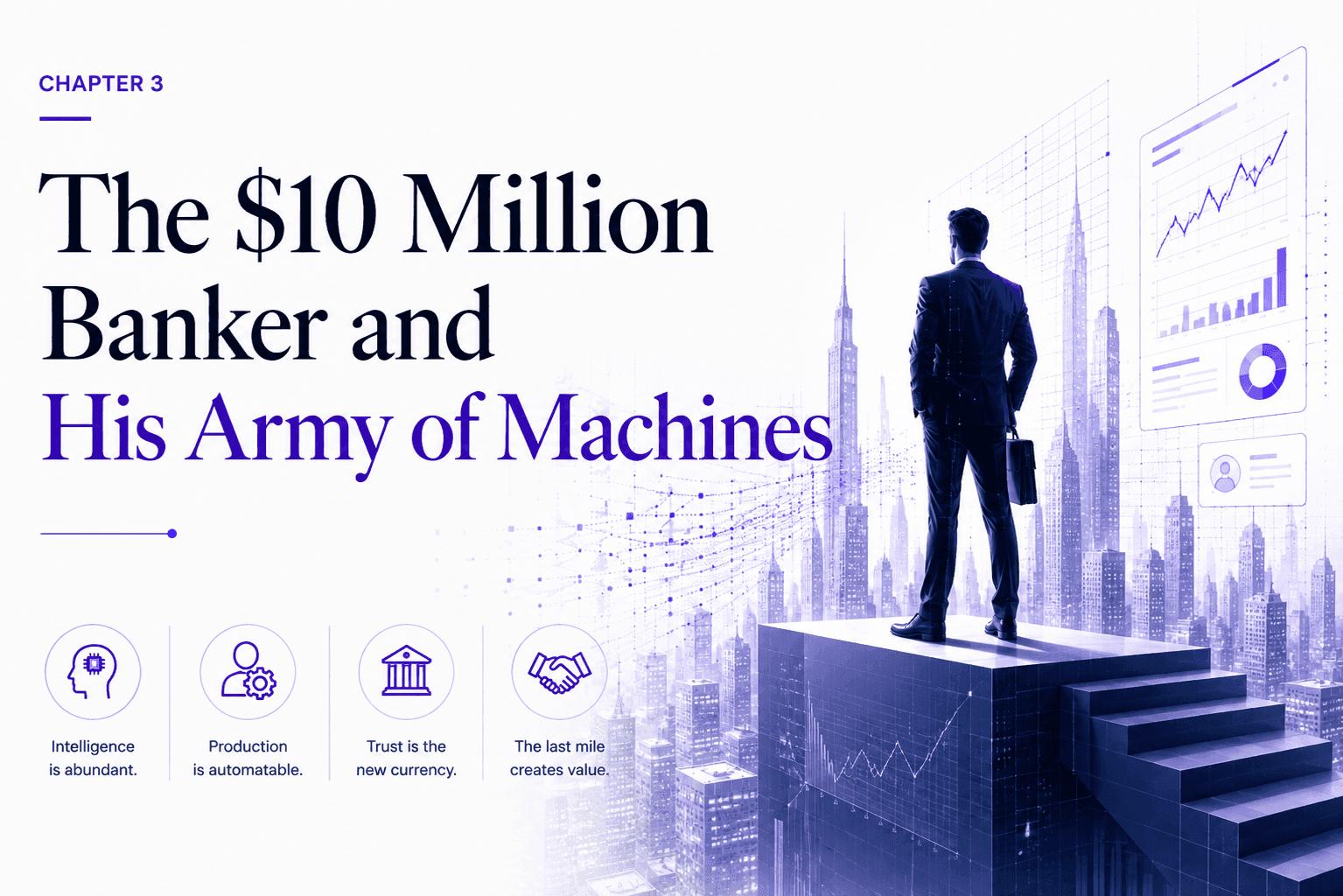
The $10 Million Banker and the Age of Machines
Meet the Forward Deployed Banker, the strange new archetype as Wall Street's production machine begins to disappear
Experience is merely the name men gave to their mistakes.— Oscar Wilde
There is an old joke on Wall Street that the highest-paid person in the room is rarely the person who did the work.
For most of my career, this was structurally true.
The Analyst built the model. The Associate checked it. The VP rebuilt the bits the Associate checked incorrectly. The Managing Director arrived at the meeting with a beautifully printed book, turned confidently to page 37, and said: “What we believe…” when that “we” had enjoyed a rather unequal weekend.
This was not stupidity. It was the operating system of capital markets.
For decades, financial institutions solved complexity with people. More information required more analysts. More transactions required more deal teams. More diligence required more lawyers. More reporting required more operations people. More regulation required more compliance people.
We built pyramids because human intelligence was expensive and human attention was finite. And then something rather inconvenient happened.
Intelligence started getting cheaper.
1. What Happens When Intelligence Is No Longer Scarce?
For most of human history, intelligence was expensive. We may be about to discover what happens when it goes on sale.
In the last newsletter, I argued that capital markets no longer really have an information problem.
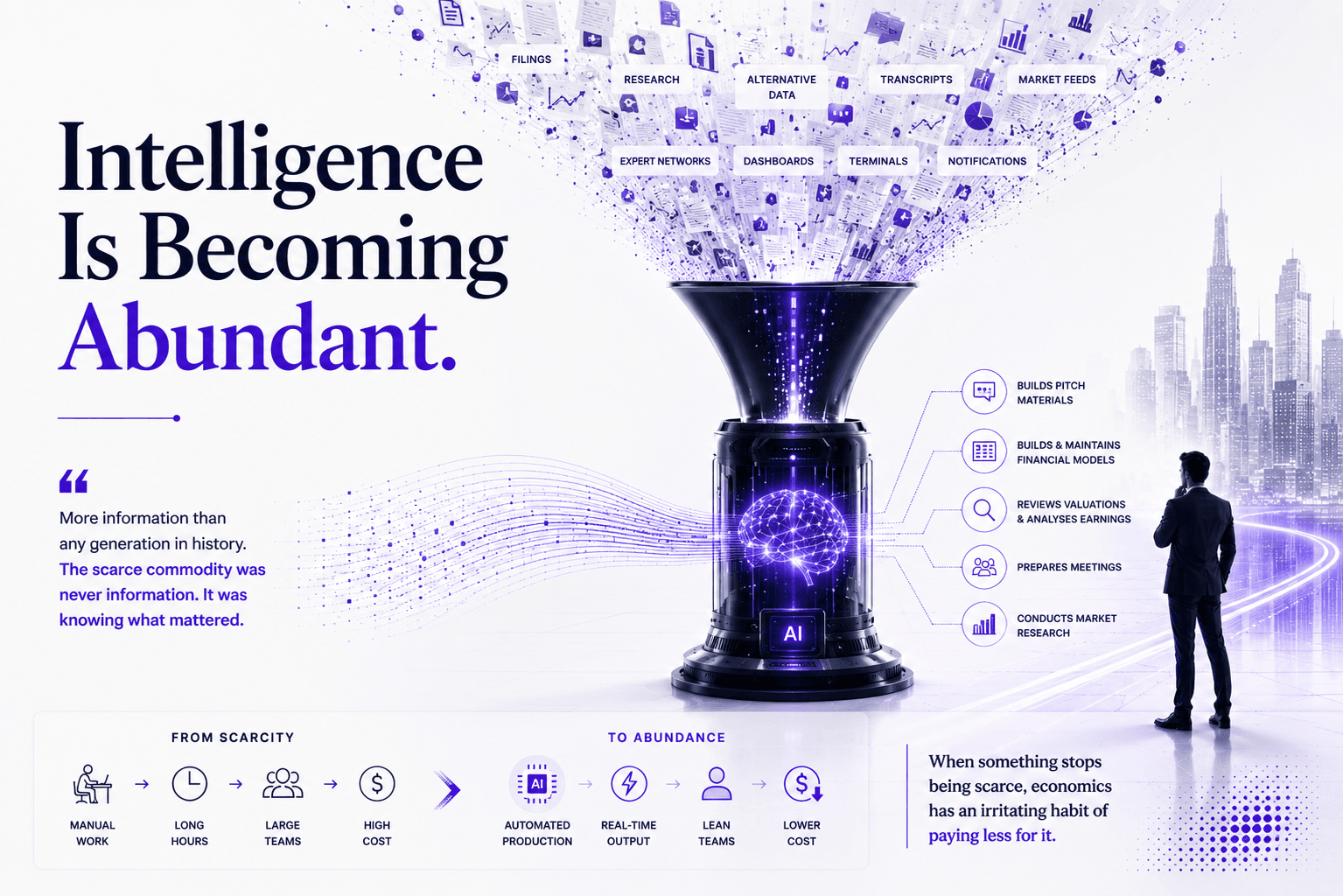
We have more information than any generation of investors in history. More filings. More research. More alternative data. More transcripts. More market feeds. More expert networks. More dashboards. More terminals. More notifications telling us that somebody on CNBC has changed their mind about interest rates for the third time since breakfast.
The scarce commodity was never ultimately information. It was knowing what mattered.
Now AI introduces a second inversion - Intelligence. And that itself is becoming abundant. Not judgment, not accountability, certainly not wisdom. Those remain stubbornly supply-constrained.
Intelligence - that distinction matters because we may be crossing from the age of abundant information into the age of abundant intelligence.
2. Silicon Valley Discovered the Last Mile
One of the more interesting organizational inventions of the technology industry wasn’t a piece of software. It was a person.
Palantir called them the Forward Deployed Engineer. The basic insight was simple. Enterprise software works beautifully in PowerPoint. Reality does not. Walk into a government department, intelligence agency, factory, hospital or giant corporation and you discover something enterprise-software sales presentations tend to omit.
The data is messy. The systems hate one another. So do people. Half the institutional knowledge lives inside software written before some employees were born. The other half lives inside Susan. Susan has worked there for twenty-seven years. Nobody knows precisely what Susan does. or where she sits. Everyone knows the company would collapse approximately forty-eight hours after Susan retired.
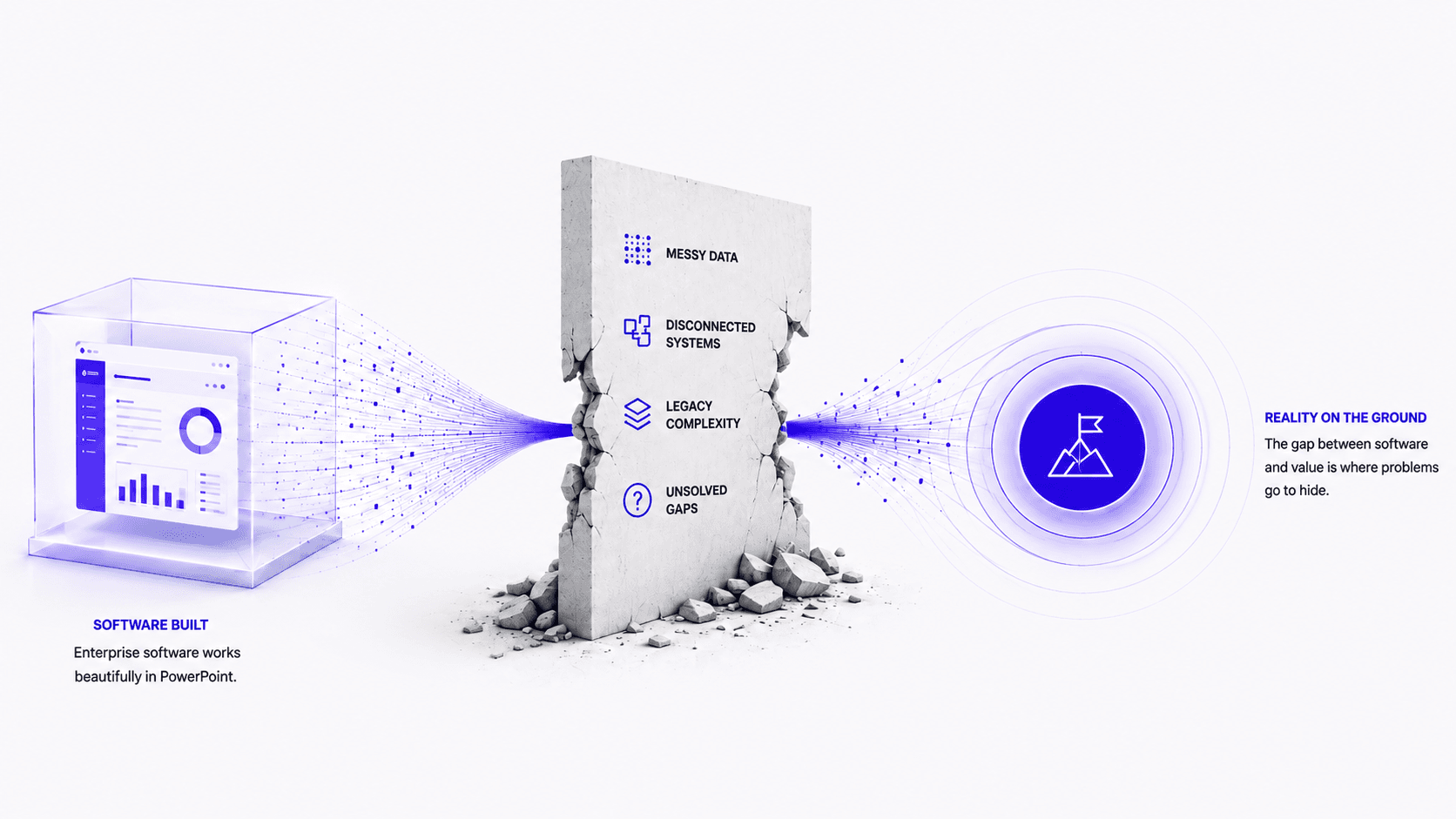
Traditional software companies sold the software and left the customer to bridge that gap. Palantir took a different approach. It sent engineers into the problem. The Forward Deployed Engineer sat beside the people actually making decisions. They understood the operational problem, connected the systems, configured the technology and turned general-purpose computing power into something useful in the specific environment where the problem existed.
The insight wasn’t really about engineering. It was about distance. The closer you could place technical capability to the actual decision, the more valuable the technology became.
Capital markets are approaching exactly this moment. Because finance has spent decades putting extraordinary organizational distance between the person asking the question and the people producing the answer. Mike Bloomberg is not going to sit next to you now, is he?
3. Wall Street’s Human API
Consider a perfectly ordinary question during a transaction. A private-equity partner is sitting across the table and asks:
If we increase leverage, carve out one division, change the exit multiple and rates stay 150 basis points higher than expected, what happens to our returns and where do we break the covenants?
Today, the senior banker will probably have a view. But the machinery required to prove the view begins immediately.
Managing Director asks VP.
VP asks Associate.
Associate asks Analyst.
Analyst opens Excel.
Excel asks God for forgiveness :)
Then begins the production chain. Models are changed. Documents are searched. Credit agreements are checked. Precedent transactions are pulled. Slides are rebuilt. Numbers are reviewed. Comments travel back down. Numbers travel back up. Eventually the client receives the answer. The extraordinary thing is that we barely notice this architecture anymore.
But look at it computationally:
Client → MD → VP → Associate → Analyst → Systems → God
and then: Systems → Analyst → Associate → VP → MD → Client (The Real God)
For decades, the hierarchy of investment banking wasn’t merely a hierarchy of seniority. It was a human API. We discussed this in our newsletter couple of weeks ago.
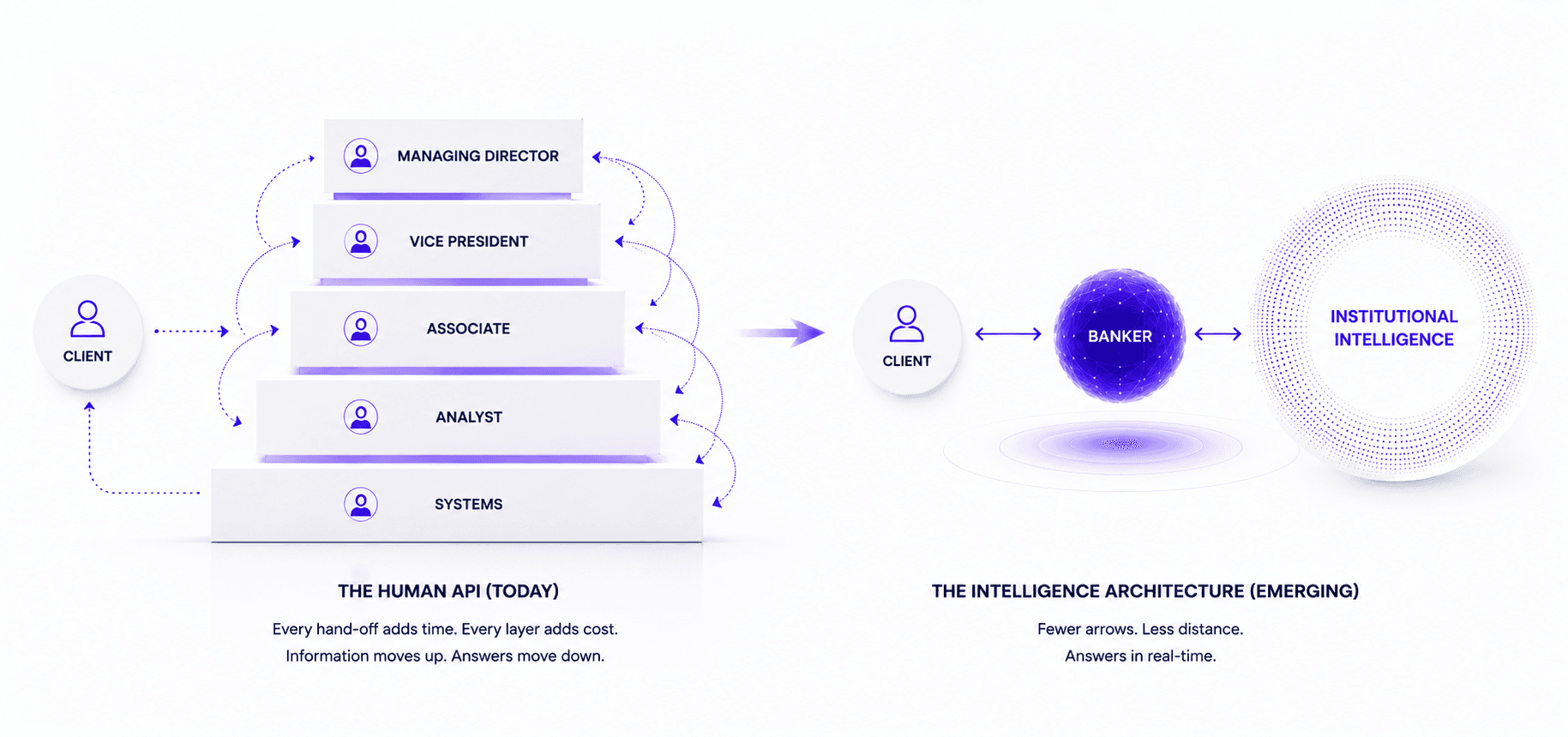
Every layer translated information for the layer above it. Every arrow introduced time. Every hand-off introduced interpretation. Every additional layer introduced a cost. And occasionally someone changed 6.8% to 6.9% and an entire Saturday disappeared. AI begins removing those arrows.
4. Meet the Forward Deployed Banker
This brings us to the banker I think will define the next era. The Forward Deployed Banker.
Not an analyst with ChatGPT. Not a Managing Director who has learned the phrase “agentic workflow” and is now terrorising the technology department. And certainly not a software engineer wearing a Patagonia vest and pretending to understand EBITDA adjustments.
The Forward Deployed Banker is something genuinely different. They combine three capabilities that historically lived in different parts of the institution:
- Deep financial judgment. They understand accounting, valuation, capital structures, markets, regulation, incentives and transaction mechanics.
- Machine orchestration. They can command a network of models, agents, proprietary data and institutional systems to investigate and simulate complex financial problems.
- Human consequence. They can sit across from a CEO, family founder, investment committee, sovereign wealth fund or analysts and associates, and understand that the technically optimal answer may be politically impossible, strategically stupid or psychologically unacceptable.
That last part matters enormously. Because deals are not equations. Deals contain equations. Deals themselves contain fear, ambition, ego, careers, regulators, boards, shareholders, creditors, employees and occasionally two billionaires who have stopped speaking to one another. The machine understands the capitalization table. The banker needs to understand the table.
The Forward Deployed Banker can understand the company, interrogate the evidence, structure the transaction, challenge the assumptions, sit opposite management and remain present when the decision is made.
In that sense, the banker of 2030 may look strangely similar to the merchant banker of 1835. Closer to the capital. Closer to the client. Closer to the consequence.
Technology does not always move history neatly forward. Sometimes it gives us enough machinery to rediscover what industrialization removed. The craftsman returns. Only this time, the workshop contains a few thousand GPUs.
There is, however, an awkward flaw in my beautiful future. Where do Forward Deployed Bankers come from?
Wall Street has historically manufactured senior judgment through an extremely inefficient apprenticeship.
If AI removes the repetition human pyramid, what produces the intuition? This is the Apprenticeship Paradox. And I think it may become one of the most important problems financial institutions face over the next decade.
This changes whom Wall Street should fight to hire. For decades, investment banks optimized recruitment around a particular archetype. Extremely intelligent. Extremely conscientious. Comfortable with hierarchy. Capable of surviving sleep deprivation. Unreasonably concerned about whether two logos are horizontally aligned. That person was perfect for the production machine.
The Forward Deployed Banker is different. You want the ex-grinder who learned the mechanics but always wondered why the mechanics were so ridiculous. The systems thinker who sees a transaction not as twelve workstreams and forty-seven PDFs, but as a connected architecture of cash flows, contracts, incentives, probabilities and human decisions. The technologist who understands finance deeply enough to know that a theoretically elegant solution can still get laughed out of an investment committee.
The banker capable of arguing with the machine. And above all, the person comfortable carrying responsibility. Because once production becomes abundant, hiding inside production becomes harder.
There will be fewer places to disappear. You cannot say: “The analyst’s model had an error.”
You commanded the model. You interrogated it. You approved the assumptions. You made the recommendation. This may make finance more productive. It may also make it considerably less comfortable.
5. The $10 Million Banker
So why call this person the $10 Million Banker? Not because I predict that every Forward Deployed Banker will earn $10 million. Most won’t. The number is deliberately provocative because it describes economic leverage, not a compensation survey.
Imagine one exceptional senior dealmaker today. Around that individual sits an enormous production apparatus. analysts, associate, Vice Presidents, Research, data & Data Sources, presentation teams, internal & external lawyers, credit, accounts, specialists, operations etc etc - the list is endless. Now imagine that a meaningful portion of that production capability becomes software. The banker does not suddenly become twenty times smarter.
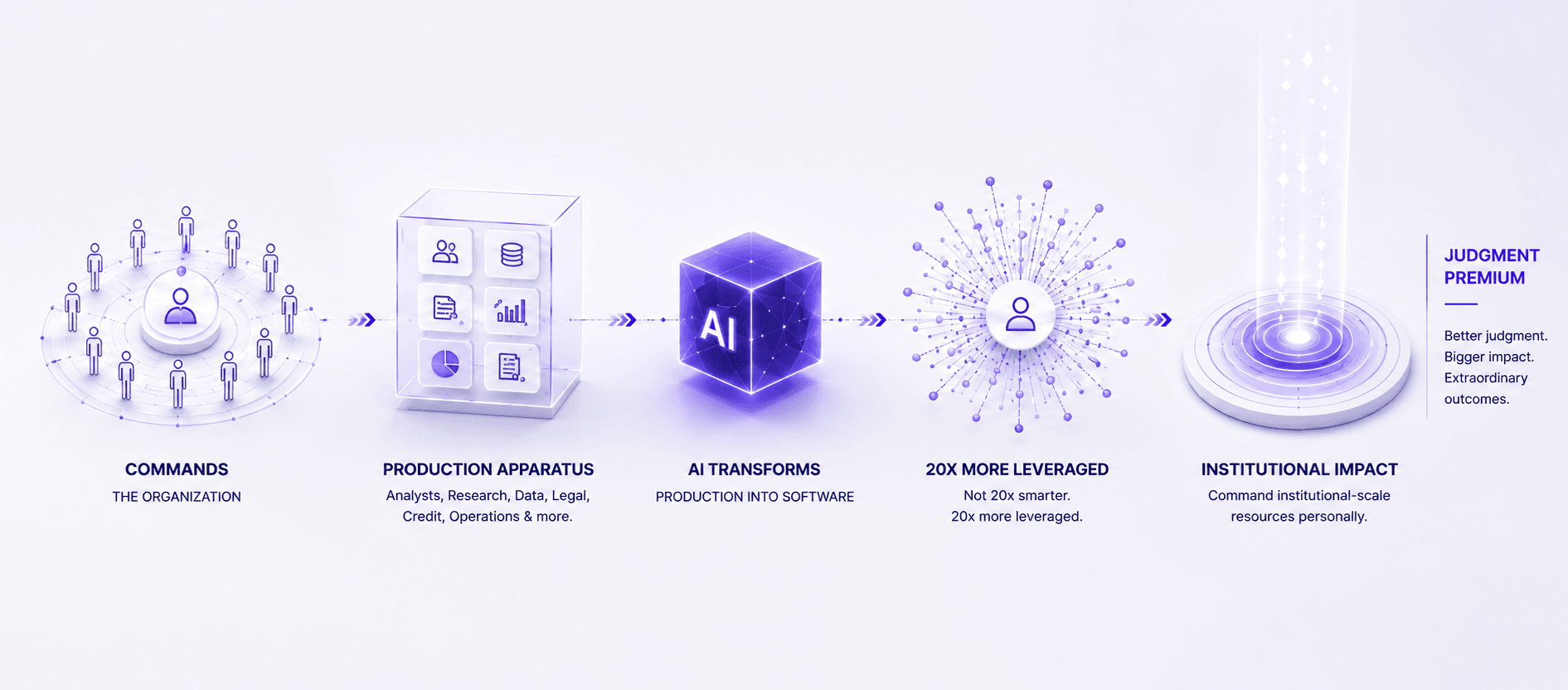
They become twenty times more leveraged. This is the part of the AI debate I think Wall Street underestimates. We spend enormous amounts of time discussing the productivity of the average worker. But technology often creates its greatest economic consequences at the extremes. The tractor didn’t merely make every farmer slightly faster. It radically increased the amount of land one farmer could work.
The Bloomberg Terminal didn’t merely make every trader slightly better informed. It concentrated enormous amounts of market infrastructure in front of one human being. The personal computer didn’t simply reduce secretarial work. It gave one knowledge worker capabilities that once required departments. AI may do something similar to elite professional judgment.
The biggest consequence may not be that the average banker becomes 30% more productive. It may be that an exceptional banker becomes capable of commanding institutional-scale analytical resources personally. That changes the economics of talent.
Judgement Premium
And it produces what I think of as the Judgment Premium where information becomes cheap, production becomes cheaper, analysis becomes faster. What remains stubbornly expensive? Being right when being wrong matters. That is judgment.
There is an old pattern here. Photography made accurate reproduction cheap. It did not eliminate art. It moved value away from merely reproducing reality toward interpreting it. Calculators made arithmetic cheap. They did not eliminate mathematics. Bloomberg made financial information dramatically easier to access. It did not eliminate investors. Excel made financial modelling dramatically easier. It somehow produced even more financial models. Technology repeatedly commoditizes one layer of human capability and moves economic value toward the layer above it.
AI is unusual because it is beginning to commoditize something we thought sat near the top: analysis itself.
Which forces finance to discover what sits above analysis. I think the answer is judgment. And the cheaper the answer becomes, the more valuable the right question becomes.
6. Reimagining the Org Structure Around Forward Deployed Banker
AI and Forward Deployed Banker dos not mean two people replace Goldman Sachs. Banks are not simply factories producing PowerPoint. They contain regulatory licenses, balance sheets, distribution networks, risk systems, compliance infrastructure, institutional relationships and decades of accumulated trust.
You cannot prompt your way into a banking licence. Not yet, anyway. But something inside the institution changes dramatically. Small groups of exceptional humans can command capabilities that once required large teams to coordinate.
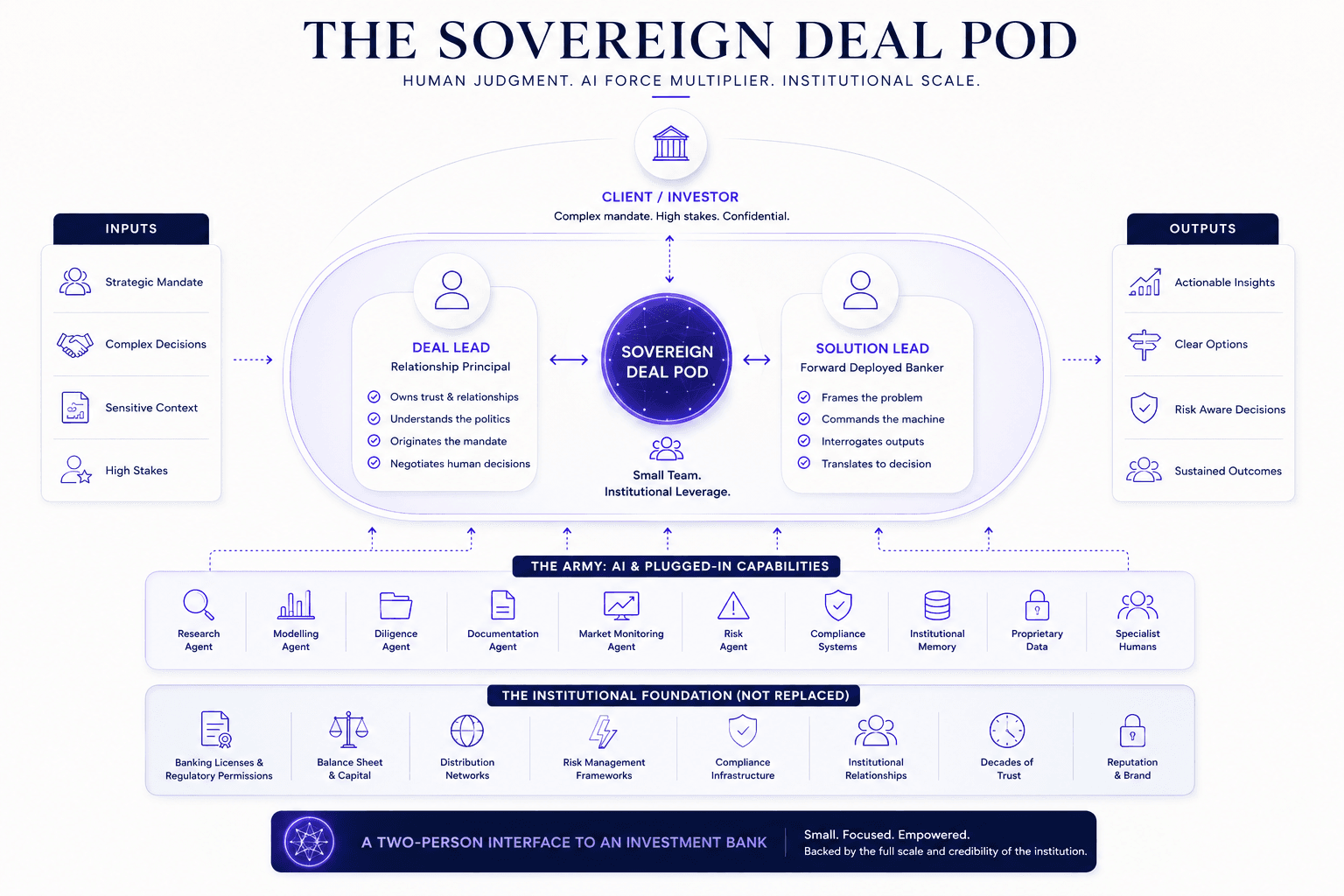
I call this the Sovereign Deal Pod. At its centre might sit:
- The Relationship Principal: The person who owns trust, understands the politics, originates the mandate and negotiates the consequential human decisions - Deal Lead
- The Forward Deployed Banker: The person who converts the client’s messy problem into a computational problem, commands the institutional machine, interrogates the outputs and translates them back into a decision - Solution Lead
Behind them sits the army. Except much of the army is AI & plugged in software.
Research agents. Modelling agents. Diligence agents. Documentation agents. Market-monitoring agents. Risk agents. Compliance systems. Institutional memory. Proprietary data. And specialist humans entering precisely when their expertise matters.
This isn’t a two-person investment bank. It is potentially something more powerful: a two-person interface to an investment bank. That’s the distinction. The institution remains enormous. The surface area through which the client accesses its intelligence becomes radically smaller.
7. The Most Valuable Word in AI Finance May Be “No”
There is another misconception about the Forward Deployed Banker.
Their greatest skill will not be knowing how to use AI. Soon everyone will know how to use AI. Prompting will become about as impressive as knowing how to Google. The elite FDB’s advantage will be knowing when not to trust the machine.
No. That document conflicts with the filing.
No. Management’s EBITDA adjustment is doing yoga.
No. The model is mathematically correct but economically absurd.
No. The comparable company isn’t comparable unless we redefine the English language.
No. We do not have sufficient evidence to make that recommendation.
No. The regulatory interpretation is novel enough that a human lawyer needs to own it.
No. The CEO may want this transaction, but the board should not approve it.
That is the difference between intelligence and judgment.
AI can generate probability. Institutions require responsibility. And responsibility occasionally requires someone to ruin an otherwise excellent meeting.
8. But Someone Still Has to Sign
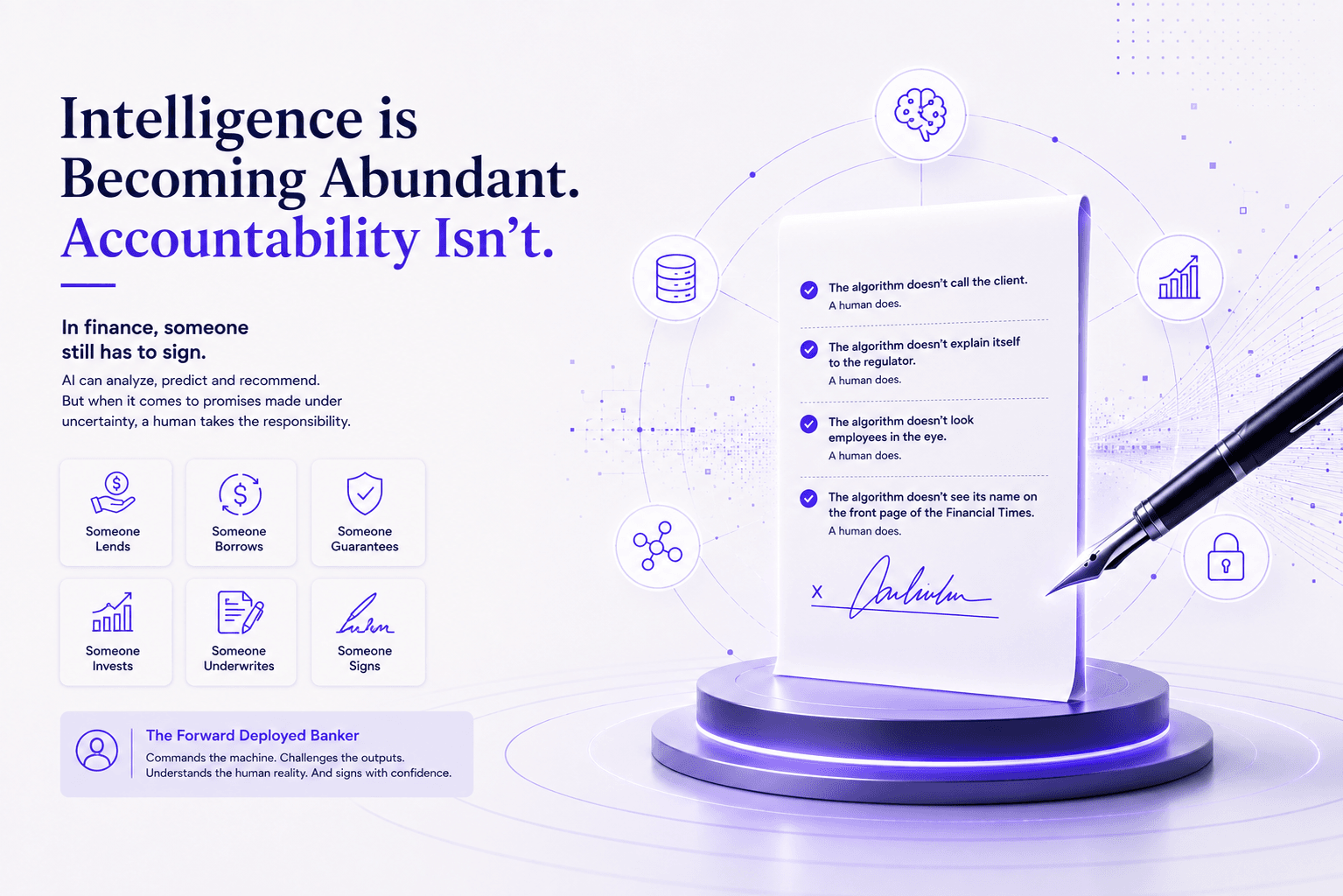
There is a temptation to imagine that the final destination of AI is autonomy. Perhaps in many industries it is. Finance is different.
Because finance is ultimately a chain of promises made under uncertainty with regulatory oversight.
- Someone lends.
- Someone borrows.
- Someone guarantees.
- Someone invests.
- Someone underwrites.
- Someone signs.
And when the model fails, the market gaps, the covenant breaks, the clever structure encounters an unimpressed regulator, or several billion dollars disappear somewhere between “base case” and reality, the algorithm does not walk into the boardroom. A human does.
- The algorithm doesn’t call the client.
- The algorithm doesn’t explain itself to the regulator.
- The algorithm doesn’t look employees in the eye.
And the algorithm does not suffer the wonderfully motivating experience of seeing its name on the front page of the Financial Times. A human does. That may be the central paradox of AI in capital markets.
The more intelligence we delegate to machines, the more consequential the remaining human responsibility becomes. The analyst of the old Wall Street was valuable because they could produce the work. The Forward Deployed Banker will be valuable because they can command the machine, challenge its conclusions, understand the human reality around it and still be willing to put their name underneath the answer.
That is why I think the future belongs neither to the traditional banker nor to the autonomous financial agent. It belongs to something in between. A human with judgment. An institution behind them. An army of machines beneath them. Perhaps that person generates $10 million of economic value. Perhaps $100 million.
The precise number doesn’t matter. The leverage does. Because for most of financial history, we built organizations to compensate for the scarcity of intelligence. We are now entering a world in which intelligence may become the abundant resource. Which leaves us with the thing markets have always struggled to manufacture.
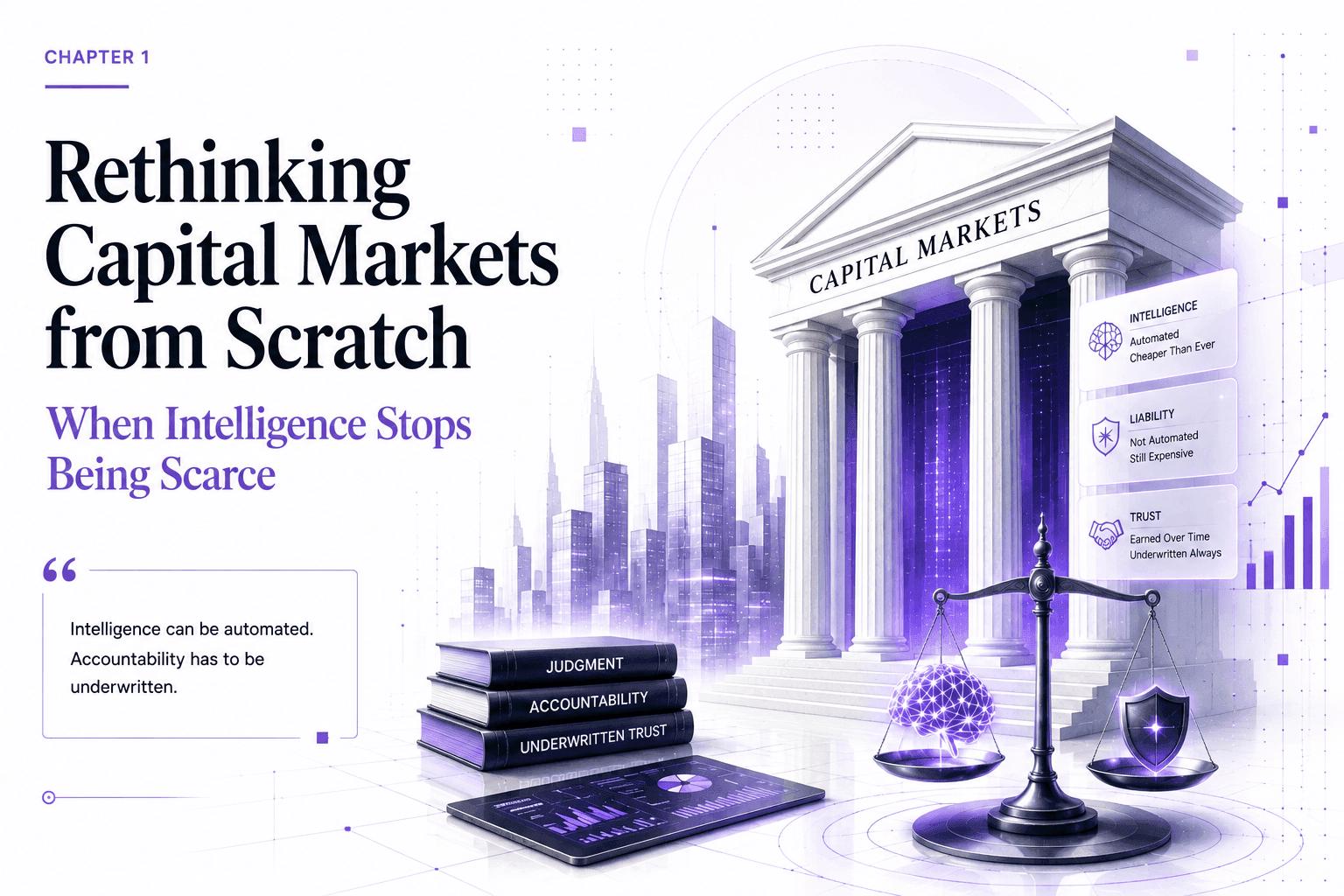
Judgment. Intelligence is becoming abundant. Accountability isn’t. And perhaps that is what we were underwriting all along.
What do you think?
If intelligence is becoming abundant, what becomes truly valuable in finance?
Perhaps it’s no longer access to information or even analytical horsepower, but:
- Judgment
- Accountability
- Conviction
- Trust
When machines can find the information, build the model and surface the risks, does trust become the real product?
I’d love to hear how bankers, investors, founders, and builders see this transition.
Have a different view? Leave a comment or reach out.