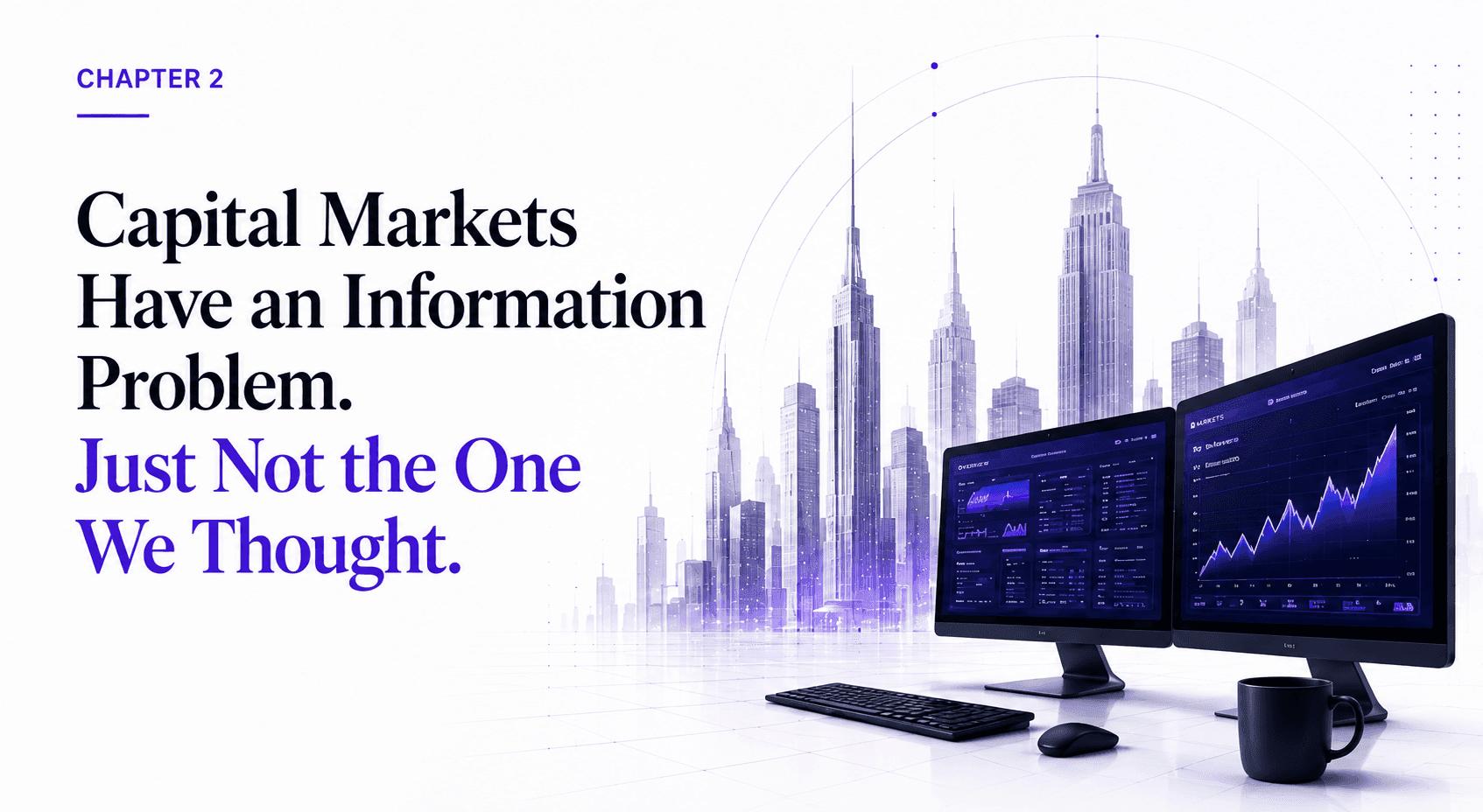
Capital Markets Have an Information Problem. Just Not the One We Thought
For forty years, the measure of seriousness in global finance has been a dual-screen terminal blinking in amber and black. Two rectangular screens. Usually black. Occasionally four, if the owner is particularly important or particularly insecure. Orange text flashing at a speed designed to remind you that somewhere, somebody knows something you don’t. The Bloomberg terminal may be one of the greatest financial information machines ever built.
It sits on every desk in every financial center from 200 West Street to Mayfair to Central in Hong Kong. It costs roughly US$30,000 a year per seat. It can tell you the yield on a Brazilian government bond, the CDS spread of a French bank, the price of Korean electricity, the latest estimate for American payrolls and what a Federal Reserve governor said approximately seventeen seconds ago. It can show you almost every public company, bond, currency, commodity, index and economic series worth caring about. It can tell you what happened. It can increasingly tell you why people think it happened.
What it cannot reliably tell you is whether you are being an idiot. Unfortunately, that has historically been the expensive part.
Welcome to the central paradox of modern capital markets. We have spent roughly two centuries constructing an extraordinary global machine for collecting, transmitting, storing and analysing financial information. And there are hundreds of other data sources that aggregated together make an analysts’ life worth $250,000 / year start.
Don’t get me wrong, it worked. Almost too well.
Finance solved information scarcity so successfully that it created information obesity
1. The Bloomberg Illusion
The modern financial institution possesses vastly more information than Nathan Rothschild, J.P. Morgan or Siegmund Warburg could have imagined. And yet it can still be spectacularly wrong. That is worth thinking about. Because if better information automatically produced better judgment, the history of modern finance should look like a steadily declining sequence of mistakes. It does not. The screens got better. The mistakes got bigger.
Every single major crisis in modern financial history from the subprime CDO implosion of 2008 to the London Whale in 2012, from Archegos Capital to the sudden run on Silicon Valley Bank in 2023, and the latest Leopold Aschenbrenner’s AI-focused hedge fund disaster, Situational Awareness, that was extremely leverage up to 400%, amplified heavy losses happened on desks equipped with Bloomberg terminals.
Every analyst had the data. Every managing director had the pricing. Every risk officer had the feeds. The data was not missing. The information was moving at the speed of light.
What failed was something completely untouched by the terminal: JUDGEMENT
The information machinery largely worked. Prices arrived. Positions existed. Models calculated. Reports circulated. Committees met. PowerPoints were produced, because civilisation had not yet completely collapsed. And still, somewhere between knowing and acting, something broke.
This is what I call the:
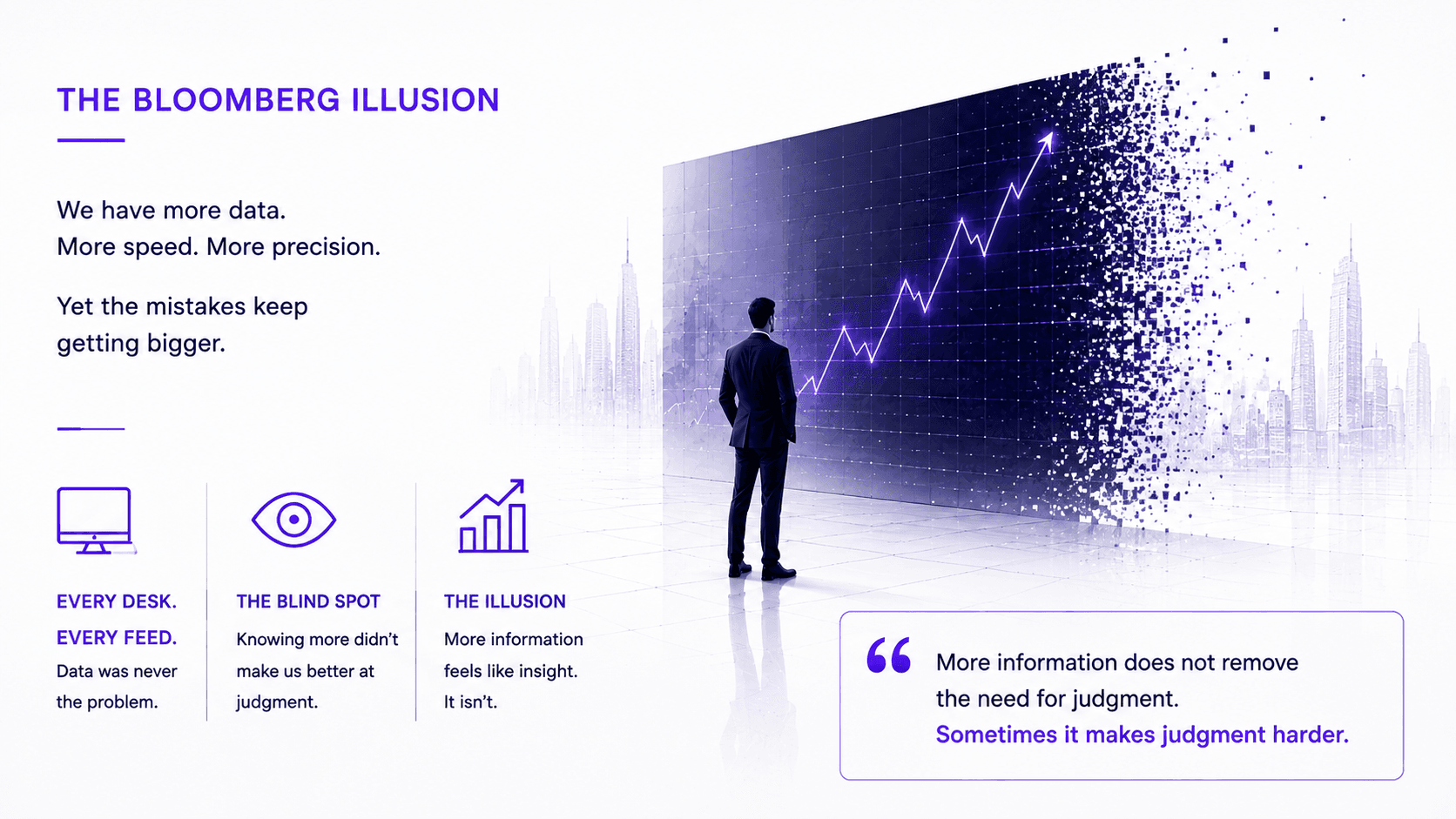
Bloomberg Illusion
The belief that increasing the quantity, speed and precision of information, necessarily improves the quality of institutional judgment
It feels intuitively true. If I know more, surely I should decide better. If I know it faster, better still. If I can model it, chart it, compare it, stress-test it and place it in a 97-page investment committee memorandum with six appendices, surely uncertainty should eventually surrender.
Except it doesn’t. Capital markets have spent generations discovering an uncomfortable truth: More information does not remove the need for judgment. Sometimes it makes judgment harder. To understand why, we need to go backwards.
2. Information paradox: Two Hundred Years of Solving the Wrong Bottleneck
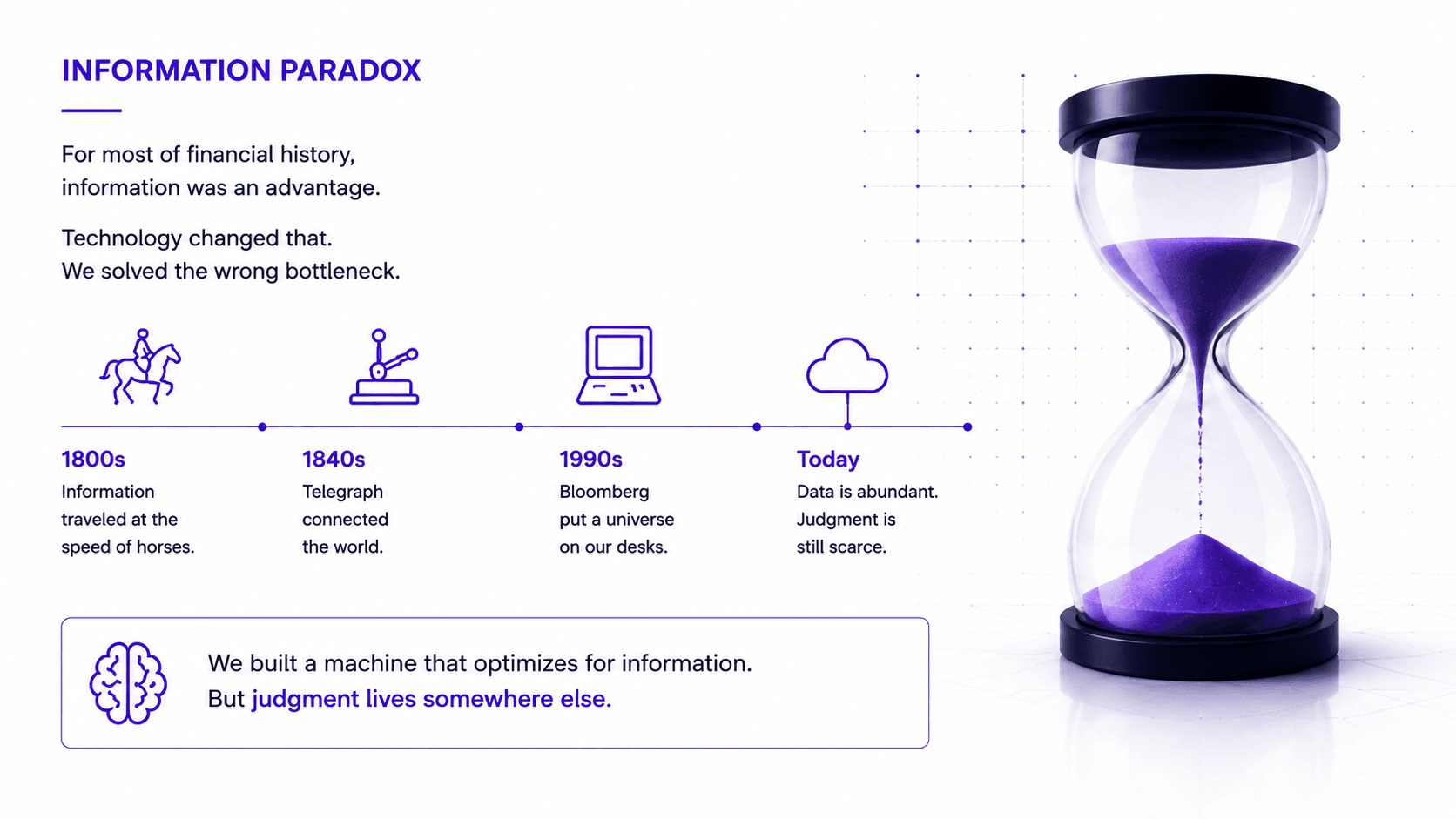
For most of financial history, information really was an edge. A formidable one.
In the early nineteenth century, knowing what had happened in another country before your competitors knew could make a fortune. Information travelled at the speed of horses, ships and human beings.
The Rothschild banking network became famous partly because it developed unusually effective systems of couriers and correspondence across Europe. The economic logic was straightforward. If markets in London did not yet know what had happened in Paris, Vienna or Frankfurt, knowing first mattered enormously.
A fact had value because facts were scarce. Then technology began attacking the scarcity. In the 1840s came the telegraph. Paul Julius Reuter famously used carrier pigeons to bridge a gap in the telegraph network between Aachen and Brussels before establishing the news organisation that still bears his name.
It sounds quaint now. At the time it was high-frequency trading with feathers.
Then came expanding telegraph networks. The stock ticker. The telephone. Electronic market data. Personal computers. Spreadsheets. Bloomberg. The internet. Cloud computing. Alternative data. Each generation made financial information faster, cheaper and more abundant. And each time, markets adapted.
This is important because the history of financial technology is partly the history of scarcity moving somewhere else. When reliable information was scarce, possessing information created advantage. When information became easier to obtain, processing it became the advantage. When computing became ubiquitous, increasingly sophisticated analysis became the advantage. And now we have arrived somewhere strange.
For many large financial institutions, the problem is no longer obtaining enough information. It is surviving it. Judging it quickly, judging it accurately and executing on it even faster. This is just about to exponentially accelerate in my humble opinion.
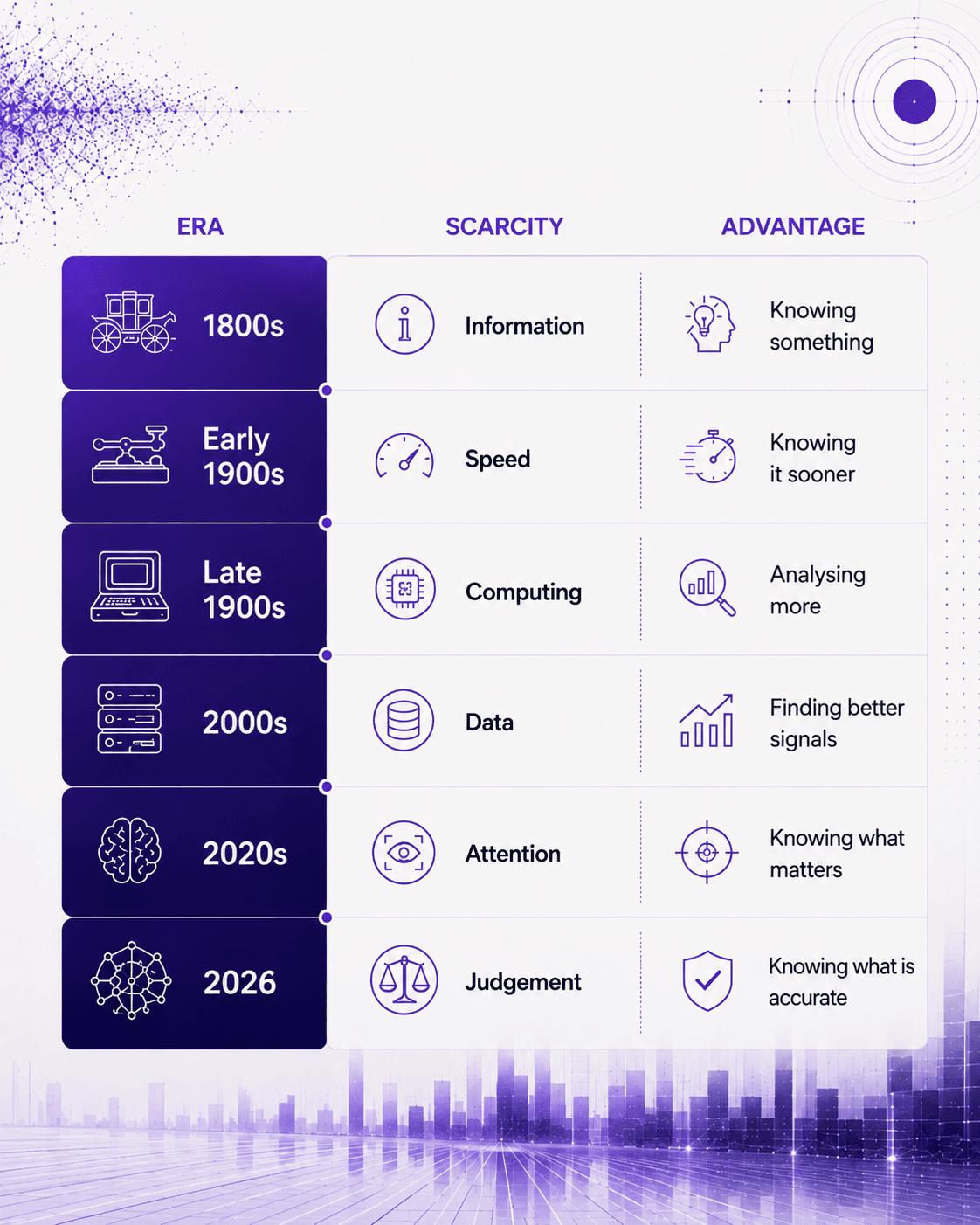
Look at that table carefully. For 175 years, technology merely handed humans more data, faster.
The human was still expected to read the filing, spot the covenant loophole, reconcile the conflicting versions of EBITDA, evaluate management’s credibility, price the structural illiquidity, and bear the liability of the decision.
That last transition in the table changes everything. Because human attention did not experience Moore’s Law. The amount of financial information available to an institution increased exponentially. The number of hours in the day remained annoyingly regulated at twenty-four.
So we responded in the traditional Wall Street manner. We added dashboards. Then reports explaining the dashboards. Then analysts summarize the reports explaining the dashboards. Then meetings to discuss the summaries. Committees to discuss meetings. And, when matters became truly serious, another committee. Then either the CEO resigned, or the firm went bankrupt - often hand in hand trolling towards Central Park.
The modern banker is not information-starved. He is being waterboarded by PowerPoints & PDFs. An investment decision today might involve earnings transcripts, management presentations, regulatory filings, market data, research reports, expert calls, contracts, customer data, legal documents, industry reports, alternative datasets, news feeds, internal emails and several Excel files whose provenance disappeared three analysts ago.
Somewhere inside that mountain may be the fact that changes the entire decision. Good luck.
The haystack became enormous. So finance hired more people to search for it. Then technology created more hay.
This is the Information Paradox: The more information an institution can access, the more valuable the ability to determine what deserves attention becomes.
We have crossed from information scarcity into attention scarcity. And that distinction matters enormously for AI. Because the popular framing of AI in capital markets is still often backwards.
The deeper opportunity begins when AI stops merely increasing the supply of information and starts attacking the scarcity that replaced it. And that too proactively.
That is Attention. What matters? What changed? What contradicts what? What is unusual? What is missing? Which assumption is carrying the entire conclusion? Which apparently insignificant clause changes the economics of the transaction? Which piece of evidence should make us distrust the other 9,000 pieces of evidence? Those are much more valuable questions. Because eventually every financial decision reaches the most expensive word in finance.
3. So?
Imagine I tell you: Revenue declined 12%. Useful information. But almost economically meaningless on its own.
So? Was the decline expected? Temporary? Structural? Industry-wide? Company-specific? Was volume down or price? Did the company deliberately abandon an unprofitable customer? Did a competitor launch something better? Did demand disappear? Is management telling the truth about why? What happens to margins? What happens to leverage? What happens to valuation? What happens if the trend continues? What should we do?
The number is information. The money lives in the “So?”
Consider another. Treasury yields rose 40 basis points.
So?
Or:
Customer concentration increased to 38%.
So?
Or:
Management has added another $17 million of adjustments to EBITDA.
So?
At some point even Excel begins to look embarrassed. This distinction sounds almost trivial. It is not. It sits close to the economic heart of capital markets. Markets are extraordinarily efficient at producing facts and prices. The valuable work increasingly lies in understanding consequences.
A fact becomes valuable when it changes a decision. That means the chain looks something like this:
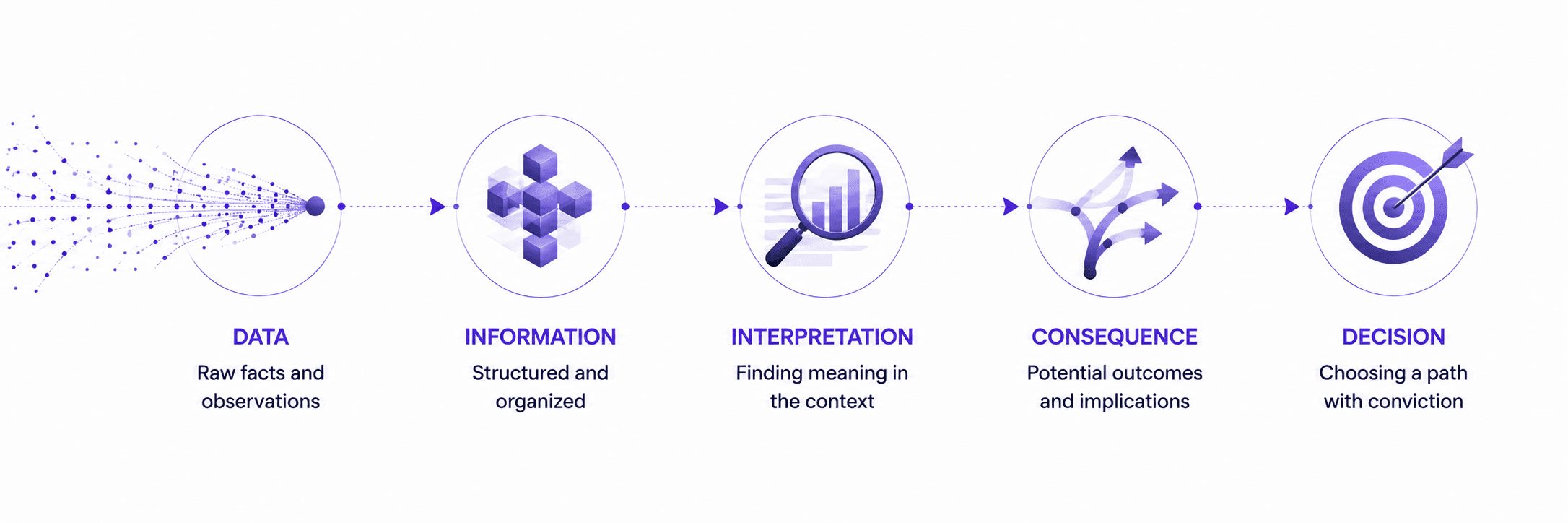
Technology has spent decades making the left side cheaper. Capital markets continue to pay enormous sums for the right side. That is why two intelligent investors can possess exactly the same information and take opposite positions. It is why an investment committee can spend three hours debating a company whose historical financial statements everyone in the room has already read. It is why markets exist at all.
If information mechanically produced one objectively correct conclusion, there would be considerably less need for investors. We could simply upload the annual report and await the answer.
But the future refuses to cooperate. And this brings us to a distinction that becomes extremely important in the AI age. Not all uncertainty is the same.
To understand why AI is not merely “Bloomberg 2.0,” we have to dismantle the journey from information gathering to making judgment.
Information is descriptive. It is the record of what exists or what occurred:
A company’s quarterly revenue was $412 million.
The 10-year Treasury yield is 4.28%.
Creditor A has a senior secured lien on the inventory.
The EBITDA adjustment on page 87 includes $14M of “non-recurring restructuring costs.”
Information is a commodity. In 2026, its marginal cost of distribution is zero.
Judgment, by contrast, is evaluative, predictive, and evidentiary. It is the synthesis of conflicting information under conditions of uncertainty to take accountable action:
Is that $14M EBITDA add-back legitimate recurring operational burn disguised as restructuring?
If we issue this mezzanine debt tranche, will the inter creditor agreement allow the sponsor to strip the collateral in a downturn?
Is management’s projected 30% margin expansion physically compatible with their capital expenditure plan?
Are we taking liquidity risk, credit risk, or governance risk and are we getting paid for it?
AI is the first technology in human history that functions as a judgment partner. It answers: “What does the data imply, where does the narrative contradict the numbers, and what is the evidential chain that supports this conclusion?”
When a legacy bank adopts AI by placing a conversational chat widget on top of a market data feed, they have succumbed to the Bloomberg Illusion. They think they bought an intelligence system. In reality, they bought a faster search bar for an information silo.
4. Reducible vs. Irreducible Uncertainty
Suppose you are considering acquiring a company or helping your client acquire one. You have thousands of documents. Contracts. Customer data. Financial statements. Emails. Management presentations. Market research. Legal agreements. Board materials.
There are things you do not know because nobody has yet done enough work. And there are things you do not know because nobody can know them. Those are completely different problems.
I would divide them into two categories.
Reducible Uncertainty
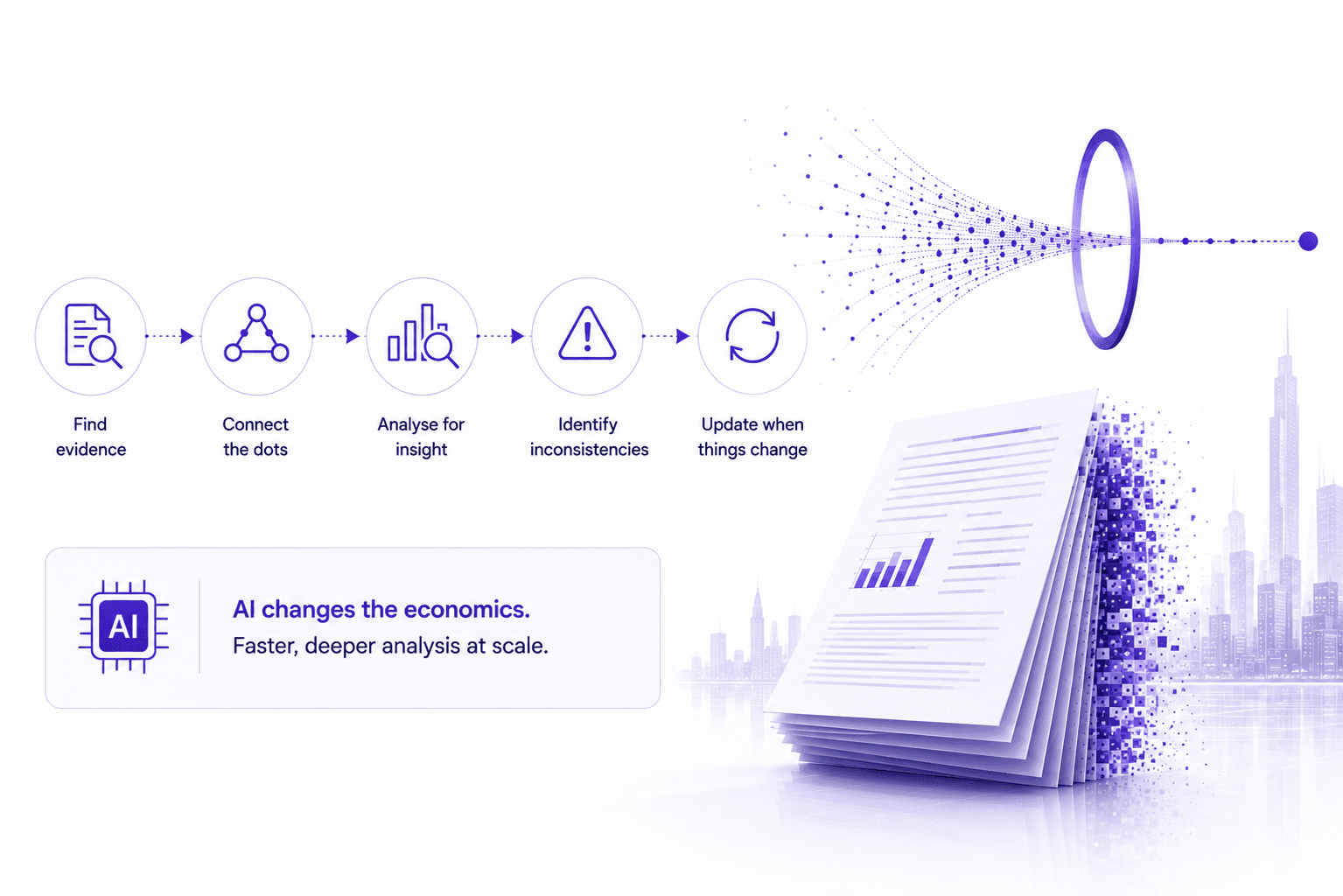
This is uncertainty created by incomplete work. What does this contract actually say? How concentrated are the company’s customers? Do the numbers in the management presentation reconcile with the audited accounts? Has management changed the definition of adjusted EBITDA? Which comparable transactions are genuinely comparable? What assumptions drive the model? Where do different documents contradict each other? Has this risk appeared before? What did management previously say about it?
These questions have answers. The evidence exists somewhere. The uncertainty remains because finding, connecting and analysing that evidence requires time and effort. Historically, capital markets solved this problem with human labour. Lots of it.
Interns brought boxes of documents. Analysts read. Associates checked. Vice presidents reviewed. Lawyers reviewed the reviewers. Consultants built workstreams. Somebody ordered pizza. Interns paid the pizza delivery guy and brought it back to the desk at 2 A.M. Trust me - been there and done that. The transaction moved forward. No pizza, no deal.
AI changes the economics of this category dramatically. A machine can read every available document. It does not become tired on page 427. It does not skim the appendix because it is 2:13 a.m. It can compare documents simultaneously. It can search enormous datasets. It can identify inconsistencies. It can rerun analysis when assumptions change. Most importantly, AI does not eat pizza. It eats tokens :)
And these capabilities will continue improving. Which means a significant amount of uncertainty that institutions historically accepted as an unavoidable feature of complex transactions may turn out to have been something else entirely.
A bandwidth problem. That is reducible uncertainty. And AI should increasingly crush it. But then we reach the second category.
Irreducible Uncertainty
Will China invade Taiwan? Will Trump speak today? Will this founder remain effective when the company becomes ten times larger? Will consumers still want this product in 2031? Will regulators change the rules? Will the Federal Reserve cut rates? Will a competitor invent something better? Will the merger actually generate the promised synergies? Will management panic during a crisis? Will the market care?
You can collect more information. You can construct scenarios. You can study history. You can interview experts. You can build models so beautiful that somebody eventually puts them in a board presentation. But you cannot make the future disclose itself.
This is irreducible uncertainty.
It exists because the world has not happened yet.No Bloomberg terminal fixes that. No language model fixes it either. And that matters because it gives us a much more sensible way to think about AI in capital markets.
The goal is not omniscience. It is not an artificial oracle whispering next year’s S&P 500 level into the CEO’s ear. It is something both more modest and more consequential.
The purpose of AI in markets is not to eliminate uncertainty.
It is to eliminate the uncertainty we have no excuse for still having.
5. From Better Telescopes to Better Questions
We assumed that if the telescope became powerful enough, uncertainty would disappear. It didn’t. It multiplied. Because seeing more of the world also means discovering more things that might matter.
Every new dataset creates another possible explanation. Every new signal creates another possible contradiction. Every new model creates another set of assumptions. Information abundance does not abolish uncertainty. It changes its shape.
That is why I think the coming AI transformation of capital markets will be misunderstood if we measure it merely by how much information machines can produce. We already have enough information. Quite possibly too much.
The more interesting question is whether machines can help us build a clearer hierarchy of relevance:
What do we know? What do we merely think? What contradicts our thesis? What could we know if we did more work? What can nobody know yet? And finally: What uncertainty are we actually being paid to take?
That last question matters most.Because the purpose of finance was never to eliminate uncertainty. If the future were certain, capital would require considerably fewer bankers, investors, traders, analysts and risk committees. There would be no great debate about valuation.
No disagreement about credit. No competing investment theses. No need to decide what risk deserves what return.
There would simply be arithmetic. Capital markets exist precisely because the future is uncertain. Their function is to move capital through that uncertainty.
To decide which risks deserve funding. Which companies deserve capital. Which promises deserve credit. Which assets deserve what price. Which futures are worth betting on. AI does not change that fundamental purpose. It changes something immediately before it.
Not a market that knows everything. A market that becomes much clearer about what it cannot know. AI’s opportunity is to help us decide where to point it, what deserves disbelief, and which uncertainty is real. Because capital markets were never created to know the future. They were created to put a price on not knowing it.
6. If Intelligence Is Abundant, What Are We Charging For?
When information was scarce, banks charged for access. When execution was manual, banks charged for labor. When financial models were difficult to build, banks charged for technical complexity.
Today, access is universal. Labor is automatable. Complex financial models can be constructed, stress-tested, and audited by autonomous agents in less time than it takes an associate to open Microsoft Excel. If intelligence is abundant and friction is zero, what is an investment bank actually selling?
It is not selling the Pitchbook.
It is not selling the Model.
It is not selling the Bloomberg Terminal.
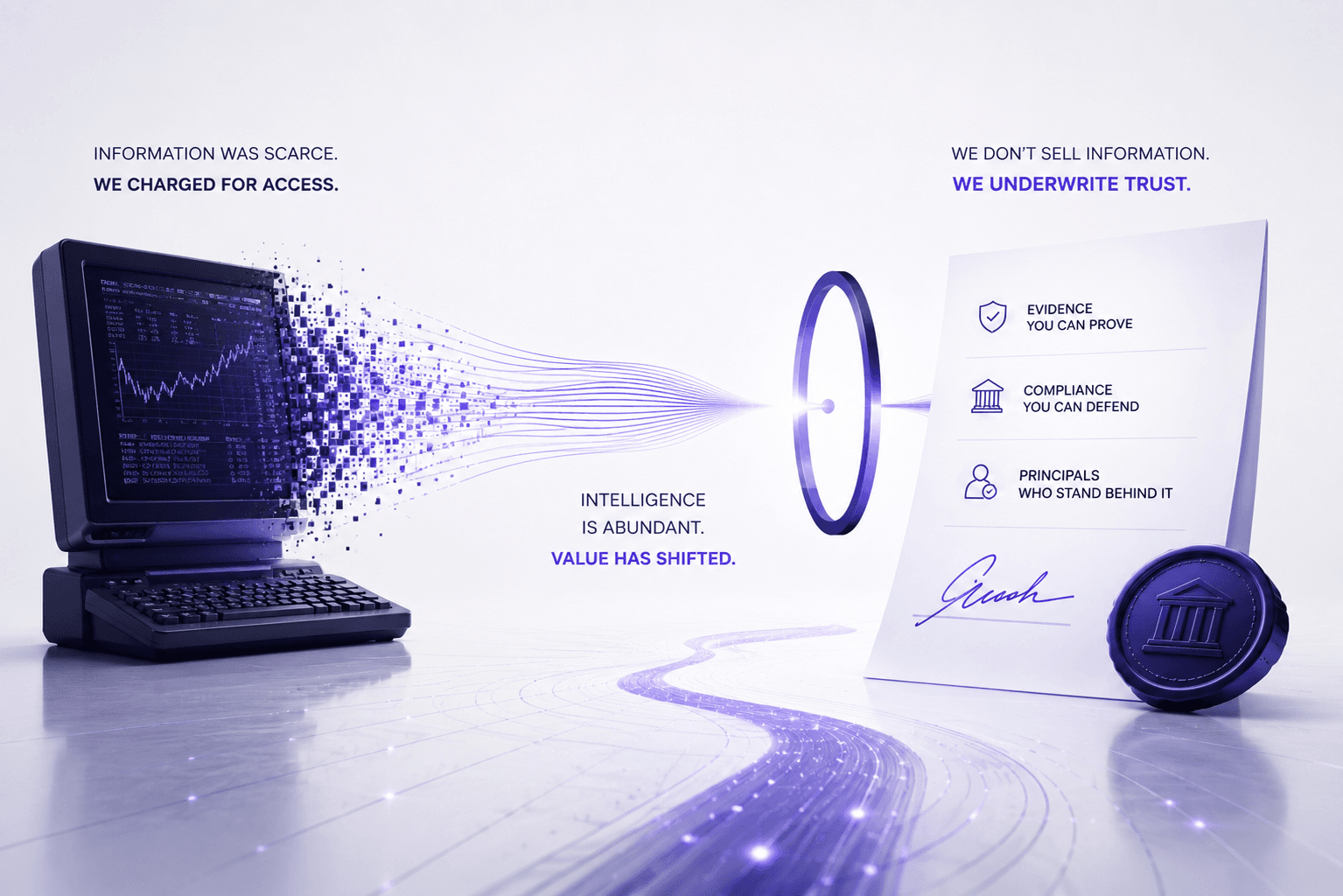
It is selling Underwritten Trust:
- The Evidentiary Chain: The immutable proof that every fact, assumption, and risk parameter has been audited against ground truth.
- Regulatory & Fiduciary Defensibility: The legal and structural architecture that guarantees compliance cannot be compromised by human fatigue or rogue shortcuts.
- Accountable Human Balance Sheet:The willingness of a human principal to sign their name, risk their capital, and assume liability for the outcome.
The Bloomberg era taught finance to worship the screen. The AI era will force finance to re-learn the art of the signature. For forty years, we mistook the glow of the dual-screen terminal for the light of intelligence.
We built trillion-dollar empires on the premise that whoever gets the headline two seconds faster wins the deal. That game is over. In a world where every machine possesses all the information instantly, speed is table stakes and data is ambient air. The future of finance does not belong to the institution with the most terminals or the largest army of human compilers. It belongs to the institution that builds an immutable architecture of judgment and has the courage to stand behind it.
What do you think?
If intelligence is becoming abundant, what is a financial institution actually being paid for?Is the future of finance about having the best AI? Or about building the institution that can turn abundant intelligence into judgment people can trust?
Because when machines can find the information, build the model, test the assumptions and surface the risks, the scarce asset may become something very different:
- Evidence
- Accountability
- Conviction
- Trust
And perhaps the bigger question: When intelligence becomes a commodity, does trust become the real product?
We’d genuinely love to hear how bankers, investors, founders, and builders are thinking about this transition especially those who have seen firsthand how financial decisions actually get made.
Have a different view? I’d love to hear it. Leave a comment or reach out.