A Walk Into Goldman Sachs, 2036
Every great financial institution is perfectly designed for the technology of its time. This is the story of what happens when a revolutionary technology arrives.
For the last few months, I’ve become obsessed with a deceptively simple question.
If we were building Goldman Sachs from scratch today, knowing everything we know about Artificial Intelligence... Would we even build a Goldman Sachs?
I don’t mean the brand. Or the people. Or even the business. I mean the institution itself. Its organisational chart. Its workflows. Its hierarchy. Its committees. Its culture. It’s economics.
Would we build it the same way? I don’t think we would. And that’s not because Goldman Sachs is broken. It’s because every great institution is perfectly designed for the technology of its era.
Banks have survived wars, depressions, financial crises, rogue traders, countless “once-in-a-century” events, and more economists’ predictions than economists would care to remember.
My bet is that Artificial Intelligence won’t be the first thing that kills them. It will be the first technology that forces them to quietly rebuild themselves from the inside out.
The name on the building will survive. The marble lobby will probably survive. The regulators will almost certainly survive they seem to have discovered the secret to eternal life.
But the jobs, the workflows, the economics and perhaps even the definition of expertise will be almost unrecognisable.
History suggests that institutions rarely disappear overnight. They simply wake up one day looking nothing like the institutions they used to be.
In the 1800s, a bank’s competitive advantage was often the speed of its horse. In the early 1900s, it became the speed of the telegraph. Then came the telephone. Then Reuters. Then Bloomberg terminals. Then Excel. Then the Internet.
Every generation confidently declared that the latest technology had transformed finance forever. Every generation was right. Just not in the way it expected. Each wave made finance faster.
The Roman Empire wasn’t built for airplanes. Otherwise Julius Caesar and the Senate would probably have spent more time arguing over lounge access than conquering Gaul. Kodak wasn’t built for digital photography. Blockbuster wasn’t built for streaming. Nokia wasn’t built for the App Store.
Great institutions rarely fail because they’re badly run. More often, they continue winning yesterday’s game long after the rules have changed. Perhaps today’s financial institutions were never designed for a world where intelligence itself has become programmable.
Don’t get me wrong. Every major bank is investing billions into AI. Every CEO has an AI strategy. Every board has an AI committee. Every consultant has an AI maturity framework with seven coloured boxes, three arrows pointing upwards and a final slide titled “The Journey Ahead.” If PowerPoint alone could reinvent financial institutions, Wall Street would have finished the AI revolution years ago.
The reality is much less glamorous. Buying AI is easy. Redesigning a two-hundred-year-old institution around it is something else entirely.
In 1869, when Goldman Sachs was founded, banking was almost entirely a relationship business. Information travelled at the speed of paper, ships and telegraphs. A partner’s reputation was often worth more than the firm’s balance sheet.
By the 1980s, the competitive advantage had shifted. Bloomberg terminals, electronic trading and global communications made information abundant. The winners weren’t necessarily the people who knew the most. They were the people who could process information faster than everyone else.
By 2010, when I was spending my days inside large financial institutions, another pattern had emerged. Banks had become extraordinary at moving information. But they were still remarkably dependent on humans to produce judgment. Analysts built models. Associates built pitch books. Managing Directors made the final call. Technology accelerated the work. It didn’t fundamentally change who did the thinking.
I don’t think that will be true for much longer. So allow me to take you somewhere.
It’s Monday morning. August 2036. and I walk into the future Goldman Sachs. The marble lobby is still there. The logo is still there. The regulators are still there too (Some things, thankfully or unfortunately, seem to outlive every technological revolution).
What isn’t there is the reception desk. A lady smiles before I introduce myself. Or so I think. A second later I realise she isn’t a woman at all. She’s a humanoid robot. Whether it was a Tesla Optimus, a Unitree, or something that finally convinced America and China to agree on one standard, I couldn’t tell. By 2036, asking whether someone is human has become about as socially awkward as asking their age.
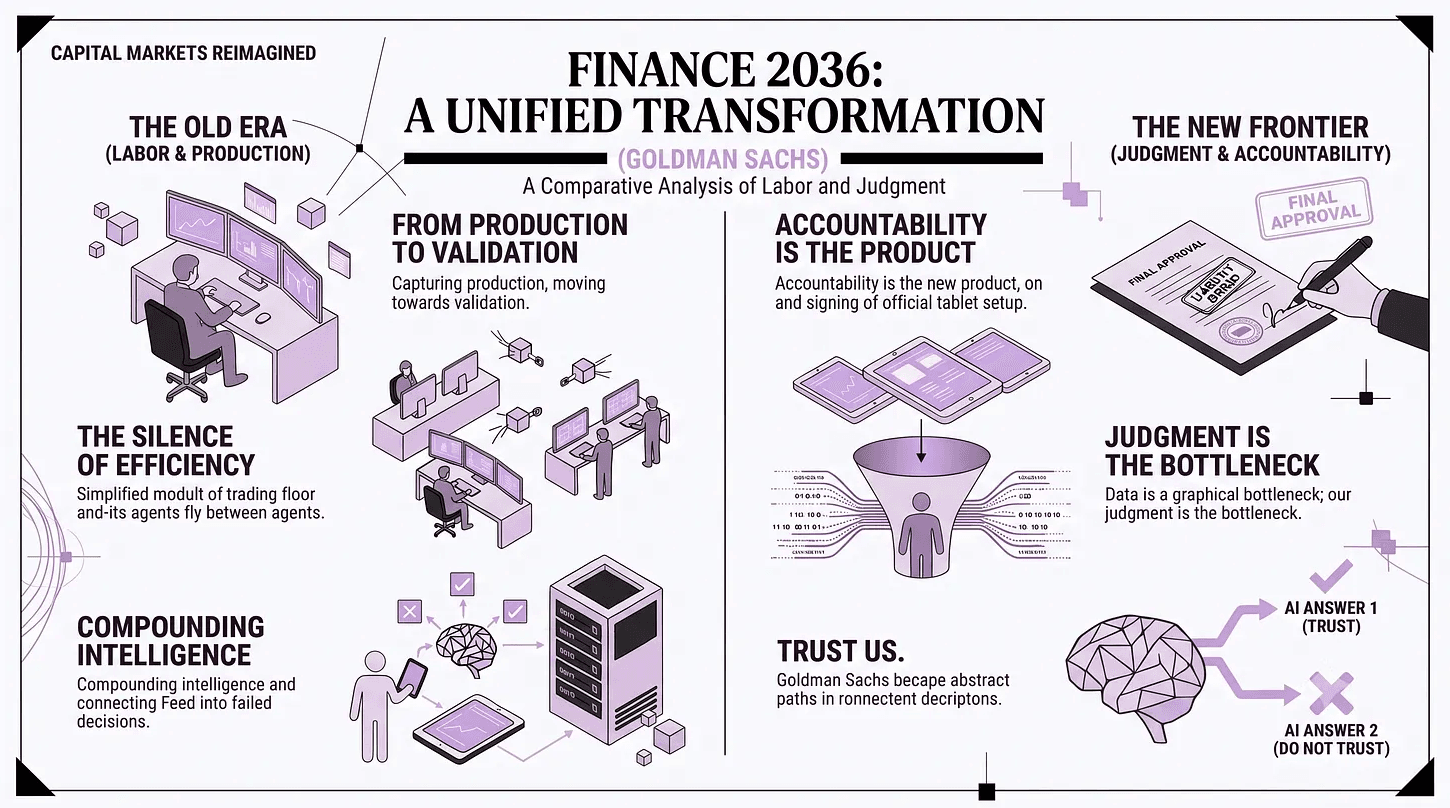
“Good morning, Sankalp. Marcus is expecting you on twenty-nine.” I don’t ask how she knows. In 2036, that’s like asking how Wi-Fi works. The elevator already knows where I’m going.
To be honest, I’m already beginning to see glimpses of this future today in New York and Singapore, two cities where I spend most of my time. The future never arrives all at once. It leaks into a few cities first, looking slightly ridiculous before it starts looking obvious. Waymo is a classic hot narrative of our times - gradually creeping into our lives while Elon decides when to release that driverless Tesla on Mars with Grok guiding it and navigating via Starlink.
Back to the future - The first thing I notice isn’t what I see. It’s what I don’t hear.
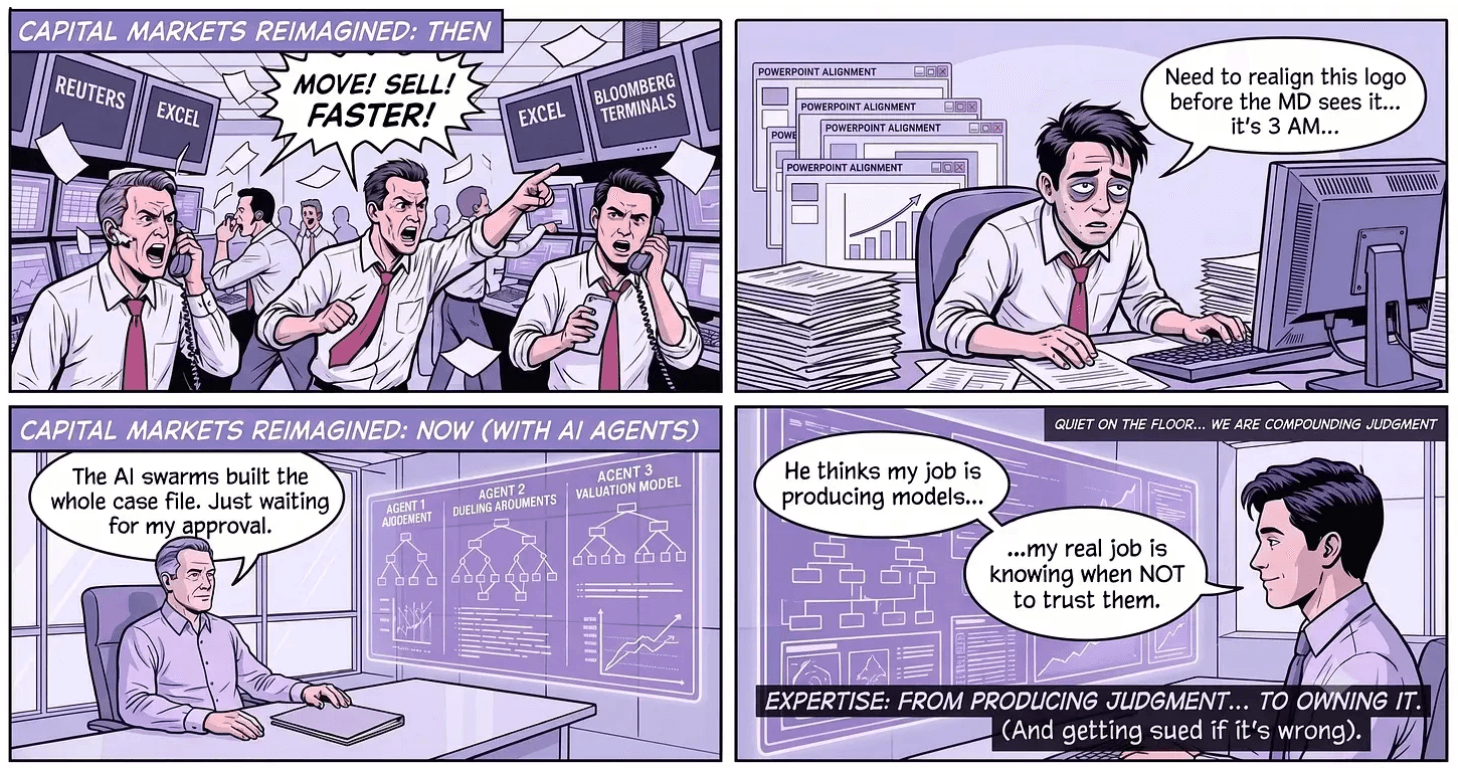
For almost two centuries, trading floors were designed to be loud. Noise meant activity. Activity meant markets. Markets meant money. I’ve been there. I spent years inside some of the world’s largest financial institutions before deciding to build one of my own.
Back then, if the floor was quiet, somebody was probably about to lose a lot of money. Now the floor is almost silent. Not because there’s less work. Because the work has changed.
There are no analysts frantically rebuilding financial models at two in the morning. No associates debating whether a logo should move two pixels to the left as though civilisation itself depended on PowerPoint alignment. No junior banker is spending three nights copying numbers from one spreadsheet into another. In fact, one thing strikes me immediately. For decades, every deal had multiple versions of reality.
“The CRM has one version of reality.”
“Bloomberg has another.”
“The virtual data room has another.”
“The financial model has another.”
“The analyst knows something.”
“The partner knows something.”
“The lawyer knows something.”
“The credit & compliance team knows something.”
Those jobs didn’t disappear. The definition of the job changed.
Reading this, you might think this is science fiction. It isn’t. Over the past few months, while building Brexy.ai, we’ve quietly rebuilt large parts of this workflow ourselves. Today, AI Brexy agents can already read data lakes, aggregated virtual data rooms, analyse financial statements, build valuation models, draft investment memorandums, perform due diligence and challenge each other’s conclusions before a human ever opens the file.
We’re nowhere near the destination. But we’re probably much closer than most people realise. The leap from here won’t be linear. Like every technological revolution before it, it will feel gradual.....until one day it feels sudden. Imagine three years ago Open AI did not exist properly. Or 30 years Apple was relatively unknown. Now Imagine next 10 years……….
A young analyst notices me looking around. He can’t be older than twenty-six. He turns his screen towards me. Not enough for me to read it. Just enough for me to understand what I’m looking at. “This is the case file,” he says.
The AI generates the valuation - LIVE. Built four capital structures. Drafted the investment memorandum and updates it weekly for the Agent Committee to provide feedback. Reviewed the legal documentation and send to the Legal & Liability Officer. Stress-tested every assumption. Compared to every historical transaction. Argued with itself. Disagreed with itself. Changed its own mind three times. Even politely highlighted where my own investment thesis was internally inconsistent.
“So what do you do?” I ask. He smiles. “I try to prove it’s wrong.”
“How often is it wrong?” “Less often than I am.” He pauses. “But when it’s wrong, it’s wrong in ways I would never imagine.So my job isn’t to produce the first draft anymore. It’s to know when not to trust it.”
At that moment I realised something. THAT IS THE NEW JOB PROFILE.
The analyst hasn’t become less important. He’s become more important. His value no longer comes from producing judgment. It comes from validating it. Trying to find flaws in AI’s judgement. And by AI I actually mean swarms of agents reporting to their AI master and the AI master producing judgements and documents - to be judged by another human - analyst in this case.
A Managing Director then welcomes me into a meeting room. There is no corner office. No oversized desk. No army of business managers, compliance, IT Staff. Nothing. Status has quietly become less architectural. A single physical folder sits on the table.
I point towards it. She notices. “That’s the only thing I sign.”
“The AI built everything inside it, I didn’t write the analysis. I just challenged it till I was satisfied and then I approved it.”
“And if it’s wrong...”She taps the folder gently. “...I’m the one who gets sued.”
I laugh….nervously. “So liability became your job description?”
She laughs back. “It always was. We just confused production with responsible judgement.”
That sentence stays with me for the rest of the day. For almost a century, we believed the value of expertise came from producing answers. Perhaps the future belongs to the people who know which answers NOT to trust.
As we walk through the building, she points to a wall-sized sheet of glass. My first thought is Minority Report. Instinctively I look around for the Precogs floating in a tank somewhere in the basement. I never find them. Instead I find something much more powerful.
Every significant investment decision made across the firm is displayed as a living history. Every recommendation. Every assumption.Every disagreement between agents. Every human override. Every final decision. Every outcome. Nothing is deleted. Everything becomes evidence.
For the first time, I realise the institution isn’t getting smarter because it has better AI. It’s getting smarter because it remembers.
“What happens to bad decisions?” I ask. “They don’t disappear. They become training data.”
“We either compound our judgment......or we compound our mistakes.”
Walking out of the building, one thought refuses to leave me. For two hundred years, every technological revolution made finance faster.
The telegraph accelerated communication. Bloomberg accelerated information. Excel accelerated analysis. The internet accelerated distribution. None of them challenged the real bottleneck.
Judgement
Artificial Intelligence is the first technology in financial history that doesn’t simply move judgment faster. It participates in creating it. That doesn’t make financial institutions obsolete. The strange part is that, from where I sit, this isn’t a prediction anymore. It’s becoming a creative and thoughtful engineering problem.
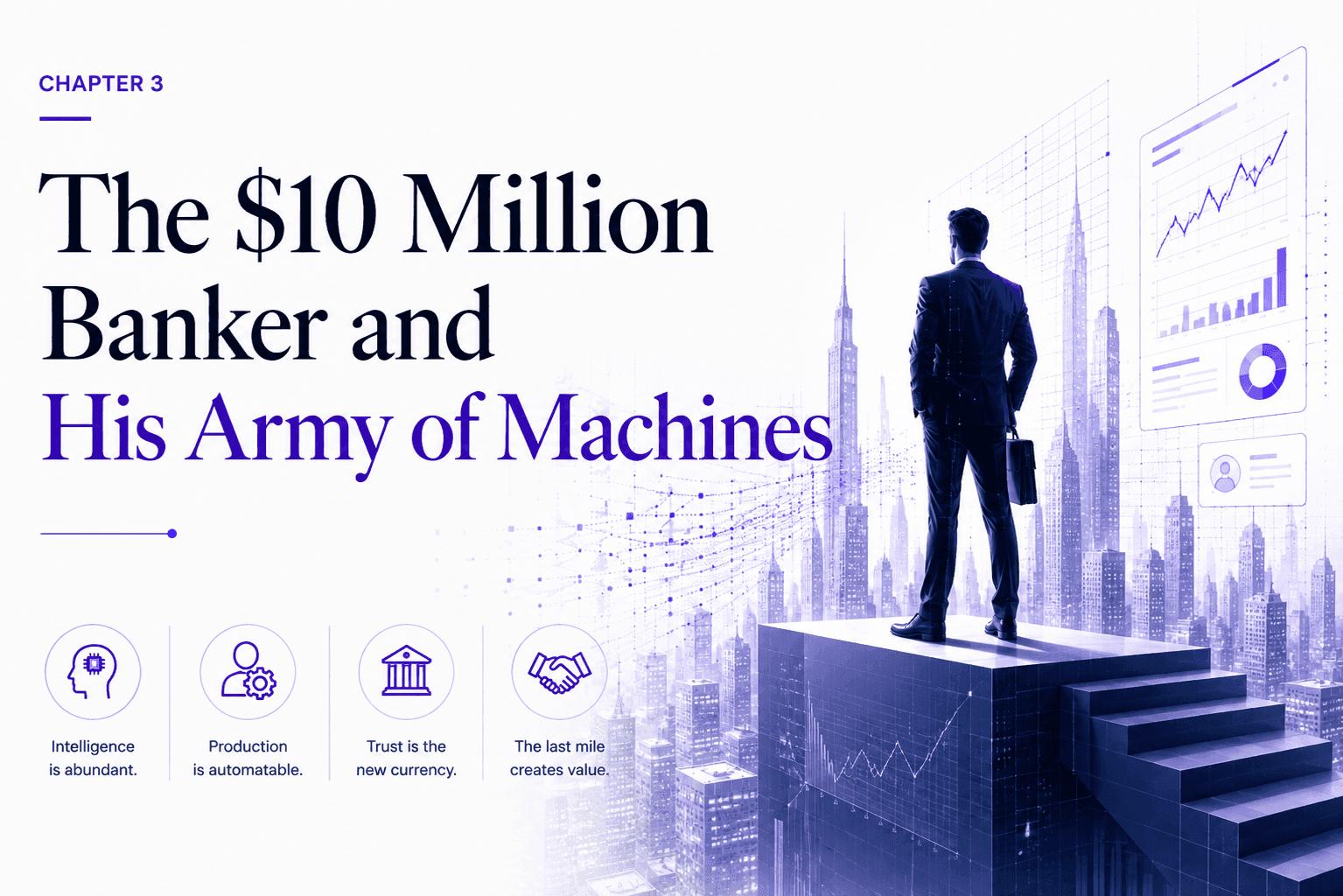
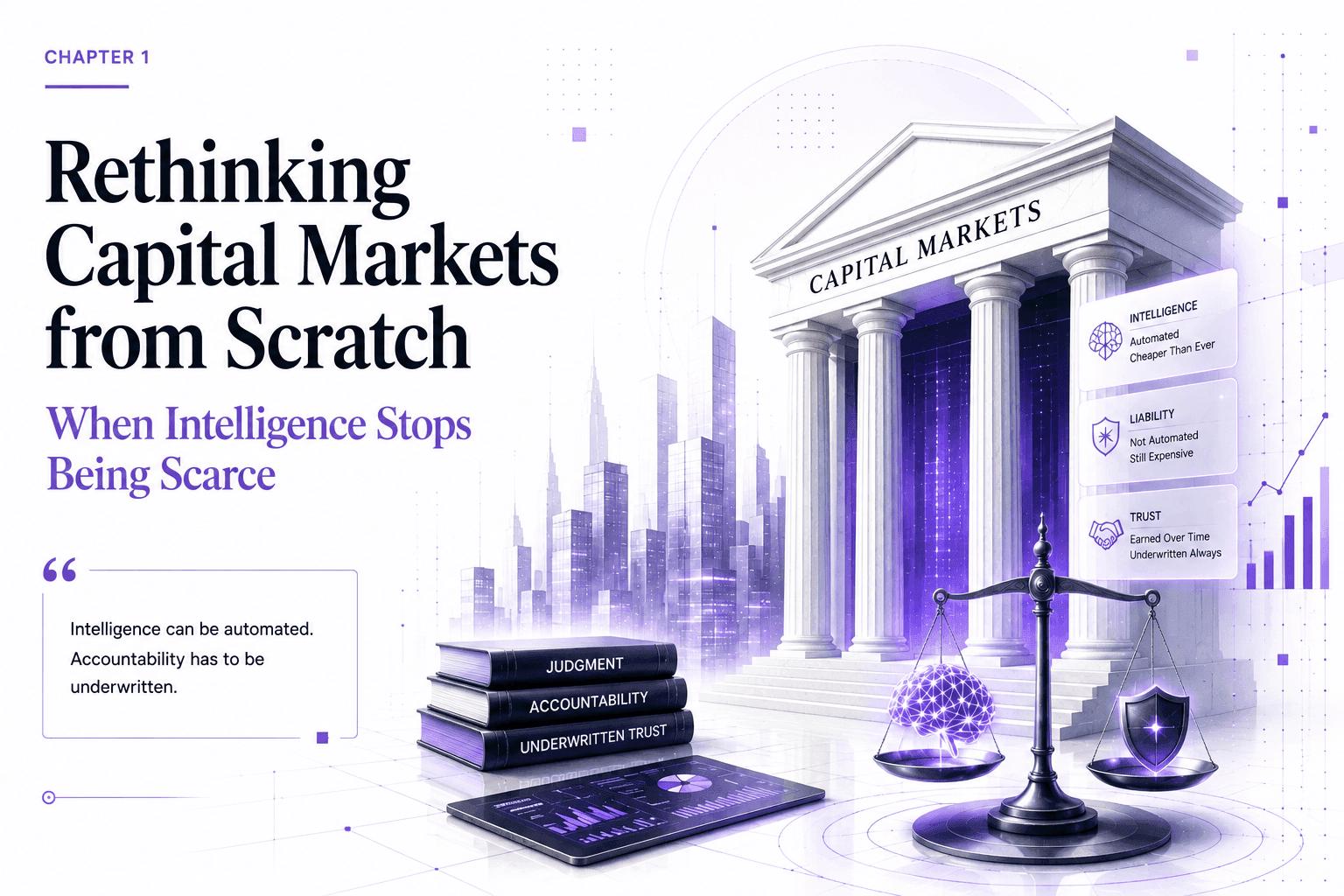
Ironically.…It makes them even more necessary. Because intelligence may become abundant. Computation may become almost free. Even expertise may become increasingly commoditised. But accountability remains gloriously expensive. Someone still has to sign the folder. Someone still has to answer the regulator. Someone still has to stand behind the balance sheet. Someone still has to look a client in the eye and say,
Perhaps that is the real story of AI. Not that machines are replacing humans. But humans are finally being liberated from producing judgment......to owning it.
This is my first essay in a longer journey.
Over the coming months, I’ll explore a question that I believe will define the next generation of capital markets.
If we were building the world’s greatest financial institution today... what would we build differently?
Because I have a suspicion. The next Goldman Sachs or whatever it’s called won’t win because it has the best AI. It will win because it understood, earlier than everyone else, the difference between intelligence….....and responsibility.
One final thought. At Brexy.ai, we spend our days building AI for investment banks, private equity firms and capital markets professionals. Every day convinces me of one thing:
The question is no longer whether AI will transform financial institutions. The only question is which institutions will redesign themselves before everyone else does. That’s the journey I’m documenting in this series.
What do you think?
If you were building Goldman Sachs from scratch today, what would you build differently?
Leave a comment below or reach out. I’m genuinely curious to hear how founders, bankers, investors, and builders are thinking about this transition.
I regularly share insights on AI, capital markets, investment banking, and the future of financial institutions.
If you enjoyed this piece, consider subscribing to Capital Markets Reimagined.