Rethinking Capital Markets in the Age of AI
Wall Street did not build a hierarchy because bankers loved titles. It built one because intelligence was expensive.
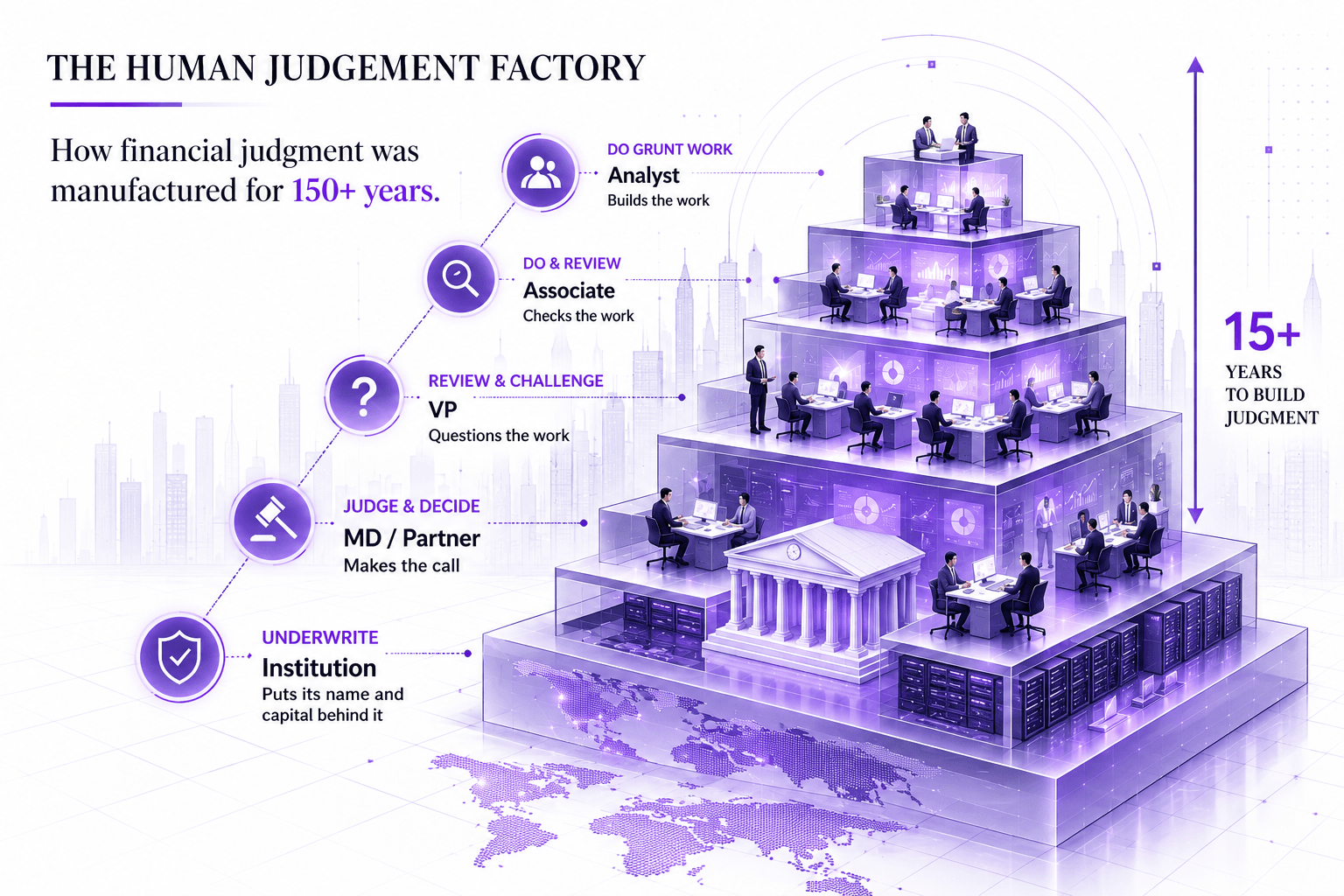
For more than 150 years, financial institutions have been perfecting one of the most sophisticated machines ever created for producing financial judgment.
The modern investment bank is not merely a collection of people, Bloomberg terminals and expensive suits moving urgently between meetings. It is an industrial system for manufacturing judgment.
And that system was designed around the defining constraint of its age: Human intelligence was scarce.
If you wanted more judgment, you needed more intelligent humans. If you wanted more intelligent humans to work together, you needed hierarchy. And if you wanted that hierarchy to produce consistently good decisions, you needed experience, repetition, supervision and time.
So Wall Street developed a remarkably effective production line: Hire intelligent humans. Give them an enormous amount of work. Analysts. Let them make small, survivable mistakes. Teach them to catch other people’s mistakes. Associates. Put more experienced humans above them to review the work, challenge assumptions and occasionally ask why the font changed on page 37. VPs and SVPs. Repeat the process for a decade or so. Directors.
Eventually, a small number become very good at making decisions where the consequences are measured not in PowerPoint comments, but in hundreds of millions of dollars. Managing Directors. Promote the survivors. Partners. Management. Then recruit another class of bright twenty-somethings and begin again.
Rinse. Repeat. Promote.
It sounds faintly medieval when written down apprentice, journeyman, master except the monastery now has Bloomberg terminals, the monks wear Zegna, and the disciples are mysteriously still editing Excel at 2 a.m.
But there was nothing stupid about this system. This worked. It’s still working. It was an extraordinarily rational response to intelligence scarcity.
The pyramid existed because judgment could not be copied. Experience could not be downloaded. Pattern recognition could not be summoned on demand. An institution could only manufacture senior judgment slowly, by pushing human beings through thousands of transactions, mistakes, negotiations, crises and committee rooms until experience became instinct.
However, we have a new intelligent sheriff in town. AI changes the economics of intelligence itself. And when the economics of the raw material changes, eventually the factory has to change with it. But first let’s understand the economics of this factory as it exists today.
1. Have You Ever Thought What the Banker Actually Sells
Every great technology arrives in finance promising to kill the banker. Somehow, the banker survives usually with a larger bonus and a more expensive machine.
This has happened before. Many times.
The telegraph was supposed to destroy the informational advantage of the great merchant banks. The telephone made communication instantaneous. The ticker brought market prices directly into the office. Computers industrialised calculation. Spreadsheets put financial modelling on every desk. Bloomberg put the world’s markets behind an orange keyboard. The internet made information almost universally available. Electronic trading removed armies of humans from exchange floors.
And yet here we are. Goldman Sachs has not become a museum. JPMorgan has not been converted into a WeWork. Private equity partners have not taken up subsistence farming.
Quite the opposite. Every technological revolution has destroyed part of finance’s old value proposition while making another part more important.
AI is simply the latest and potentially largest turn of that historical wheel.
So let us perform a small intellectual autopsy on JPMorgan. Jamie Dimon can relax. This one does not require regulatory approval. To understand what should change, we first need to understand what should not. So let’s strip a JP Morgan down.
What does it actually sell?
- Pitchbooks? Take them away. JPMorgan survives. Several forests may even recover.
- Financial models? Take them away. JPMorgan survives. A generation of analysts may have to confront the disturbing possibility that moving an EBITDA multiple from 11.7x to 11.9x was not actually the cornerstone of Western civilisation.
- Research? Increasingly commoditised. Take much of it away. JPMorgan survives. In fact this is one cost center that could be trimmed down considerably.
- Bloomberg terminals? Wonderful machines. But J.P. Morgan was financing railways, reorganising industrial empires and rescuing financial institutions almost a century before Michael Bloomberg persuaded Wall Street that orange text on a black screen was worth several thousand dollars a month. AI is available for few hundred a month with 10X productivity. JPMorgan survives.
- Analysts & Associates? Careful now. The institution changes considerably. Some VP’s & directors may have to reopen Excel themselves. A managing director may accidentally encounter PowerPoint without adult supervision. But the institution survives.
- Relationships? Now we are getting closer. Finance has always run on relationships because capital ultimately travels through networks of trust. But relationships alone cannot be the product. Davos contains enough well-connected people per square metre to reconstruct the Austro-Hungarian Empire. You still would not let most of them underwrite your $10 billion acquisition.
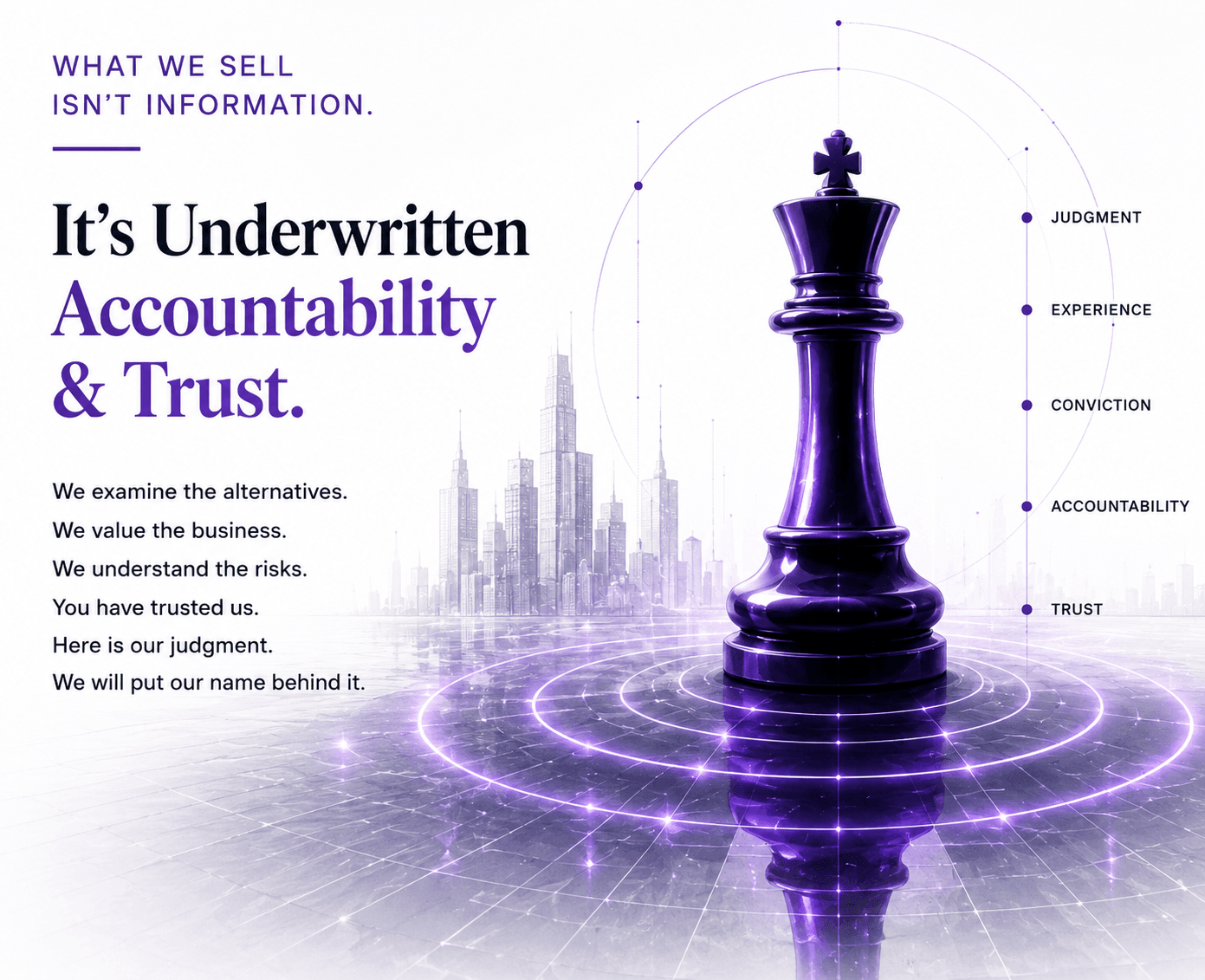
So keep stripping. Remove JPMorgan’s reputation. Remove its regulated entities. Remove its balance sheet. Remove its institutional memory. Remove its ability to commit capital. Remove its willingness to stand behind a transaction when everything goes magnificently wrong. Most importantly, remove its ability to say:
This is our judgment, and we will put our name behind it.
Now something fundamental disappears. Now you have removed the bank. Because what JPMorgan ultimately sells is not information. It is not analysis. It is not access. It is not even intelligence.
It sells underwritten trust. More precisely: Underwriting Accountability & Liability
But now this distinction becomes rather important when intelligence starts getting very cheap.
- Research is getting cheaper
- Analysis is getting cheaper
- Computation is getting cheaper.
- First drafts are becoming almost free.
- Even expertise may become increasingly commoditised.
Thanks to AI - that is all great but clients still demand accountability. Unfortunately, those lawsuits and legal bills from Harvey Reginald Specter have shown no corresponding decline in price. You know what I am talking about Mr Suits, don’t you?
Neither has the bank regulatory capital. Nor reputational damage. That distinction becomes enormously important in the age of AI as liability has shown remarkably little interest in following Moore’s Law.
AI may have a wonderful cost curve. Liability does not.
And however intelligent the model becomes, it still doesn’t wake up on Sunday morning worried that its photograph might appear on the front page of the Financial Times on Monday. That remains a distinctly human feature.
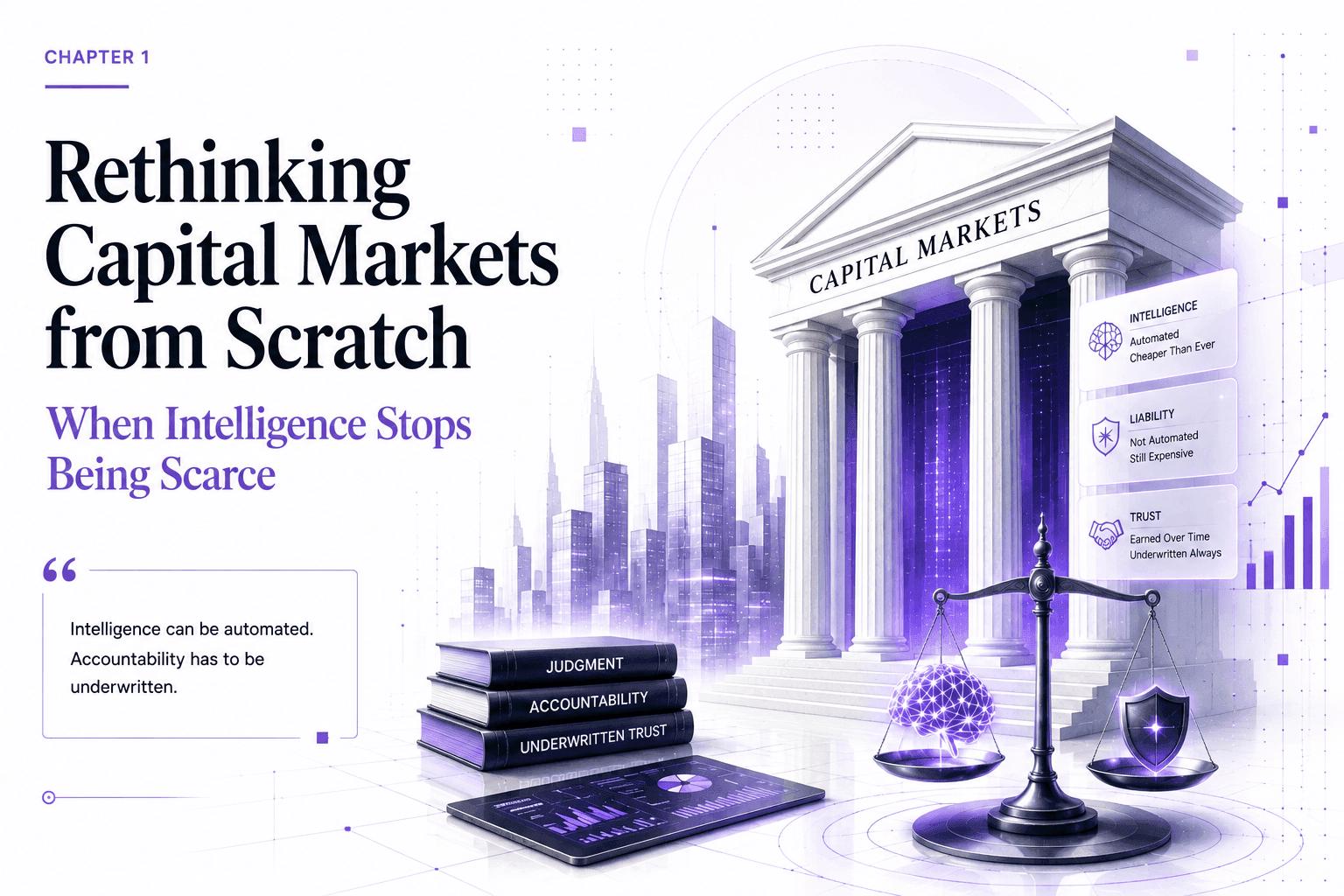
Intelligence can be automated. Accountability has to be underwritten. That may become one of the defining economic distinctions of the AI era.
2. The Human Pyramid - How Wall Street Manufactured Judgement
Before finance could automate intelligence, it had to manufacture it one exhausted graduate at a time.
For most of financial history, good judgment was frustratingly difficult to produce. You couldn’t download it. You couldn’t license it. You couldn’t API into it. And you certainly couldn’t ask a Managing Director to copy-paste twenty years of experience into the new analyst before Monday morning.
You had to grow it. So financial institutions built pyramids - Analysts. Associates. Vice Presidents. Directors. Managing Directors. Partners. Around them came Risk, Compliance, Legal, Operations, Finance, Technology and enough committees to make the Roman Senate look entrepreneurial.
Nobody really designed this as a central intelligence system. It evolved, like most financial infrastructure, over decades of transactions, crises and expensive mistakes.
A new risk appeared; somebody created a department. A scandal happened; somebody created a committee. The committee failed; somebody created another committee to supervise the first committee. This is approximately how both banking and government have evolved for centuries. And yet the pyramid worked remarkably well.
The model was hardly new. Medieval craftsmen had apprentices. Armies had junior officers. Medicine had residents. Law had articled clerks. The principle was always the same: Rinse, Repeat, Promote. Wall Street simply replaced the blacksmith’s hammer with Excel and removed control over the apprentice’s weekends.
An analyst didn’t spend until 2 a.m. rebuilding a merger model because the senior banker enjoyed observing human suffering. At least, not primarily. Repetition created pattern recognition. After modelling fifty companies, you started noticing which assumptions mattered. After reading twenty data rooms, you started noticing what wasn’t in them. After watching enough management teams present hockey-stick forecasts, you developed the useful financial ability to distinguish optimism from fiction. After hearing “there is absolutely no way this deal falls apart” often enough, you learned to treat it as a leading indicator that the deal was about to fall apart. Eventually, something difficult to quantify appeared.
Judgment.
This is how finance manufactured it. Work was the tuition fee. And Wall Street charged plenty of tuition. Take brilliant graduates. Give them Excel, Bloomberg, PowerPoint and theoretical ownership of their weekends. Make them solve similar problems hundreds of times. Put their work in front of increasingly experienced people who explain precisely why it is wrong. Repeat for fifteen years.
Congratulations. You have manufactured a senior banker.
Medieval? Slightly. Effective? Extremely.
The Bank Had Intelligence. But It Didn’t Really Have a Brain.
There was, however, a fundamental weakness. Most institutional intelligence lived inside people, not the institution. Inside people’s heads. Emails. Models. Committee papers. Bloomberg terminals. Legal documents. Risk systems. And the memory of the Managing Director who remembers why the bank rejected something remarkably similar in 2007. Essentially, the modern bank became: A biological neural network connected through Outlook.
Take JPMorgan’s London Whale in 2012. One of the world’s most sophisticated banks ultimately lost more than $6 billion on enormous synthetic credit positions inside its Chief Investment Office. The institution was hardly short of intelligence. It had traders, quants, risk managers, models, committees and some of the smartest financial professionals in the world. Pieces of the truth existed throughout the organisation.
The problem was that those pieces lived across different models, spreadsheets, people and hierarchies. Jamie Dimon initially called the issue a “tempest in a teapot.” The teapot subsequently lost $6 billion. This is generally considered poor crockery management.
The lesson was not that JPMorgan lacked smart people. The institution knew more than the institution could effectively know that it knew. That is the paradox of the human pyramid. It was extraordinarily good at manufacturing individual judgment, but far less effective at creating central institutional intelligence.
This wasn’t stupidity. It was an engineering constraint. The bank was built around the most sophisticated processing technology available for most of its history: Human beings. Humans remembered. Humans interpreted. Humans connected departments. Humans challenged each other. And because individual humans could process only so much information, institutions stacked them vertically.
Hierarchy was, in part, a solution to limited human bandwidth.
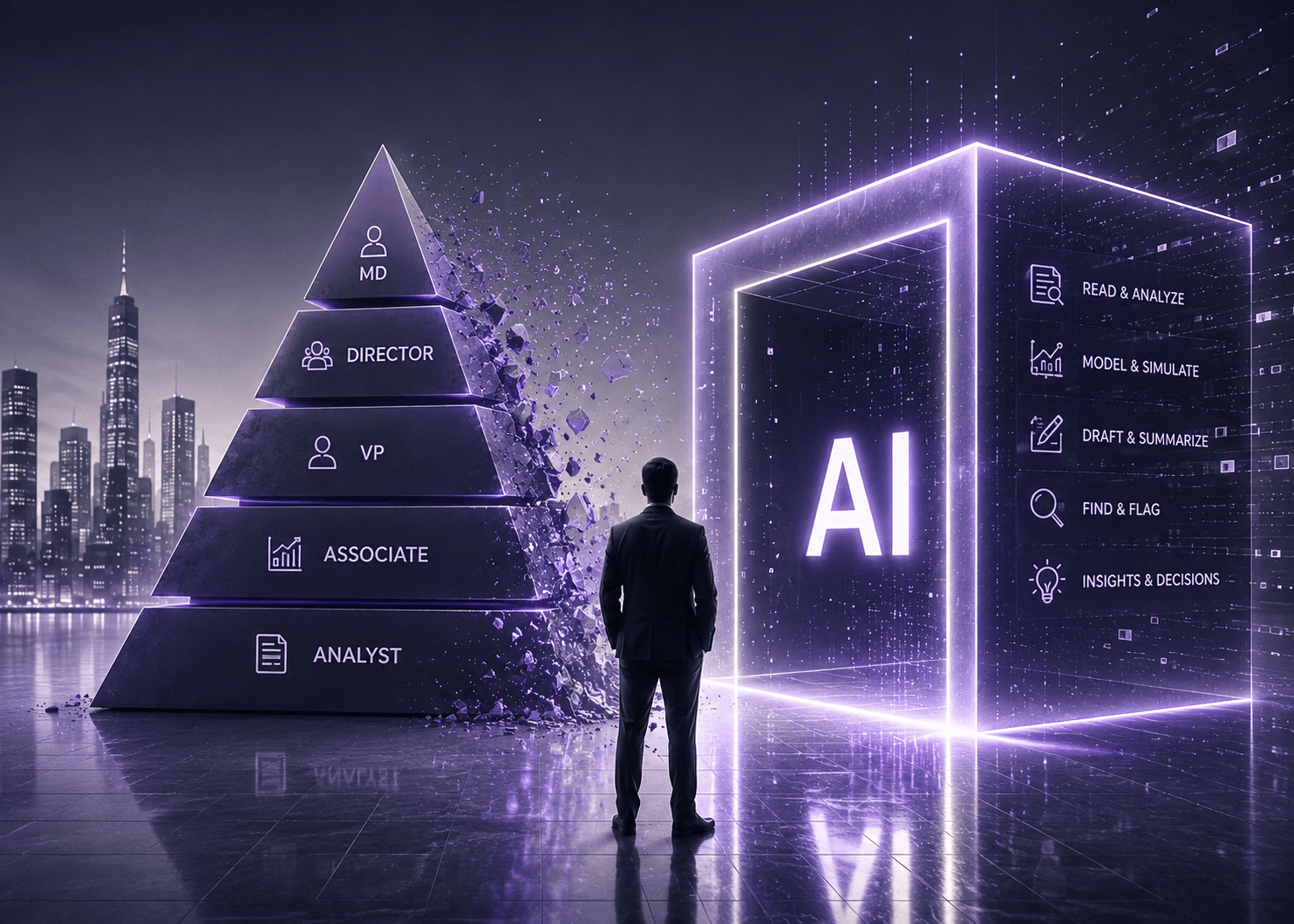
Wall Street May Automate the Analyst Before It Figures Out How to Manufacture the MD.
3. Faster Horses Are Still Horses, But Not Automobiles
Consider what is already possible with AI native operating systems today. A capital markets AI native operating system can already read thousands of pages from hundreds of private and public data sources, internal and external (with permission of course), before a human has finished locating the coffee machine.
It can extract financials - of public and private companies, compare competitors, build scenarios, search precedent transactions, summarise contracts,draft investment memoranda, identify inconsistencies between documents, generate questions for management, run sensitivities, and your chief of staff agent can challenge other AI agents before presenting a conclusion to a human analyst.
Much of this is exactly the grunt work junior financial professionals historically performed - for weeks, if not months, on a select few transactions.
This all sounds wonderful - and productive. And mostly it is. Although somewhere, I suspect, a Managing Director will continue asking for the logo to be moved two pixels to the left purely to maintain institutional culture. But there are a few compelling philosophical arguments for preserving the 2 a.m. pitchbook. Eliminating repetitive work creates an uncomfortable second-order effect. The repetitive work wasn’t merely producing documents. It was producing bankers - aka employment.
That’s the paradox. We spent years complaining that junior finance was full of mundane work. Now we may discover that some of the mundane work was secretly doing something useful. It created reps. And reps created intuition for senior bankers. And senior bankers created judgement.
AI can remove the reps. It cannot automatically replace what the reps produced. That gives us a problem I think almost every professional institution not just finance is about to confront:
The first response from financial institutions is entirely rational, and expected.
Give everyone AI. Give them Copilots. Research assistants. Coding assistants. Internal chatbots. Agentic workflows. Automated meeting notes. Automated compliance. Automated analysis. Automated PowerPoint, which may finally resolve one of humanity’s longest-running productivity crises. There are plenty of startups and apps for each of these.
All of this matters. But there is a difference between AI-enabled and AI-native. Very few are, however, thinking about at the operating system level. 10 years ahead, not the IPO ahead. And I suspect a lot of money will be spent discovering it. After all VC’s & PE need to earn their worth.
Giving every banker an AI copilot and declaring yourself AI-native is a little like giving every horse in 1905 a better saddle and announcing that you’ve invented the automobile. The horse is unquestionably more productive. But that is not what “Fast & Furious” meant.
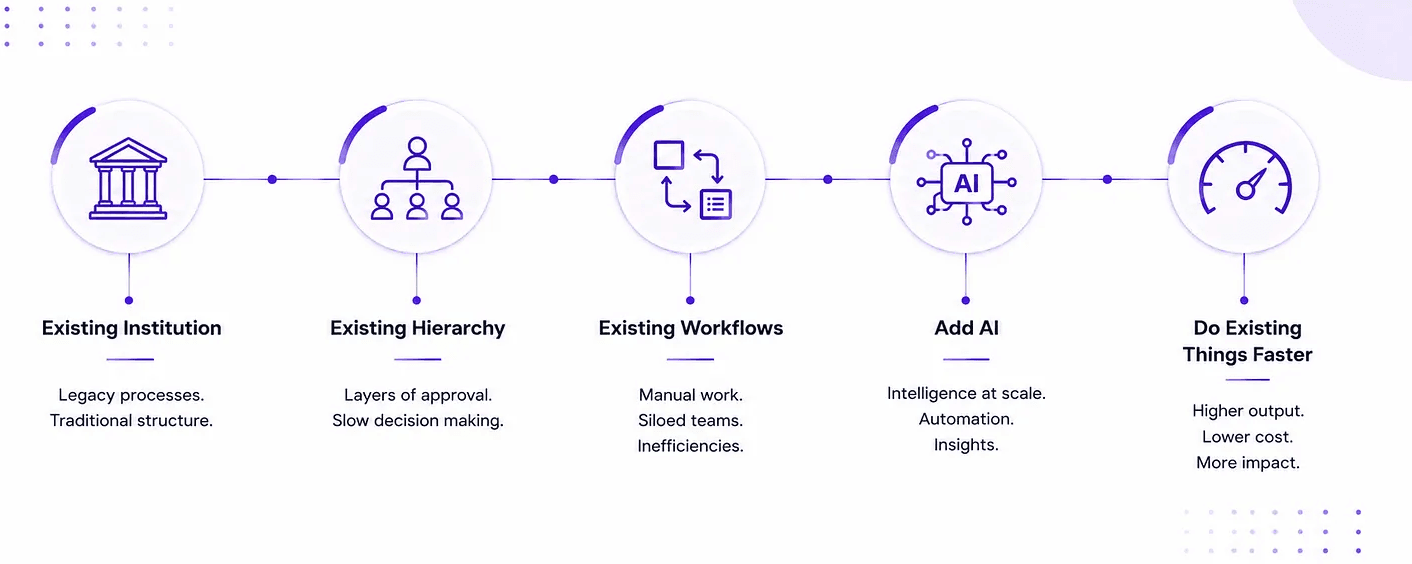
Most institutions understand that today, and are understandably asking: How can AI make our existing people and workflows faster?
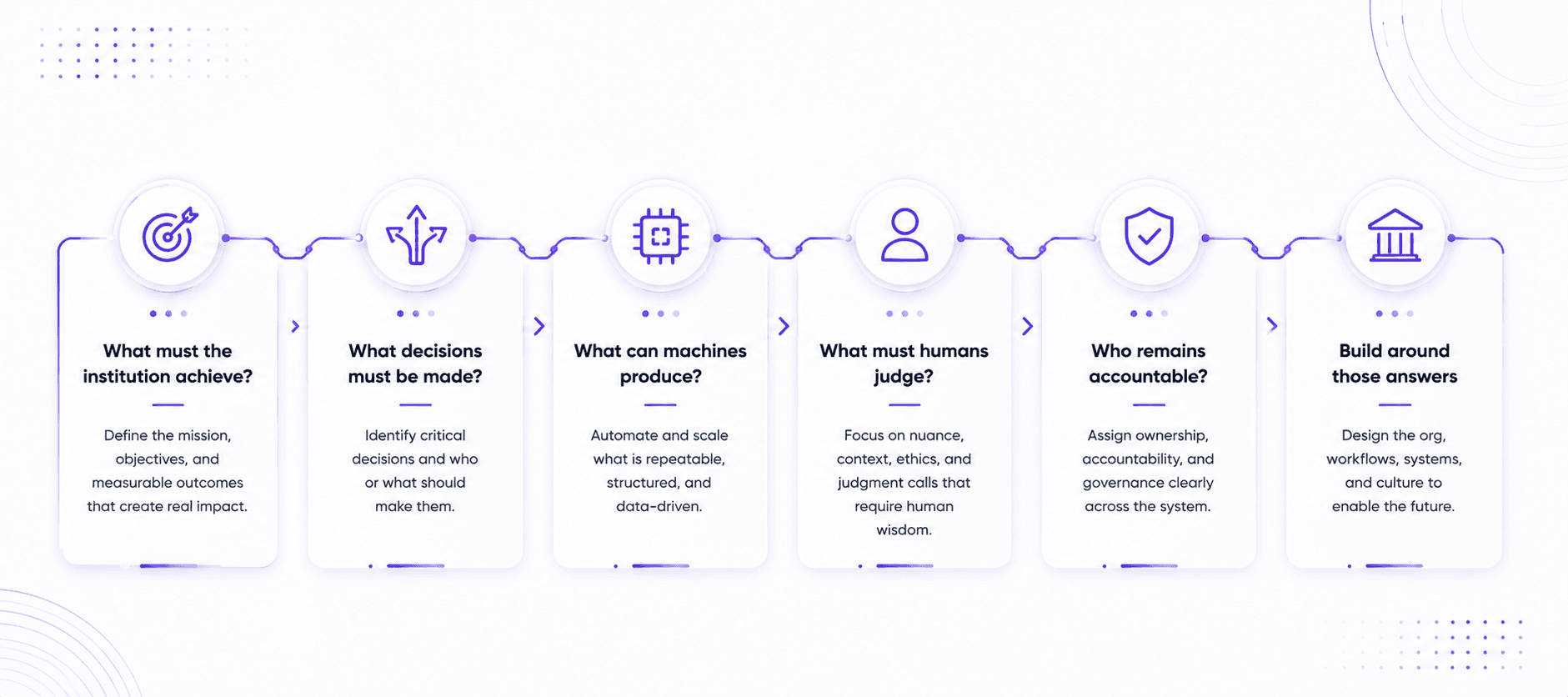
The more interesting question however is: If these capabilities had always existed, would we have designed these people and workflows this way in the first place?
That’s the architecture question. They lead to very different outcomes.
The Productivity Path
The Architecture Path
4. The Scarcity Flip & Humans Re-Organized
This is where I think the economics of financial institutions begin to change. The old institution was designed around scarce intelligence.
Good analysts were scarce. Great asset managers were scarcer. Experienced bankers were extremely scarce. Therefore institutions competed to accumulate intelligent people. More talent meant more analytical capacity. More analytical capacity meant more judgment. More judgment meant more business.
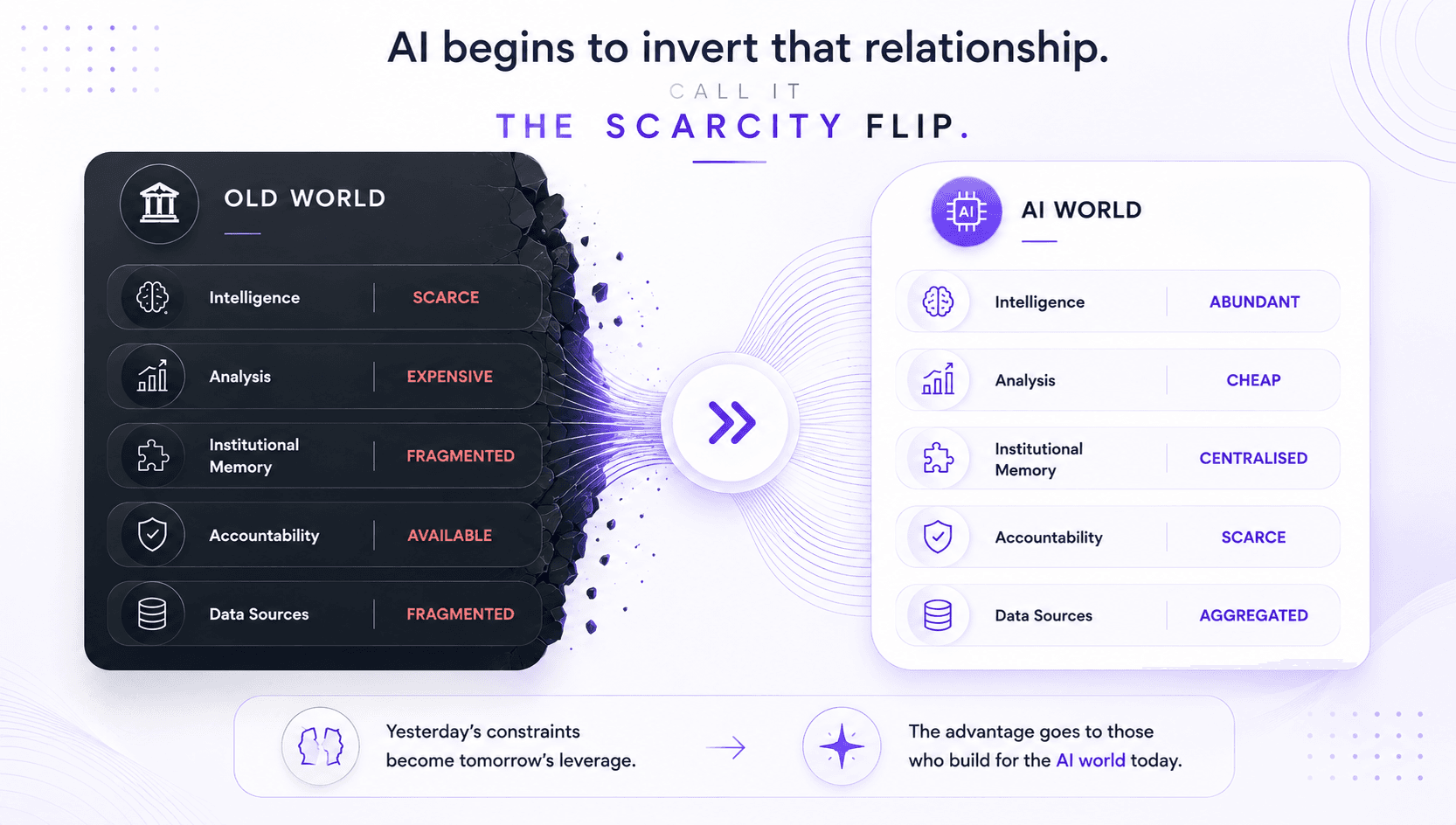
That final line matters. If everyone can generate a valuation, the valuation itself becomes less valuable. If everyone can generate an investment memo, the memo becomes less valuable. If everyone can generate an opinion, opinions become very cheap indeed which, judging by social media, may already have happened. What becomes valuable is knowing:
- Which judgment should I trust?
- Who challenged it?
- What evidence supports it?
- What assumptions were made?
- What alternatives were rejected?
- Who approved it?
- And who answers if it is catastrophically wrong?
Perhaps the more important question is what becomes scarce because machines become smarter.
So what happens to Humans? Not unemployment. At least, that’s far too simple.
The role changes. Today’s junior banker is largely trained to do grunt work & produce standard repeatable outputs. Tomorrow’s may be trained to challenge AI. The distinction matters.
Imagine two analysts. One spends three days building a model. The other receives six independently generated models from specialised AI capital markets platforms and asks:
- Which one is wrong?
- Why?
- What assumption caused the divergence?
- What information are all six missing?
- What happens if the macro regime changes?
- Where is the model most confidently wrong?
- That second analyst may actually learn faster than the first.
- But only if the institution deliberately designs the learning process around challenge rather than production.
That’s the opportunity. AI doesn’t have to destroy apprenticeships. It can create a better apprenticeship. Instead of spending three years teaching junior people how to manufacture the answer, we can spend three years teaching them how to interrogate one. Now that is going to be a massive business leadership line.
Instead of: Build this model.
The instruction becomes: Break this model.
Instead of: Prepare the memo.
It becomes: Tell me what the memo missed.
Instead of: Find the answer.
It becomes: Tell me why the answer might be wrong.
That is a much higher-order skill.
And it gets us closer to what senior professionals were supposed to be doing all along.
5. The Institution Changes Shape
When electricity arrived, factories initially replaced steam engines with electric motors but kept much of the old factory layout. The real productivity gains came later, when factories were redesigned around what electricity made possible.
The early internet gave us newspaper websites that looked suspiciously like newspapers. The first smartphones came with little keyboards because apparently humanity could imagine a computer in its pocket but not life without BlackBerry.
We do this repeatedly. We invent the future, then force it to wear the clothes of the past. Finance is in danger of doing exactly the same thing with AI. I don’t believe the financial institution of the future is today’s JPMorgan with 40% fewer employees and a chatbot sitting politely beside Excel.
That’s not transformation. That’s cost-cutting with better marketing. Nor do I think the future is one enormous AI with three humans sitting upstairs drinking coffee and occasionally signing documents. Also lazy.
The interesting future is a fundamental redesign of the division of labour between humans, machines and institutions. Machines become extraordinary at producing intelligence. Research. Analysis. Modelling. Monitoring. Drafting. Pattern recognition. Scenario generation.
And they will keep getting better. Humans move in the opposite direction. Away from production. Toward challenge, judgment, governance, relationships and accountability.
Trusted Institutional Judgment
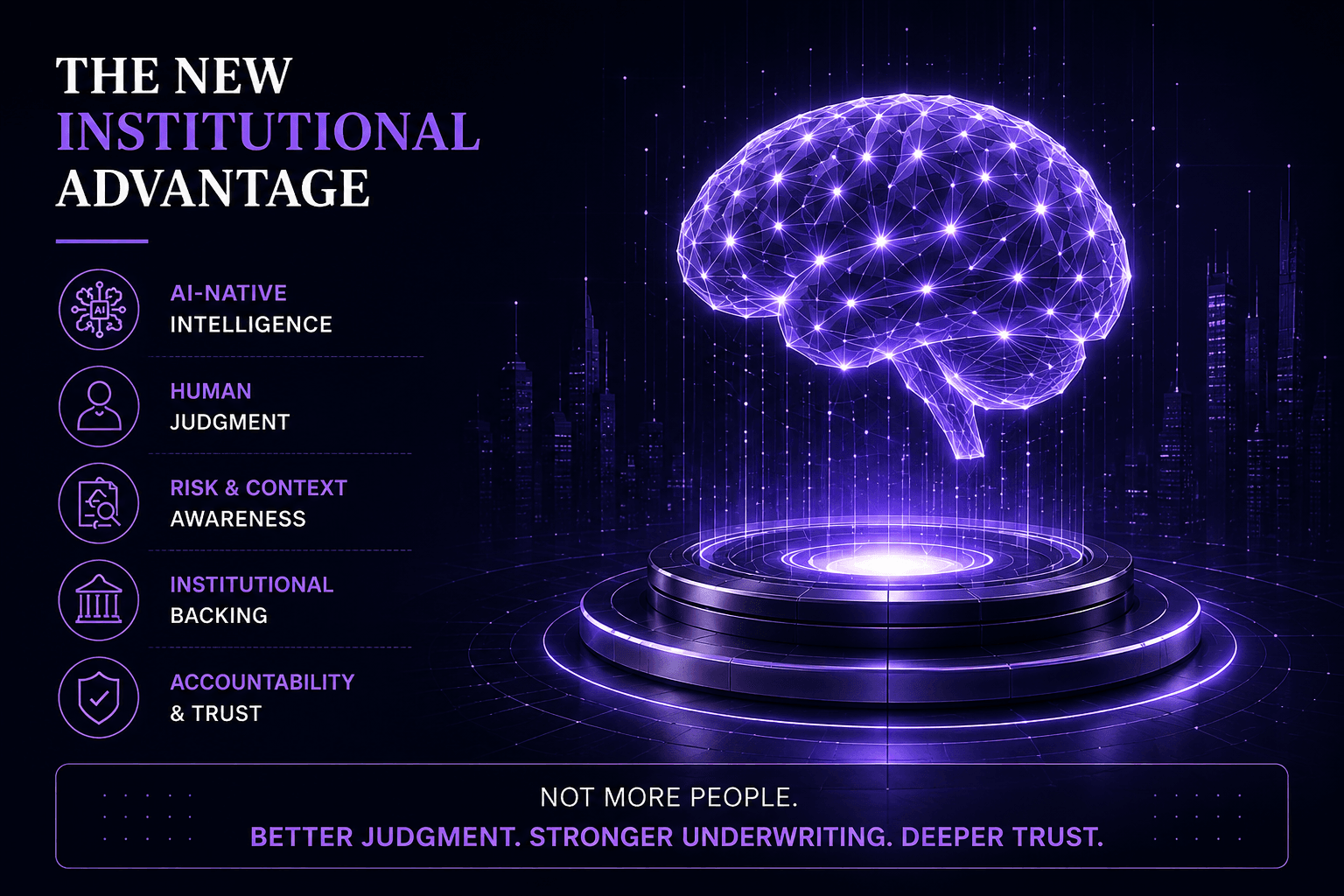
Senior humans move even further away from production. Their role becomes judgment, governance, relationships, and ultimately accountability. They don’t need to write every word. They need to know whether they are willing to sign their name underneath it.
That is a very different institution. And there is another difference that may matter even more. It remembers.
Imagine that every significant institutional decision creates a permanent record: what did we know? → what did the AI conclude? → what did humans challenge? → what did we decide? → who approved it? → what actually happened? → what did we learn? and the loop closes back into what the institution knows the next time.
Now the institution doesn’t merely execute transactions. It learns from them.
A banker leaves. The judgment stays. A team rotates. The reasoning stays. A deal fails. The evidence stays. A recommendation succeeds for completely the wrong reasons. The institution can potentially distinguish skill from luck. Over time, decisions stop being isolated events. They become institutional memory. And institutional memory becomes institutional intelligence.
That is where economics becomes interesting. Because the moat may no longer be: how many smart people can you hire? The moat may become: how effectively can your institution compound judgment?
Senior professionals spend less time supervising document creation and more time evaluating conclusions.Compliance moving earlier into the decision process rather than arriving at the end like airport security after you’ve already packed the suitcase.
Institutional knowledge being captured rather than walking out of the building every time somebody joins a competitor. And every important decision leaving behind something extraordinarily valuable:
A record of what the institution believed, why it believed it, who challenged it, who approved it and what happened next. Because a financial institution that remembers why it was wrong can eventually become better at being right.
That sounds obvious. It isn’t how most institutions work today.
6. If We Started Again from Scratch Tomorrow
Now imagine something more radical. No JPMorgan. No Goldman Sachs. No BlackRock. No inherited organisation chart. No legacy workflow. No system called Project Phoenix Final v3 that nobody understands but everybody is terrified to switch off. And no committee whose original purpose disappeared three reorganisations ago but which still meets every Tuesday because Susan has the recurring calendar invite.
We have capital. Clients. Markets. Regulators. AI. And a blank sheet of paper.
What would we build?
I would not start with analysts.
I would not start with departments.
I would not even start with technology.
I would start with the purpose of the financial institution:
Turn uncertainty into judgment, judgment into action, and stand behind the consequences.
Then design everything backwards from there.
- Machines produce intelligence.
- Humans challenge it.
- Institutions remember it.
- Governance controls it.
- Capital backs it.
- And somebody ultimately accepts responsibility for it.
Because when something goes spectacularly wrong as finance periodically insists upon doing the AI will not be summoned before Congress.
- The GPU will not be fined.
- The algorithm will not lose its banking licence.
- Someone still has to sign their name.
- Someone still gets sued, fired, fined or struck off.
For now, at least:
Intelligence can be automated. Accountability cannot.
Don’t Put a Jet Engine on a Horse Cart
This is why I don’t think AI kills financial institutions. I think it gives us the first serious opportunity in generations to redesign them.
The danger is that we don’t.
History is full of institutions taking revolutionary technologies and initially using them to perform old processes slightly faster. That is the temptation facing finance today.
- Add Copilot.
- Automate the pitchbook.
- Generate the research.
- Reduce headcount.
- Congratulations.
We have attached a jet engine to a horse cart.
It is certainly faster.
I am less convinced we have solved transportation.
The real opportunity is not yesterday’s hierarchy with tomorrow’s chatbot bolted onto it.
It is an institution designed around an entirely different economic reality:
- Machines produce more of the intelligence.
- Humans challenge and underwrite it.
- Institutions remember and compound it.
- Governance makes it trustworthy.
- Capital makes it consequential.
For more than a century, the human development chain in finance was relatively simple:
Work → Experience → Judgment → Accountability
AI breaks the first link. And that means we have to deliberately construct a better chain. Perhaps:
Machine Intelligence → Human Challenge → Institutional Memory → Judgment → Accountability
What do you think?
If AI can produce the intelligence, what should the financial institution of the future actually be built to do?
Will the winners simply be the firms with the best AI or the ones that can turn AI-generated intelligence into better judgment, stronger accountability, and institutional memory?
And perhaps the bigger question:
If the traditional banking pyramid disappears, what replaces it?
I’d genuinely love to hear how bankers, investors, founders, and builders are thinking about this transition.
Leave a comment below or reach out. I’m especially interested in perspectives from people who have actually worked inside these institutions and seen how decisions get made.
I regularly share ideas on AI, capital markets, investment banking, and the future of financial institutions.
If you enjoyed this piece, consider subscribing to Capital Markets Reimagined.