AI Due Diligence: How Deal Teams Are Closing Faster in 2026
Learn how AI due diligence is reshaping M&A with AI document intelligence, contract analysis, automated workflows, and faster deal execution.
Due diligence has always been where deals are won or lost quietly.
Not in the negotiation room. Not at the signing table. In the data room, at 1 AM, where an analyst is on page 340 of a 600-page credit agreement, three weeks into a compressed auction process, trying to find the clause that changes everything before the bid deadline closes.
That is where traditional M&A due diligence breaks down. Not from lack of talent. From lack of capacity. The volume of documentation required to properly assess a transaction has always outpaced what any human team can realistically process in the time a competitive deal demands.
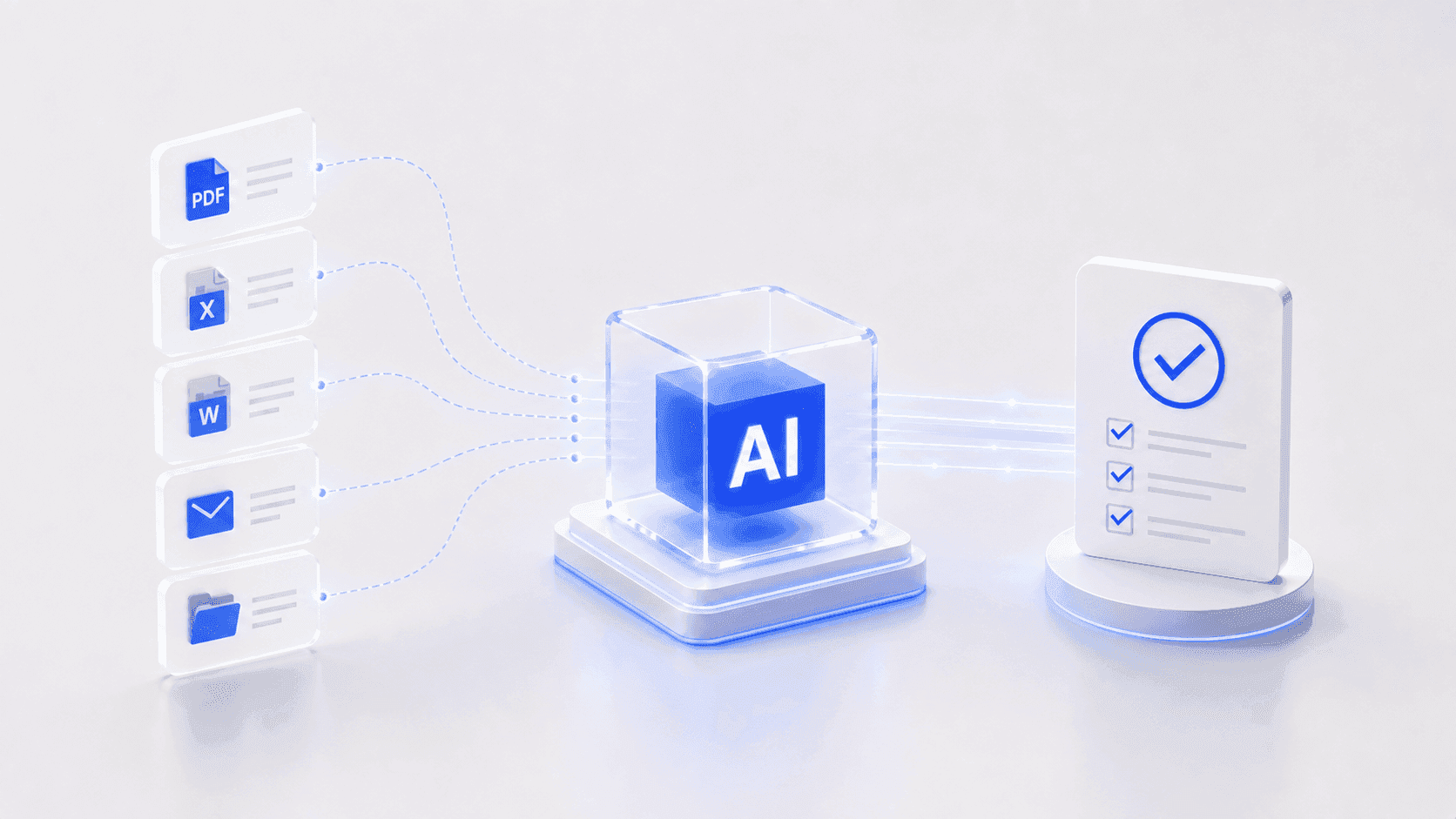
AI due diligence changes that equation entirely. It is the application of large language models and machine learning to the extraction, analysis, and synthesis of transaction documents, allowing deal teams to process entire data rooms in hours, surface cross-workstream risk signals in real time, and produce institutional-grade deliverables in a fraction of the time manual workflows require. The right AI due diligence software does not replace the judgment of an experienced banker or investor. It removes the constraints that have always limited that judgment.
What the Market Is Already Telling Us
This is not a technology in evaluation. It is in production, across the most active deal markets in the world.
According to Bain and Datasite, 36% of the world's most active acquirers are already using AI in their M&A due diligence processes. Not piloting. Using, on live transactions, in active mandates. More than 60% of private equity firms are deploying AI for deal sourcing, screening, or diligence, up from 47% just one year prior.
FTI Consulting's 2026 Private Equity AI Radar adds the dimension most often missing: results. 95% of PE funds report their AI initiatives are meeting or exceeding their original business case. For any enterprise technology deployment in financial services, that confirmation rate is remarkable.
And the Deal Origination Benchmark Report surfaces the cost of standing still: PE firms using traditional processes see only 16.5% of relevant deals in their target markets. The majority of opportunities never reach the investment committee, not because firms are not looking, but because manual processes cannot cover the ground fast enough.
The right AI due diligence software does not just make existing workflows faster. It expands the universe of what deal teams can evaluate before the window closes.
Where AI Is Changing the Diligence Process
M&A due diligence runs across five parallel workstreams simultaneously: legal, financial, operational, commercial, and compliance. Each has its own document set, its own risk threshold, and its own deadline pressure. Here is precisely where AI is reshaping each one.
AI Document Intelligence at Data Room Scale
A mid-market data room holds several thousand documents. A large-cap transaction pushes into the tens of thousands. Contracts, financial statements, regulatory filings, HR records, environmental disclosures: each requires reading, classification, and risk assessment.
AI document intelligence ingests entire data rooms, extracts material provisions, benchmarks contract language against market standards, and produces structured risk trackers with full source citations. Output quality does not degrade because it is 2 AM on day six of the process.
The result is a fundamental reallocation of analyst bandwidth. Instead of spending the first week of a mandate reading, deal teams spend it interpreting. The MD receives a risk matrix built on complete information, not a partial picture shaped by how many documents the team managed to get through before the deadline.
In a competitive auction where multiple bidders work from the same data room on the same compressed timeline, that reallocation is a direct and measurable edge.
AI Contract Analysis: Finding What Matters Before It Costs You
This is where the absence of AI contract analysis capability carries its most visible price tag.
A Swedish PE platform working on a US acquisition used AI to surface a regulatory exposure that a two-week manual review had missed entirely. The finding sat at the intersection of a vendor agreement and a state-level environmental filing that no single workstream had connected. That one catch justified the entire technology investment on that transaction alone.
AI contract analysis scans documents in bulk, identifies material clauses including change-of-control provisions, debt covenants, indemnification caps, non-compete restrictions, and consent requirements, and flags deviations from market-standard terms. It cross-references findings across thousands of documents simultaneously, catching the contradiction between a representation in the purchase agreement and a disclosure buried three layers deep in an exhibit that a fatigued reviewer under deadline pressure would never connect.
In M&A due diligence, that kind of cross-document intelligence is not a luxury. It is the difference between entering a negotiation with complete risk visibility and discovering a material issue after signing.
Cross-Workstream Pattern Recognition
Individual document review is valuable. Cross-workstream correlation is where deal outcomes are actually determined.
Consider a specific scenario. The financial model shows stable EBITDA margins. The legal workstream surfaces customer contracts with non-standard termination provisions. The commercial workstream flags two accounts representing 61% of revenue. Individually, each item clears a standard threshold review. Together, they construct a picture of revenue quality risk material enough to affect valuation, deal structure, and potentially the decision to proceed at all.
Human teams catch these patterns eventually, after synthesis calls and tracker reconciliation sessions that consume days a compressed timeline cannot spare. AI document intelligence surfaces the correlation before the management presentation, not after it.
Financial Modeling and Deliverable Generation
AI accelerates financial model construction by automating data extraction from financial statements, populating DCF and LBO frameworks with verified inputs, and flagging inconsistencies between model inputs and source documents. Initial outputs are generated within hours of data room access rather than days.
On the output side, investment committee memos, risk summaries, and board presentations are generated from structured AI outputs, with deal teams focused on strategic narrative rather than document production mechanics. The time savings compound: a process that moved faster through analysis also closes faster on deliverables. The cumulative compression across a full M&A due diligence cycle is measured in weeks.
Where Brexy Fits Into This
Most AI due diligence software that deal teams encounter was built for general enterprise use and adapted for finance afterward. The gap between a general-purpose platform and a finance-native one becomes visible the moment you are inside a live mandate with compressed timelines and institutional-grade output requirements.
Brexy was purpose-built for investment banking, capital markets, and deal teams, by former bankers who understood precisely where generic AI breaks down when deal pressure is highest.
On AI document intelligence, Brexy allows deal teams to reason across 1,000 or more documents simultaneously, surfacing risk signals and producing deal memos with full citation trails. Every output is traceable to its source document. In a diligence context, a finding without an auditable source is a liability. Brexy's outputs are defensible from the first draft, in front of an investment committee and in a negotiation with a counterparty.
Brexy's AI financial research platform integrates directly with Datasite and the firm's own data infrastructure, bringing AI contract analysis and document intelligence capabilities inside the data room environment rather than requiring documents to be exported and reprocessed elsewhere. With 30 or more live integrations spanning Bloomberg, FactSet, PitchBook, Capital IQ, SEC filings, and international regulatory databases, Brexy connects to the financial data ecosystem deal teams already rely on daily.
The Brexy Agent executes end-to-end M&A due diligence workflows: running screening memos, generating deal summaries, drafting IC presentations, and managing deal pipeline, all under banker approval. Teams using Brexy evaluate five times more deals with the same headcount, produce initial investment memos in under two minutes, and operate at 98.5% accuracy on financial benchmarks.
On security, Brexy meets the requirements financial institutions actually need: SOC 2, ISO 27001, GDPR, CCPA, and EU AI Act compliance, with end-to-end encryption, no model training on client data, and private sovereign deployment for firms that require it. The data that goes into Brexy stays with the firm it belongs to.
The Competitive Arithmetic
If your diligence process takes six weeks on a complex transaction and the firm bidding against you completes a comparable process in four weeks using AI-assisted workflows, you are not on the same competitive terms. You are slower to identify risk, slower to price it accurately, and slower to submit a binding offer. In a seller's auction, those two weeks are not a neutral gap. They are expensive in bid quality, negotiating position, and sometimes in whether the deal closes at all.
The firms winning mandates in 2026 have treated AI due diligence software not as a productivity initiative but as core transaction infrastructure. The diligence workstream, historically the most labor-intensive and error-prone phase of any deal, is precisely where that infrastructure delivers its most measurable returns.
What Has Not Changed
AI does not close deals.
Relationships close deals. Judgment closes deals. The capacity to sit across from a management team and build genuine conviction about whether a business is worth what you are paying. The ability to navigate a difficult negotiation on reps and warranties where both sides have legitimate concerns. The skill to structure a transaction so it works for seller, buyer, and lender simultaneously.
None of that is being automated.
What AI document intelligence, AI contract analysis, and purpose-built M&A due diligence software have done is clear the path to those moments with more speed, more complete information, and less process friction than this industry has ever had. The best dealmakers in 2026 are not the ones who learned to tolerate these tools. They are the ones who understood early that this is the sharpest analytical edge their craft has ever had, and they are using it on every mandate they run.